电化学(中英文) ›› 2026, Vol. 32 ›› Issue (2): 2507092. doi: 10.61558/2993-074X.3593
哈梅萨·哈梅萨a,b, 伊斯娜伊妮·拉赫玛瓦蒂a, 安德烈亚·菲奥拉尼c, 永永康昭c, 恩妮·库斯里尼d, 阿安·约翰·瓦尤迪b, 阿塞普·赛富米拉a, 特里比达萨里·A·伊万迪尼a,*( )
)
收稿日期:2025-07-09
修回日期:2025-10-09
接受日期:2025-11-14
发布日期:2025-11-14
出版日期:2026-02-28
Harmesa Harmesaa,b, Isnaini Rahmawatia, Andrea Fioranic, Yasuaki Einagac, Eny Kusrinid, A'an Johan Wahyudib, Asep Saefumillaha, Tribidasari A Ivandinia,*()
Received:2025-07-09
Revised:2025-10-09
Accepted:2025-11-14
Online:2025-11-14
Published:2026-02-28
Contact:
Tribidasari A Ivandini, E-mail: 摘要:
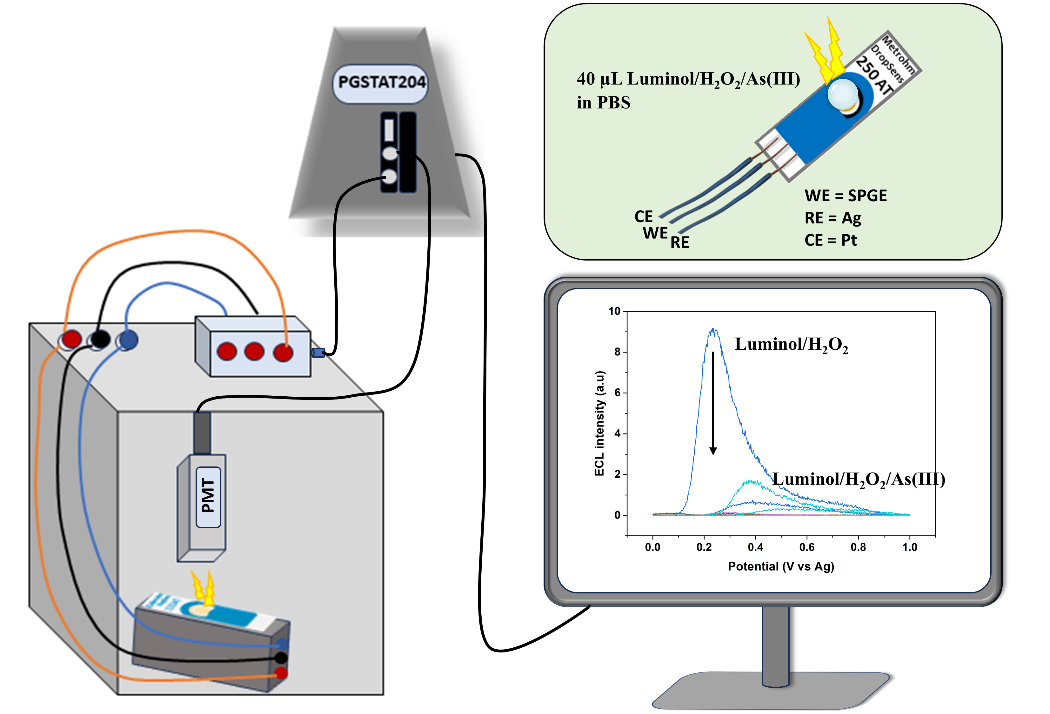
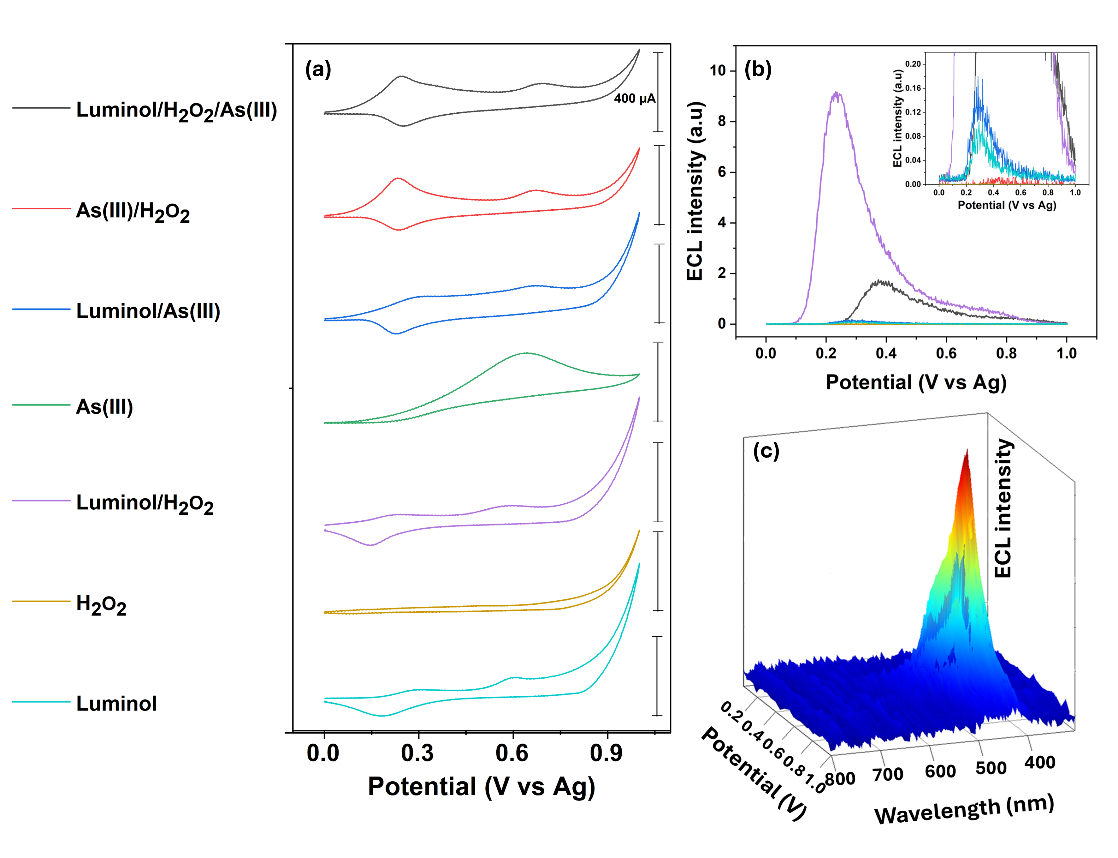
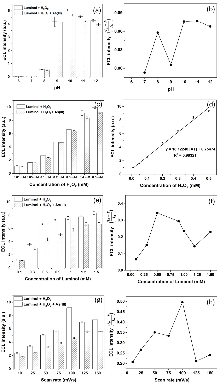
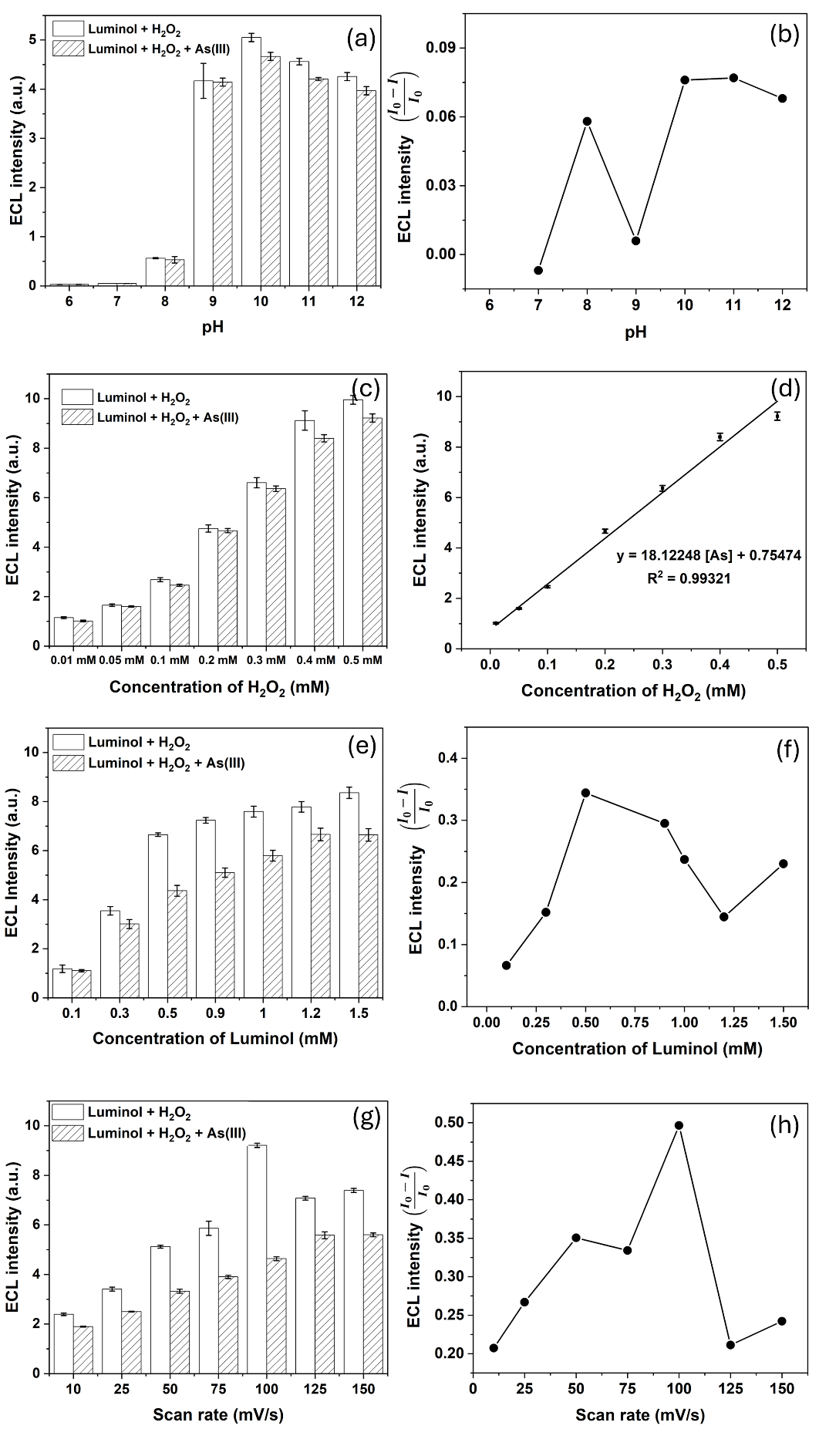
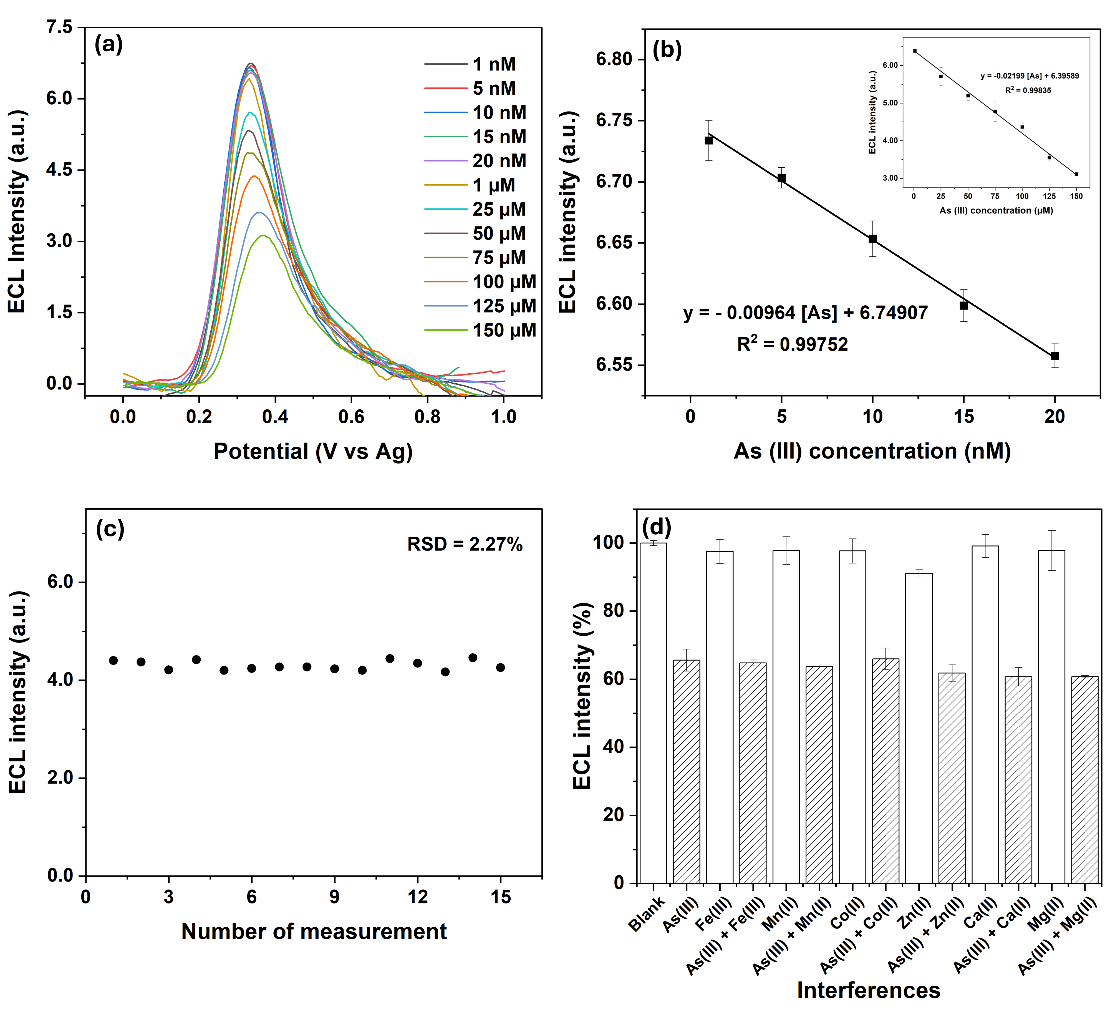
在丝网印刷金电极上研究了鲁米诺的电化学发光,用于简单而灵敏地检测砷离子(砷(III))。采用循环伏安法研究了鲁米诺的电化学行为,并评估了砷离子对电化学发光体系的影响;同时以过氧化氢作为共反应物,在碱性条件下增强了鲁米诺发光效率。通过精细优化pH值、扫描速率及过氧化氢/鲁米诺浓度等关键参数,实现了电极性能最优化。结果表明,砷(III)的存在对鲁米诺/过氧化氢电化学发光系统产生淬灭效应,导致该系统在1 nmol·L-1至150 µmol·L-1的宽浓度范围内电化学发光信号呈线性衰减,展现出1.21 nmol·L-1的低检测限,并具有2.27%相对标准偏差的优异重复性,彰显其在砷(III)检测中的灵敏度与可靠性。本研究的关键优势在于成功采用市售裸电极——这类电极易于获取且无需改性,充分验证了其在电化学发光砷检测中的有效性。优化后的pH 10缓冲液在提升砷检测选择性方面发挥关键作用:该条件既促进鲁米诺最佳去质子化反应,又确保砷保持溶解态,而其他潜在金属离子干扰物则更易形成固态金属(氢)氧化物。此外,本文研发的传感器还成功应用于海水基质中的砷(III)检测,证明其作为基于电化学发光技术的砷传感器在环境应用中具有可靠且高效的潜力。
哈梅萨·哈梅萨, 伊斯娜伊妮·拉赫玛瓦蒂, 安德烈亚·菲奥拉尼, 永永康昭, 恩妮·库斯里尼, 阿安·约翰·瓦尤迪, 阿塞普·赛富米拉, 特里比达萨里·A·伊万迪尼. 基于电化学发光的砷(III)传感器:采用丝网印刷金电极上的鲁米诺[J]. 电化学(中英文), 2026, 32(2): 2507092.
Harmesa Harmesa, Isnaini Rahmawati, Andrea Fiorani, Yasuaki Einaga, Eny Kusrini, A'an Johan Wahyudi, Asep Saefumillah, Tribidasari A Ivandini. An Electrochemiluminescence-Based Arsenic (III) Sensor using Luminol on Screen-Printed Gold Electrodes[J]. Journal of Electrochemistry, 2026, 32(2): 2507092.
| Sample no spike/(nmol·L-1) | Spike concentration of As(III) Standard/(nmol·L-1) | Observed/(nmol·L-1) | Recovery/% |
|---|---|---|---|
| 0.65a | 1 | 1.68 ± 0.34 | 101.82 |
| 5 | 5.89 ± 0.59 | 104.25 | |
| 10 | 10.68 ± 1.41 | 100.28 |
| Technique | System, precursor, or electrode | Linearity/(µmol·L-1) | LOD/(nmol·L-1) | Reference |
|---|---|---|---|---|
| ECL | Luminol/H2O2/As(III) on SPGE | 0.0010 - 150 | 1.2100 | This study |
| Aptamer-based ECL | As(III)/PDDA/Ars-3/Au-g-C3N4/GCE and Ru(bpy)32+ | 0.000001 - 10* | 0.0007** | [ |
| Aptamer-based DPV | As(III)/PDDA/Ars-3/AuNP/SPCE and Ru(NH3)63+ | 0.0002 - 0.1000 | 0.1500 | [ |
| Fluorescence | C-dots/silica aerogel porous matrix | 0.3700 - 1500 | 24.4000 | [ |
| Colorimetry | PVA assay | 1 - 40 | 440 | [ |
| Colorimetry | DDS assay | 0.1000 - 15 | 60 | [ |
| ASV | Au macro-electrode | 0.0100 - 0.1000 | 10 | [ |
| ASV | AuNP/GCE | 0.0050 - 0.1000 | 5 | [ |
| DPV | BS/GCE | 0.1000 - 20 | 100 | [ |
| [1] |
Amen R, Bashir H, Bibi I, Shaheen S M, Niazi N K, Shahid M, Hussain M M, Antoniadis V, Shakoor M B, Al-Solaimani S G, Wang H L, Bundschuh J, Rinklebe J. A critical review on arsenic removal from water using biochar-based sorbents: The significance of modification and redox reactions[J]. Chem. Eng. J., 2020, 396: 125195. https://doi.org/10.1016/j.cej.2020.125195.
doi: 10.1016/j.cej.2020.125195 URL |
| [2] | kaur R, Garkal A, Sarode L, Bangar P, Mehta T, Singh D P, Rawal R. Understanding arsenic toxicity: Implications for environmental exposure and human health[J]. J. Hazard. Mater. Lett., 2024, 5: 100090. https://doi.org/10.1016/j.hazl.2023.100090. |
| [3] |
Rahaman M S, Rahman M M, Mise N, Sikder M T, Ichihara G, Uddin M K, Kurasaki M, Ichihara S. Environmental arsenic exposure and its contribution to human diseases, toxicity mechanism and management[J]. Environ. Pollut., 2021, 289: 117940. https://doi.org/10.1016/j.envpol.2021.117940.
doi: 10.1016/j.envpol.2021.117940 URL |
| [4] |
Sharma V K, Sohn M. Aquatic arsenic: Toxicity, speciation, transformations, and remediation[J]. Environ. Int., 2009, 35(4): 743-759. https://doi.org/10.1016/j.envint.2009.01.005.
doi: 10.1016/j.envint.2009.01.005 URL pmid: 19232730 |
| [5] |
Alka S, Shahir S, Ibrahim N, Ndejiko M J, Vo D V N, Manan F A. Arsenic removal technologies and future trends: A mini review[J]. J. Clean. Prod., 2021, 278: 123805. https://doi.org/10.1016/j.jclepro.2020.123805.
doi: 10.1016/j.jclepro.2020.123805 URL |
| [6] |
Sevak P, Pushkar B. Arsenic pollution cycle, toxicity and sustainable remediation technologies: A comprehensive review and bibliometric analysis[J]. J. Environ. Manage., 2024, 349: 119504. https://doi.org/10.1016/j.jenvman.2023.119504.
doi: 10.1016/j.jenvman.2023.119504 URL |
| [7] |
Raju N J. Arsenic in the geo-environment: A review of sources, geochemical processes, toxicity and removal technologies[J]. Environ. Res., 2022, 203: 111782. https://doi.org/10.1016/j.envres.2021.111782.
doi: 10.1016/j.envres.2021.111782 URL |
| [8] |
Aktar S, Mia S, Makino T, Rahman M M, Rajapaksha A U. Arsenic removal from aqueous solution: A comprehensive synthesis with meta-data[J]. Sci. Total Environ., 2023, 862: 160821. https://doi.org/10.1016/j.scitotenv.2022.160821.
doi: 10.1016/j.scitotenv.2022.160821 URL |
| [9] |
Herath I, Kumarathilaka P, Bundschuh J, Marchuk A, Rinklebe J. A fast analytical protocol for simultaneous speciation of arsenic by ultra-high performance liquid chromatography (UHPLC) hyphenated to inductively coupled plasma mass spectrometry (ICP-MS) as a modern advancement in liquid chromatography approaches[J]. Talanta, 2020, 208: 120457. https://doi.org/10.1016/j.talanta.2019.120457.
doi: 10.1016/j.talanta.2019.120457 URL |
| [10] |
PétursdóttirÁ H, Gunnlaugsdóttir H. Selective and fast screening method for inorganic arsenic in seaweed using hydride generation inductively coupled plasma mass spectrometry (HG-ICPMS)[J]. Microchem. J., 2019, 144: 45-50. https://doi.org/10.1016/j.microc.2018.08.055.
doi: 10.1016/j.microc.2018.08.055 URL |
| [11] | Harmesa H, Wahyudi A J, Saefumillah A, Ivandini T A. Electrochemiluminescence systems for metal-ion detection: a systematic review[J]. ChemistrySelect, 2024, 9(21): 1-24. https://doi.org/10.1002/slct.202401544. |
| [12] |
Ivandini T A, Sato R, Makide Y, Fujishima A, Einaga Y. Electrochemical detection of arsenic(III) using indium-implanted boron-doped diamond electrodes[J]. Anal. Chem., 2006, 78(18): 6291-6298. https://doi.org/10.1021/ac0519514.
doi: 10.1021/ac0519514 URL |
| [13] | Agustiany T, Khalil M, Einaga Y, Jiwanti P K, Ivandini T A. Stable iridium-modified boron-doped diamond electrode for the application in electrochemical detection of arsenic (III)[J]. Mater. Chem. Phys., 2020, 244: 1-7. https://doi.org/10.1016/j.matchemphys.2020.122723. |
| [14] |
Rahmawati I, Fiorani A, Sanjaya A R, Irkham, Du J, Saepudin E, Einaga Y, Ivandini T A. Modification of boron-doped diamond electrode with polyaniline and gold particles to enhance the electrochemiluminescence of luminol for the detection of reactive oxygen species (hydrogen peroxide and hypochlorite)[J]. Diam. Relat. Mater., 2024, 144: 110956. https://doi.org/10.1016/j.diamond.2024.110956.
doi: 10.1016/j.diamond.2024.110956 URL |
| [15] |
Rahmawati I, Saepudin E, Fiorani A, Einaga Y, Ivandini T A. Electrogenerated chemiluminescence of luminol at a boron-doped diamond electrode for the detection of hypochlorite[J]. Analyst, 2022, 147(12): 2696-2702. https://doi.org/10.1039/d2an00540a.
doi: 10.1039/D2AN00540A URL |
| [16] |
Wang Y R, Zhao X Y, Qu N R, Gu J M. Electrochemiluminescence for high-performance Chiral recognition of enantiomers: Recent advances and future perspectives[J]. Org. Electron., 2023, 122: 106902. https://doi.org/10.1016/j.orgel.2023.106902.
doi: 10.1016/j.orgel.2023.106902 URL |
| [17] |
Husain R A, Barman S R, Chatterjee S, Khan I, Lin Z H. Enhanced biosensing strategies using electrogenerated chemiluminescence: recent progress and future prospects[J]. J. Mater. Chem., B. 2020, 8(16): 3192-3212. https://doi.org/10.1039/c9tb02578b.
doi: 10.1039/c9tb02578b URL pmid: 32068221 |
| [18] |
Zanut A, Fiorani A, Canola S, Saito T, Ziebart N, Rapino S, Rebeccani S, Barbon A, Irie T, Josel H P, Negri F, Marcaccio M, Windfuhr M, Imai K, Valenti G, Paolucci F. Insights into the mechanism of coreactant electrochemiluminescence facilitating enhanced bioanalytical performance[J]. Nat. Commun., 2020, 11(1): 2668. https://doi.org/10.1038/s41467-020-16476-2.
doi: 10.1038/s41467-020-16476-2 URL pmid: 32472057 |
| [19] |
Truong C K P, Nguyen T D D, Shin I S. Electrochemiluminescent chemosensors for clinical applications: a review[J]. Biochip J., 2019, 13(3): 203-216. https://doi.org/10.1007/s13206-019-3301-9.
doi: 10.1007/s13206-019-3301-9 URL |
| [20] |
Ying X D, Zhou L, Fu W X, Wang Y F, Su B. Electrochemiluminescence devices for point-of-care testing[J]. Sens. Diagn., 2023, 2(3): 480-491. https://doi.org/10.1039/d2sd00232a.
doi: 10.1039/D2SD00232A URL |
| [21] |
Hao N, Wang K. Recent development of electrochemiluminescence sensors for food analysis[J]. Anal. Bioanal. Chem., 2016, 408(25): 7035-7048. https://doi.org/10.1007/s00216-016-9548-2.
doi: 10.1007/s00216-016-9548-2 URL pmid: 27086020 |
| [22] |
Zhou J J, Lv X Q, Jia J L, Din Z U, Cai S Q, He J L, Xie F, Cai J. Nanomaterials-based electrochemiluminescence biosensors for food analysis: recent developments and future directions[J]. Biosensors, 2022, 12(11): 1046. https://doi.org/10.3390/bios12111046.
doi: 10.3390/bios12111046 URL |
| [23] |
Wang X B, Zhao Y Q, Hua Q, Lu J J, Tang F Y, Sun W J, Luan F, Zhuang X M, Tian C Y. An ultrasensitive electrochemiluminescence biosensor for the detection of total bacterial count in environmental and biological samples based on a novel sulfur quantum dot luminophore[J]. Analyst, 2022, 147(8): 1716-1721. https://doi.org/10.1039/d2an00153e.
doi: 10.1039/D2AN00153E URL |
| [24] |
Li L L, Che Y, Zhu J J. Recent advances in electrochemiluminescence analysis[J]. Anal. Chem., 2017, 89(1): 358-371. https://doi.org/10.1021/acs.analchem.6b04675.
doi: 10.1021/acs.analchem.6b04675 URL pmid: 27959507 |
| [25] |
Shen Y, Gao X, Lu H J, Nie C, Wang J L. Electrochemiluminescence-based innovative sensors for monitoring the residual levels of heavy metal ions in environment-related matrices[J]. Coord. Chem. Rev., 2023, 476: 214927. https://doi.org/10.1016/j.ccr.2022.214927.
doi: 10.1016/j.ccr.2022.214927 URL |
| [26] |
Liang R P, Yu L D, Tong Y J, Wen S H, Cao S P, Qiu J D. An ultratrace assay of arsenite based on the synergistic quenching effect of Ru(bpy)32+ and arsenite on the electrochemiluminescence of Au-g-C3N4 nanosheets[J]. Chem. Commun., 2018, 54(99): 14001-14004. https://doi.org/10.1039/c8cc08353c.
doi: 10.1039/C8CC08353C URL |
| [27] |
Wang R Z, Zhao Y, Jie G F. A novel DNA-quantum dot nanostructure electrochemiluminescence aptamer sensor by chain reaction amplification for rapid detection of trace Cd2+[J]. Analyst, 2023, 148(19): 4844-4849. https://doi.org/10.1039/d3an01247f.
doi: 10.1039/d3an01247f URL pmid: 37622335 |
| [28] |
Huang R F, Liu H X, Gai Q Q, Liu G J, Wei Z. A facile and sensitive electrochemiluminescence biosensor for Hg2+ analysis based on a dual-function oligonucleotide probe[J]. Biosens. Bioelectron., 2015, 71: 194-199. https://doi.org/10.1016/j.bios.2015.04.038.
doi: 10.1016/j.bios.2015.04.038 URL |
| [29] |
Zhao G H, Li X J, Zhao Y B, Li Y Y, Cao W, Wei Q. Electrochemiluminescence assay of Cu2+by using one-step electrodeposition synthesized CdS/ZnS quantum dots[J]. Analyst, 2017, 142(17): 3272-3277. https://doi.org/10.1039/c7an01014a.
doi: 10.1039/C7AN01014A URL |
| [30] |
Zhang Y, Xu J M, Zhou S, Zhu L, Lv X, Zhang J, Zhang L, Zhu P H, Yu J H. DNAzyme-triggered visual and ratiometric electrochemiluminescence dual-readout assay for Pb(II) based on an assembled paper device[J]. Anal. Chem., 2020, 92(5): 3874-3881. https://doi.org/10.1021/acs.analchem.9b05343.
doi: 10.1021/acs.analchem.9b05343 URL pmid: 31995985 |
| [31] |
Zakaria N D, Salih I L, Hamzah H H, Sönmez T, Omar M H, Nor N M, Razak K A, Balakrishnan V. Electrochemical and imaging evaluations of electrochemically activated screen-printed gold electrodes[J]. Analyst, 2024, 149(22): 5401-5410. https://doi.org/10.1039/d4an00990h.
doi: 10.1039/d4an00990h URL pmid: 39373774 |
| [32] | Kozak J, Tyszczuk-Rotko K. Screen-printed gold electrode for ultrasensitive voltammetric determination of the antipsychotic drug thioridazine[J]. Meas. J. Int. Meas. Confed., 2023, 217: 113107. https://doi.org/10.1016/j.measurement.2023.113107. |
| [33] |
Liu Z G, Huang X J. Voltammetric determination of inorganic arsenic[J]. TrAC - Trends Anal. Chem., 2014, 60: 25-35. https://doi.org/10.1016/j.trac.2014.04.014.
doi: 10.1016/j.trac.2014.04.014 URL |
| [34] |
Duan Y, Song Y, Fan N K, Yao Y Z, Deng S X, Ding S J, Shen B, Yin Q F. Self-enhanced luminol-based electrochemiluminescent hydrogels: An ultrasensitive biosensing platform for fusion gene analysis coupled with target-initiated DNAzyme motor[J]. Biosens. Bioelectron., 2022, 197: 113784. https://doi.org/10.1016/j.bios.2021.113784.
doi: 10.1016/j.bios.2021.113784 URL |
| [35] |
Liu G P, Yuan Y L, Wang J L. Hemin/G-quadruplex DNAzyme nanowires amplified luminol electrochemiluminescence system and its application in sensing silver ions[J]. RSC Adv., 2016, 6(43): 37221-37225. https://doi.org/10.1039/c6ra01809b.
doi: 10.1039/C6RA01809B URL |
| [36] |
Hu Y X, Liu Y, Wang S, Guo Z Y, Hu Y F, Xie H Z. A novel surface-tethered double-signal electrochemiluminescence sensor based on luminol@Au and Cds quantum dots for mercury ion detection[J]. ChemistrySelect, 2019, 4(10): 2926-2932. https://doi.org/10.1002/slct.201802150.
doi: 10.1002/slct.v4.10 URL |
| [37] | Zhao C L, Ma C Y, Zhang F P, Li W J, Hong C L, Qi Y. Two-dimensional metal-organic framework nanosheets: An efficient two-electron oxygen reduction reaction electrocatalyst for boosting cathodic luminol electrochemiluminescence[J]. Chem. Eng. J., 2023, 466: 1-8. https://doi.org/10.1016/j.cej.2023.143156. |
| [38] |
Huang Y T, Zhang S P, Chen S S, Chen Y J, Cheng L J, Dai H, Gao L H. Electrochemiluminescence enhanced by molecular engineering linear π-conjugated polymer: An ingenious ECL emitter for the construction of exosome sensing platform[J]. Talanta, 2024, 277: 126405. https://doi.org/10.1016/j.talanta.2024.126405.
doi: 10.1016/j.talanta.2024.126405 URL |
| [39] |
Irkham, Rais R R, Ivandini T A, Fiorani A, Einaga Y. Electrogenerated chemiluminescence of luminol mediated by carbonate electrochemical oxidation at a boron-doped diamond, Anal. Chem., 2021, 93(4): 2336-2341. https://doi.org/10.1021/acs.analchem.0c04212.
doi: 10.1021/acs.analchem.0c04212 URL pmid: 33296176 |
| [40] |
Scholz F, Kahlert H. The calculation of the solubility of metal hydroxides, oxide-hydroxides, and oxides, and their visualisation in logarithmic diagrams[J]. ChemTexts, 2015, 1(1): 7. https://doi.org/10.1007/s40828-015-0006-0.
doi: 10.1007/s40828-015-0006-0 URL |
| [41] |
Ivandini T A, Yamada D, Watanabe T, Matsuura H, Nakano N, Fujishima A, Einaga Y. Development of amperometric arsine gas sensor using gold-modified diamond electrodes[J]. J. Electroanal. Chem., 2010, 645(1): 58-63. https://doi.org/10.1016/j.jelechem.2010.04.012.
doi: 10.1016/j.jelechem.2010.04.012 URL |
| [42] |
Eikelboom M, Wang Y, Portlock G, Gourain A, Gardner J, Bullen J, Lewtas P, Carriere M, Alvarez A, Kumar A, O’Prey S, Tölgyes T, Omanović D, Bhowmick S, Weiss D, Salaun P. Voltammetric determination of inorganic arsenic in mildly acidified (pH 4.7) groundwaters from Mexico and India[J]. Anal. Chim. Acta., 2023, 1276: 341589. https://doi.org/10.1016/j.aca.2023.341589.
doi: 10.1016/j.aca.2023.341589 URL |
| [43] |
Giancarla A, Zanoni C, Merli D, Magnaghi L R, Biesuz R. A new cysteamine-copper chemically modified screen-printed gold electrode for glyphosate determination[J]. Talanta, 2024, 269: 125436. https://doi.org/10.1016/j.talanta.2023.125436.
doi: 10.1016/j.talanta.2023.125436 URL |
| [44] | Steel L, Ward A C, Jeffrey C, Alcorn D, Corrigan D K. Towards simple, rapid point of care testing for clinically important protein biomarkers of sepsis[J]. SCIOL Biotechnol., 2017, 1: 1-8. https://doi.org/10.11648/j.sjbt.20170101.11. |
| [45] |
Mccormick W J, Doran W J. Covalent immobilisation of a nanoporous platinum film onto a gold screen-printed electrode for highly stable and selective[J]. Catalysts, 2021, 11(10): 1161. https://doi.org/10.3390/catal11101161.
doi: 10.3390/catal11101161 URL |
| [46] |
Monnappa A B, Manjunatha J G, Bhatt A S. Design of a sensitive and selective voltammetric sensor based on a cationic surfactant-modified carbon paste electrode for the determination of alloxan[J]. ACS Omega, 2020, 5(36): 23481-23490. https://doi.org/10.1021/acsomega.0c03517.
doi: 10.1021/acsomega.0c03517 URL pmid: 32954201 |
| [47] |
Dhaffouli A, Moussaoui Y, Salazar-Carballo P A, Holzinger M, Carinelli S, Barhoumi H. Design of a high-performance electrochemical sensor using ZnO@SiO₂-n-propyl-NH₂-benzothiazole-AuNPs for the selective and sensitive detection of lead ions in environmental samples[J]. J. Electrochem. Soc., 2025, 172(6): 067520. https://doi.org/10.1149/1945-7111/ade47f.
doi: 10.1149/1945-7111/ade47f URL |
| [48] |
Yin F, Sun Q, Huang X Z, Wu G Q, Zhang Y J, Shen Y F. Recent progress in signal enhancement of nanomaterials-based electrochemiluminescence systems[J]. TrAC-Trends Anal. Chem., 2023, 169: 117376. https://doi.org/10.1016/j.trac.2023.117376.
doi: 10.1016/j.trac.2023.117376 URL |
| [49] |
Zhou P, Hu S J, Guo W L, Su B. Deciphering electrochemiluminescence generation from luminol and hydrogen peroxide by imaging light emitting layer[J]. Fundam. Res., 2022, 2(5): 682-687. https://doi.org/10.1016/j.fmre.2021.11.018.
doi: 10.1016/j.fmre.2021.11.018 URL |
| [50] |
Pettine M, Campanella L, Millero F J. Arsenite oxidation by H2O2 in aqueous solution[J]. Geochim. Cosmochim. Acta, 1999, 63(18): 2727-2735. https://doi.org/10.1139/v01-027.
doi: 10.1016/S0016-7037(99)00212-4 URL |
| [51] |
Molnár L, Virčíkova E, Lech P. Experimental study of As(III) oxidation by hydrogen peroxide[J]. Hydrometallurgy, 1994, 35(1): 1-9. https://doi.org/10.1016/0304-386X(94)90013-2.
doi: 10.1016/0304-386X(94)90013-2 URL |
| [52] | Pourbaix M, Zhang H, Pourbaix A. Presentation of an atlas of chemical and electrochemical equilibria in the presence of a gaseous phase[J]. Mater. Sci. Forum., 1997, 251-252: 143-148. https://doi.org/10.4028/www.scientific.net/msf.251-254.143. |
| [53] |
Liu Y, Hu Y X, Wang S, Guo Z Y, Hu Y F. A novel surface-tethered analysis method for mercury (II) ion detection via self-assembly of individual electrochemiluminescence signal units[J]. Electroanalysis, 2018, 30(5): 859-867. https://doi.org/10.1002/elan.201700660.
doi: 10.1002/elan.v30.5 URL |
| [54] |
Guo Z Y, Chen B B, Wang Z B, Jiang X H. An electrochemiluminescence biosensor for mercury ion detection based on gamma-polyglutamic acid-graphene-luminol composite and oligonucleotides[J]. Sens. Actuators B: Chem., 2015, 209: 579-585. https://doi.org/10.1016/j.snb.2014.12.028.
doi: 10.1016/j.snb.2014.12.028 URL |
| [55] |
Xu M, Zhang Y, Li L, Kong Q K, Zhang L N, Ge S G, Yu J H. Colorimetric and electrochemiluminescence dual-mode sensing of lead ion based on integrated lab-on-paper device[J]. ACS Appl. Mater. Interfaces, 2018, 10(4): 3431-3440. https://doi.org/10.1021/acsami.7b18542.
doi: 10.1021/acsami.7b18542 URL |
| [56] |
Yildiz G, Tasdoven U, Menek N. Electrochemical characterization of luminol and its determination in real samples[J]. Anal. Methods, 2014, 6(19): 7809-7813. https://doi.org/10.1039/c4ay01281j.
doi: 10.1039/C4AY01281J URL |
| [57] |
Rajendran S, Ramanaiah D V, Kundu S, Bhunia S K. Yellow fluorescent carbon dots for selective recognition of As3+ and Fe3+ ions[J]. ACS Appl. Nano Mater., 2021, 4(10): 10931-10942. https://doi.org/10.1021/acsanm.1c02391.
doi: 10.1021/acsanm.1c02391 URL |
| [58] |
Sepúlveda A C, Gatti L M, Kerl C F, Chennu A, Klatt J M. Arsenic speciation analysis in porewater by a novel colorimetric assay[J]. Sci. Total Environ., 2022, 827: 154155. https://doi.org/10.1016/j.scitotenv.2022.154155.
doi: 10.1016/j.scitotenv.2022.154155 URL |
| [59] |
Cui L, Wu J, Ju H X. Label-free signal-on aptasensor for sensitive electrochemical detection of arsenite[J]. Biosens. Bioelectron., 2016, 79: 861-865. https://doi.org/10.1016/j.bios.2016.01.010.
doi: 10.1016/j.bios.2016.01.010 URL pmid: 26785310 |
| [60] |
Zhang Y F, Li D L, Compton R G. Arsenic (III) detection with underpotential deposition on gold[J]. J. Electroanal. Chem., 2022, 909: 116154. https://doi.org/10.1016/j.jelechem.2022.116154.
doi: 10.1016/j.jelechem.2022.116154 URL |
| [61] |
Kaimal R, Maridevaru M C, Dube A, Wu J J, Sambandam A, Ashokkumar M. Borophene nanosheet-based electrochemical sensing toward groundwater arsenic detection[J]. Ind. Eng. Chem. Res., 2023, 62(38): 15418-15427. https://doi.org/10.1021/acs.iecr.3c01922.
doi: 10.1021/acs.iecr.3c01922 URL |
| [1] | 覃晓丽, 詹子颖, Sara Jahanghiri, Kenneth Chu, 张丛洋, 丁志峰. 金属有机框架材料在电化学/电化学发光免疫分析中的应用[J]. 电化学(中英文), 2023, 29(6): 2218003-. |
| [2] | Tesfaye Hailemariam Barkae, Mohamed Ibrahim Halawa, Tadesse Haile Fereja, Shimeles Addisu Kitte, 马显贵, 陈业权, 徐国宝. 鲁米诺/氨基磺酸电化学发光及其多巴胺检测应用[J]. 电化学(中英文), 2021, 27(2): 168-176. |
| [3] | 李明雪, 史 杭, 刘 佳, 张 檬, 周剑章, 吴德印, 田中群. 金电极上偶氮腺嘌呤的电化学行为研究[J]. 电化学(中英文), 2019, 25(6): 651-659. |
| [4] | 袁 洋, 王佳新, 曹玉华. 磁性印迹纳米粒子固定血红蛋白修饰磁性电极构建过氧化氢传感器[J]. 电化学(中英文), 2019, 25(6): 757-763. |
| [5] | 贾瑞虹, 张瑾轩, 张晓东, 李美仙. 电催化过氧化氢还原的纳米材料作为潜在的辐射防护剂[J]. 电化学(中英文), 2019, 25(3): 340-348. |
| [6] | 雷 刚, 刘 洋. 超四面体硫簇结构调控与电化学发光研究进展[J]. 电化学(中英文), 2019, 25(3): 349-362. |
| [7] | 王晓飞, 张 婷, 王 冰, 漆红兰, 张成孝. 基于电化学双共价键法构建可再生高灵敏的电化学发光适体传感器检测可卡因[J]. 电化学(中英文), 2019, 25(2): 223-231. |
| [8] | 张思宇,王会娟,李书芳,屈建莹. 基于碳复合Fe3O4纳米粒子的过氧化氢电化学传感器研究[J]. 电化学(中英文), 2018, 24(3): 279-284. |
| [9] | 王艳凤,罗荻,陕多亮,卢小泉. 磺酸基卟啉的电化学发光研究及应用[J]. 电化学(中英文), 2017, 23(3): 307-315. |
| [10] | 郑勇力,魏杰,陈艳霞. Au单晶电极上H2O2的氧化反应研究[J]. 电化学(中英文), 2016, 22(6): 602-606. |
| [11] | 王春燕*,刘晓秋,戚颖欣. 基于对羟基苯硼酸为前驱体的金纳米粒子修饰电极电化学检测过氧化氢[J]. 电化学(中英文), 2016, 22(1): 88-93. |
| [12] | 徐媚, 王静静, 皇甫至超, 王瑛, 何玉韩, 王朝晖. 碱性体系中金电极表面硫氰根离子的宽带和频光谱研究[J]. 电化学(中英文), 2015, 21(4): 319-325. |
| [13] | 周镇宇,许林茹,苏彬*. 电化学发光成像技术及其在阵列传感分析和潜在指纹成像分析中的应用[J]. 电化学(中英文), 2014, 20(6): 506-514. |
| [14] | 廖森梁,李修敏,郝晓刚*,王艳红,薛春峰*,王永洪. 单极脉冲一步合成聚苯胺/铁氰化镍杂化膜及其过氧化氢电催化还原活性[J]. 电化学(中英文), 2014, 20(6): 563-570. |
| [15] | 吴萍,蔡称心*. 凹土-辣根过氧化物酶复合材料制备及其细胞外过氧化氢检测[J]. 电化学(中英文), 2014, 20(3): 260-265. |
| 阅读次数 | ||||||
|
全文 |
|
|||||
|
摘要 |
|
|||||