电化学(中英文) ›› 2026, Vol. 32 ›› Issue (1): 2515009. doi: 10.61558/2993-074X.3588
• 论文 • 上一篇
丰紫薇a, 陈海忠a, 段骁b, 唐玲b, 赵云昆b, 黄龙a,b,*( )(
)( )
)
收稿日期:2025-07-13
修回日期:2025-09-07
接受日期:2025-10-13
发布日期:2025-10-13
出版日期:2026-01-28
Zi-Wei Fenga, Hai-Zhong Chena, Xiao Duanb, Ling Tangb, Yun-Kun Zhaob, Long Huanga,b,*()()
Received:2025-07-13
Revised:2025-09-07
Accepted:2025-10-13
Online:2025-10-13
Published:2026-01-28
Contact:
*Long Huang (ORCID: 0000-0002-8345-0423), E-mail: longhuang@ynnu.edu.cn
摘要:
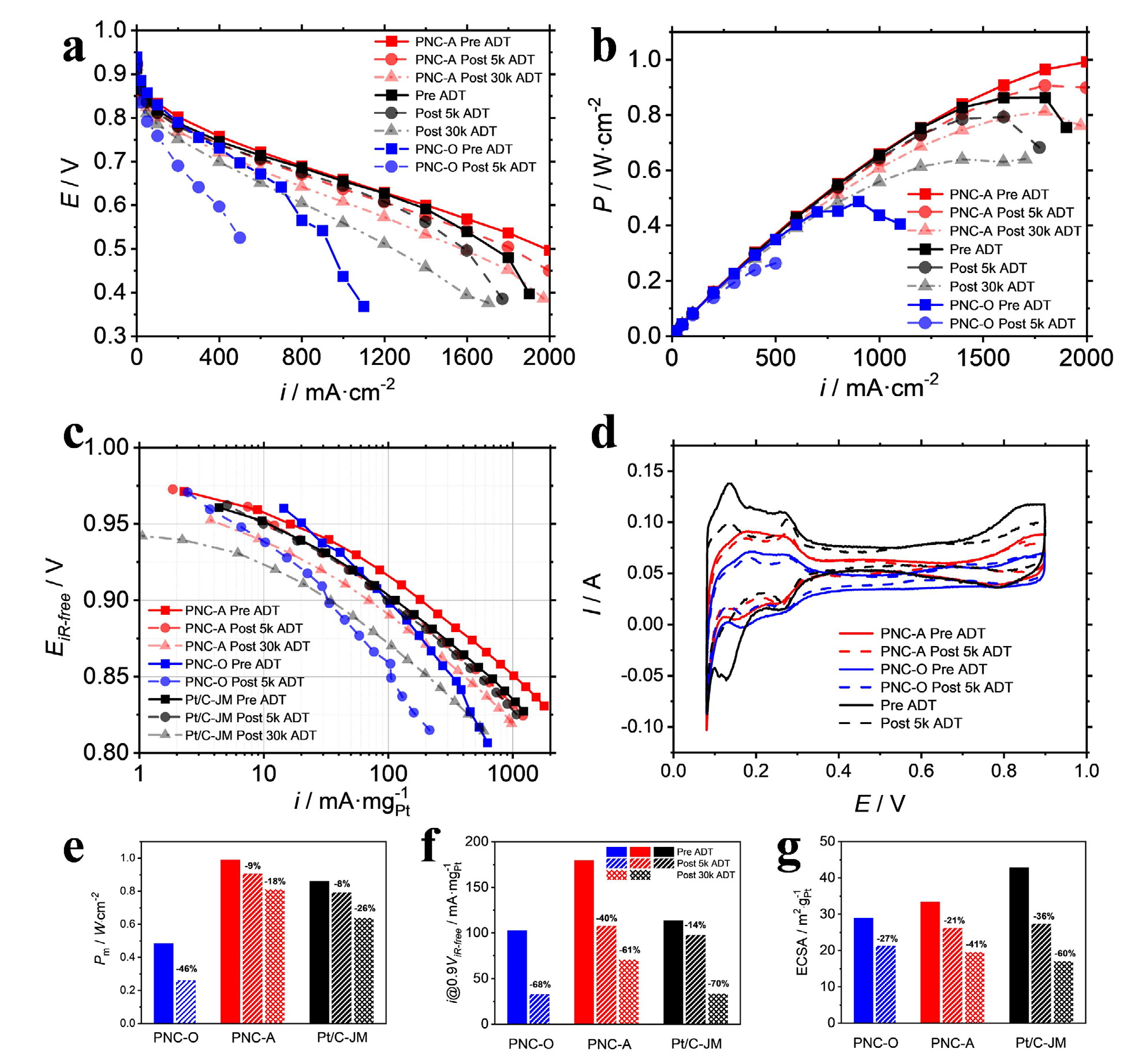
质子交换膜燃料电池(PEMFC)是一种有前景的能量转换装置,但其大规模商业应用受制于高昂的成本和较低的性能。PEMFC的性能主要受限于阴极氧还原反应(ORR)的动力学。铂是对氧还原反应催化活性最高的单金属,但是其性能仍难以满足商业化应用。前期研究表明,铂镍八面体纳米粒子(oct-PtNi-NPs)在半电池中具有优异的ORR活性,但其在膜电极组件(MEA)中的性能报道较少。本论文研究了碳载铂镍八面体纳米粒子(oct-PtNi/C)作为阴极催化剂的膜电极组件性能。研究结果表明,温和的酸洗条件可溶解oct-PtNi/C表面不稳定的镍原子,得到PNC-A催化剂;以PNC-A催化剂为阴极催化剂的MEA性能得到提高:当阴极铂负载量为0.2 mg∙cm-2时,MEA的最大功率密度达到1.0 W∙cm-2,比使用商用Pt/C作为催化剂时高15%;经30,000圈加速老化实验后,使用PNC-A催化剂的MEA的性能保持率为82%,高于Pt/C(74%)。本论文研究了使用PNC-A催化剂作为PEMFC阴极催化剂的可能性,并发现该催化剂提高了PEMFC的性能,同时降低了贵金属铂的用量。
丰紫薇, 陈海忠, 段骁, 唐玲, 赵云昆, 黄龙. 碳载铂镍八面体纳米粒子作为质子交换膜燃料电池阴极催化剂的性能研究[J]. 电化学(中英文), 2026, 32(1): 2515009.
Zi-Wei Feng, Hai-Zhong Chen, Xiao Duan, Ling Tang, Yun-Kun Zhao, Long Huang. Carbon Supported Octahedral PtNi Nanoparticles (Oct-PtNi/C) as a Cathode Catalyst for Proton Exchange Membrane Fuel Cells (PEMFCs) with Improved Activity and Durability[J]. Journal of Electrochemistry, 2026, 32(1): 2515009.
| [1] |
Wang X X, Swihart M T, Wu G. Achievements, challenges and perspectives on cathode catalysts in proton exchange membrane fuel cells for transportation[J]. Nat. Catal., 2019, 2(7): 578-589. http://dx.doi.org/10.1038/s41929-019-0304-9.
doi: 10.1038/s41929-019-0304-9 URL |
| [2] |
Swider Lyons K E, Campbell S A. Physical chemistry research toward proton exchange membrane fuel cell advancement[J]. J. Phys. Chem. Lett., 2013, 4(3): 393-401. http://dx.doi.org/10.1021/jz3019012.
doi: 10.1021/jz3019012 URL pmid: 26281730 |
| [3] |
Liu Z, Peng B, Tsai Y H J, Zhang A, Xu M, Zang W, Yan X, Xing L, Pan X, Duan X, Huang Y. Pt catalyst protected by graphene nanopockets enables lifetimes of over 200,000 h for heavy-duty fuel cell applications[J]. Nat. Nanotechnol., 2025, 20: 807-814. http://dx.doi.org/10.1038/s41565-025-01895-3.
doi: 10.1038/s41565-025-01895-3 URL |
| [4] |
Shao M, Peles A, Shoemaker K. Electrocatalysis on platinum nanoparticles: Particle Size effect on oxygen reduction reaction activity[J]. Nano Lett., 2011, 11(9): 3714-3719. http://dx.doi.org/10.1021/nl2017459.
doi: 10.1021/nl2017459 URL pmid: 21806027 |
| [5] |
Hernandez Fernandez P, Masini F, McCarthy D N, Strebel C E, Friebel D, Deiana D, Malacrida P, Nierhoff A, Bodin A, Wise A M, Nielsen J H, Hansen T W, Nilsson A, StephensIfan E L, Chorkendorff I. Mass-selected nanoparticles of PtxY as model catalysts for oxygen electroreduction[J]. Nat Chem., 2014, 6(8): 732-738. http://dx.doi.org/10.1038/nchem.2001.
doi: 10.1038/nchem.2001 URL pmid: 25054945 |
| [6] |
Chen C, Kang Y, Huo Z, Zhu Z, Huang W, Xin H L, Snyder J D, Li D, Herron J A, Mavrikakis M, Chi M, More K L, Li Y, Markovic N M, Somorjai G A, Yang P, Stamenkovic V R. Highly crystalline multimetallic nanoframes with three-dimensional electrocatalytic surfaces[J]. Science, 2014, 343(6177): 1339-1343. http://dx.doi.org/doi:10.1126/science.1249061. .
doi: 10.1126/science.1249061 URL pmid: 24578531 |
| [7] |
Cui C, Gan L, Heggen M, Rudi S, Strasser P. Compositional segregation in shaped Pt alloy nanoparticles and their structural behaviour during electrocatalysis[J]. Nat. Mater., 2013, 12(8): 765-771. http://dx.doi.org/10.1038/nmat3668.
doi: 10.1038/nmat3668 URL pmid: 23770725 |
| [8] |
Wang C, Chi M, Li D, Strmcnik D, van der Vliet D, Wang G, Komanicky V, Chang K C, Paulikas A P, Tripkovic D, Pearson J, More K L, Markovic N M, Stamenkovic V R. Design and synthesis of bimetallic electrocatalyst with multilayered Pt-skin surfaces[J]. J. Am. Chem. Soc., 2011, 133(36): 14396-14403. http://dx.doi.org/10.1021/ja2047655.
doi: 10.1021/ja2047655 URL pmid: 21770417 |
| [9] |
Polani S, Amitrano R, Baumunk A F, Pan L, Lu J, Schmitt N, Gernert U, Klingenhof M, Selve S, Günther C M, Etzold B J M, Strasser P. Oxygen reduction reaction activity and stability of shaped metal-doped PtNi electrocatalysts evaluated in gas diffusion electrode half-cells[J]. ACS Appl. Mater. Interfaces., 2024, 16(39): 52406-52413. http://dx.doi.org/10.1021/acsami.4c11068.
doi: 10.1021/acsami.4c11068 URL |
| [10] |
Fikry M, Weiß N, Bozzetti M, Ünsal S, Georgi M, Khavlyuk P, Herranz J, Tileli V, Eychmüller A, Schmidt T J. Up-scaled preparation of Pt-Ni aerogel catalyst layers for polymer electrolyte fuel cell cathodes[J]. ACS Appl. Energy Mater., 2024, 7: 896-905. http://dx.doi.org/10.1021/acsaem.3c01930.
doi: 10.1021/acsaem.3c01930 URL |
| [11] |
Polani S, MacArthur K E, Klingenhof M, Wang X, Paciok P, Pan L, Feng Q, Kormányos A, Cherevko S, Heggen M, Strasser P. Size and composition dependence of oxygen reduction reaction catalytic activities of Mo-doped PtNi/C octahedral nanocrystals[J]. ACS Catal., 2021, 11(18): 11407-11415. http://dx.doi.org/10.1021/acscatal.1c01761.
doi: 10.1021/acscatal.1c01761 URL |
| [12] |
Lu B A, Shen L F, Liu J, Zhang Q, Wan L Y, Morris D J, Wang R X, Zhou Z Y, Li G, Sheng T, Gu L, Zhang P, Tian N, Sun S G. Structurally disordered phosphorus-doped Pt as a highly active electrocatalyst for an oxygen reduction reaction[J]. ACS Catal., 2021, 11(1): 355-363. http://dx.doi.org/10.1021/acscatal.0c03137.
doi: 10.1021/acscatal.0c03137 URL |
| [13] |
Zhao X, Xi C, Zhang R, Song L, Wang C, Spendelow J S, Frenkel A I, Yang J, Xin H L, Sasaki K. High-performance nitrogen-doped intermetallic PtNi catalyst for the oxygen Reduction Reaction[J]. ACS Catal., 2020, 10(18): 10637-10645. http://dx.doi.org/10.1021/acscatal.0c03036.
doi: 10.1021/acscatal.0c03036 URL |
| [14] |
Yang T, Cheng C, Xiao L, Wang M, Zhang F, Wang J, Yin P, Shen G, Yang J, Dong C, Liu H, Du X. A descriptor of IB alloy catalysts for hydrogen evolution reaction[J]. SmartMat, 2024, 5(3): e1204. http://dx.doi.org/https://doi.org/10.1002/smm2.1204.
doi: 10.1002/smm2.v5.3 URL |
| [15] | Chen J, Arce Ramos J M, Katsounaros I, de Smit E, Abubakar S M, Lum Y, Zhang J, Wang L. Modulating oxygen affinity to enhance liquid products for the electrochemical reduction of carbon monoxide[J]. 2025, 6(2): e70010. http://dx.doi.org/https://doi.org/10.1002/smm2.70010. |
| [16] |
Wang C C, Guo Z S, Shen Q, Xu Y R, Lin C P, Yang X D, Li C C, Sun Y Q, Hang L F. Recent advances in core-shell structured noble metal-based catalysts for electrocatalysis[J]. Rare Metals, 2025, 44(4): 2180-2207. http://dx.doi.org/10.1007/s12598-024-03081-1.
doi: 10.1007/s12598-024-03081-1 URL |
| [17] |
Huang X Q, Zhao Z P, Cao L, Chen Y, Zhu E B, Lin Z Y, Li M F, Yan A, Zettl A, Wang Y M, Duan X F, Mueller T, Huang Y. High-performance transition metal-doped Pt3Ni octahedra for oxygen reduction reaction[J]. Science, 2015, 348(6240): 1230-1234. http://dx.doi.org/doi:10.1126/science.aaa8765.
doi: 10.1126/science.aaa8765 URL |
| [18] |
Cui C, Gan L, Li H H, Yu S H, Heggen M, Strasser P. Octahedral PtNi nanoparticle catalysts: exceptional oxygen reduction activity by tuning the alloy particle surface composition[J]. Nano Lett., 2012, 12(11): 5885-5889. http://dx.doi.org/10.1021/nl3032795.
doi: 10.1021/nl3032795 URL pmid: 23062102 |
| [19] |
Stamenkovic V R, Fowler B, Mun B S, Wang G, Ross P N, Lucas C A, Marković N M. Improved oxygen reduction activity on Pt3Ni(111) via increased surface site availability[J]. Science, 2007, 315(5811): 493-497. http://dx.doi.org/doi:10.1126/science.1135941.
doi: 10.1126/science.1135941 URL pmid: 17218494 |
| [20] |
Dionigi F, Weber C C, Primbs M, Gocyla M, Bonastre A M, Spöri C, Schmies H, Hornberger E, Kühl S, Drnec J, Heggen M, Sharman J, Dunin-Borkowski R E, Strasser P. Controlling near-surface Ni composition in octahedral PtNi(Mo) nanoparticles by Mo doping for a highly active oxygen reduction reaction catalyst[J]. Nano Lett., 2019, 19(10): 6876-6885. http://dx.doi.org/10.1021/acs.nanolett.9b02116.
doi: 10.1021/acs.nanolett.9b02116 URL pmid: 31510752 |
| [21] |
Kim O H, Ahn C Y, Kang S Y, Kim S, Choi H J, Cho Y H, Sung Y E. From half-cells to membrane-electrode assemblies: a comparison of oxygen reduction reaction catalyst Performance Characteristics[J]. Fuel Cells, 2019, 19(6): 695-707. http://dx.doi.org/https://doi.org/10.1002/fuce.201900120.
doi: 10.1002/fuce.v19.6 URL |
| [22] |
Jia Q, Li J, Caldwell K, Ramaker D E, Ziegelbauer J M, Kukreja R S, Kongkanand A, Mukerjee S. Circumventing metal dissolution induced degradation of Pt-alloy catalysts in proton exchange membrane fuel cells: revealing the asymmetric volcano nature of redox catalysis[J]. ACS Catal., 2016, 6(2): 928-938. http://dx.doi.org/10.1021/acscatal.5b02750.
doi: 10.1021/acscatal.5b02750 URL |
| [23] |
Han B, Carlton C E, Kongkanand A, Kukreja R S, Theobald B R, Gan L, O'Malley R, Strasser P, Wagner F T, Shao-Horn Y. Record activity and stability of dealloyed bimetallic catalysts for proton exchange membrane fuel cells[J]. Energy Environ. Sci., 2015, 8(1): 258-266. http://dx.doi.org/10.1039/C4EE02144D.
doi: 10.1039/C4EE02144D URL |
| [24] |
Wang J, Xue Q, Li B, Yang D, Lv H, Xiao Q, Ming P, Wei X, Zhang C. Preparation of a graphitized-carbon-supported PtNi octahedral catalyst and application in a proton-exchange membrane fuel cell[J]. ACS Appl. Mater. Interfaces., 2020, 12(6): 7047-7056. http://dx.doi.org/10.1021/acsami.9b17248.
doi: 10.1021/acsami.9b17248 URL |
| [25] |
Wang J, Li B, Gao X, Yang D J, Lv H, Xiao Q F, Zhang C M. From rotating disk electrode to single cell: Exploration of PtNi/C octahedral nanocrystal as practical proton exchange membrane fuel cell cathode catalyst[J]. J. Power. Sources, 2018, 406: 118-127. http://dx.doi.org/https://doi.org/10.1016/j.jpowsour.2018.10.010.
doi: 10.1016/j.jpowsour.2018.10.010 URL |
| [26] |
Huang X Q, Zhao Z P, Chen Y, Zhu E B, Li M F, Duan X F, Huang Y. A rational design of carbon-supported dispersive Pt-based octahedra as efficient oxygen reduction reaction catalysts[J]. Energy Environ. Sci., 2014, 7(9): 2957-2962. http://dx.doi.org/10.1039/C4EE01082E.
doi: 10.1039/C4EE01082E URL |
| [27] | FCTT AST and polarization curve protocols for PEMFCs[EB/OL]. https://uscar.org/technologies-teams/hydrogen-fuel-cell. |
| [28] |
Gasteiger H A, Kocha S S, Sompalli B, Wagner F T. Activity benchmarks and requirements for Pt, Pt-alloy, and non-Pt oxygen reduction catalysts for PEMFCs[J]. App. Catal. B: Environ., 2005, 56(1-2): 9-35. http://dx.doi.org/https://doi.org/10.1016/j.apcatb.2004.06.021.
doi: 10.1016/j.apcatb.2004.06.021 URL |
| [29] |
Tang M H, Zhang S M, Chen S L. Pt utilization in proton exchange membrane fuel cells: structure impacting factors and mechanistic insights[J]. Chem. Soc. Rev., 2022, 51(4): 1529-1546. http://dx.doi.org/10.1039/D1CS00981H.
doi: 10.1039/d1cs00981h URL pmid: 35138316 |
| [30] |
Gan L, Heggen M, O’Malley R, Theobald B, Strasser P. Understanding and controlling nanoporosity formation for improving the stability of bimetallic fuel cell catalysts[J]. Nano Lett., 2013, 13(3): 1131-1138. http://dx.doi.org/10.1021/nl304488q.
doi: 10.1021/nl304488q URL pmid: 23360425 |
| [31] |
Vliet D F, Wang C, Li D, Paulikas A P, Greeley J, Rankin R B, Strmcnik D, Tripkovic D, Markovic N M, Stamenkovic V R. Unique electrochemical adsorption properties of Pt-skin surfaces[J]. Angew. Chem. Int. Ed., 2012, 51(13): 3139-3142. http://dx.doi.org/https://doi.org/10.1002/anie.201107668.
doi: 10.1002/anie.201107668 URL pmid: 22351117 |
| [32] |
Khalakhan I, Bogar M, Vorokhta M, Kúš P, Yakovlev Y, Dopita M, Sandbeck D J S, Cherevko S, Matolínová I, Amenitsch H. Evolution of the PtNi bimetallic alloy fuel cell catalyst under simulated operational conditions[J]. ACS Appl. Mater. Interfaces,. 2020, 12(15): 17602-17610. http://dx.doi.org/10.1021/acsami.0c02083.
doi: 10.1021/acsami.0c02083 URL |
| [33] |
Kelly M J, Egger B, Fafilek G, Besenhard J O, Kronberger H, Nauer G E. Conductivity of polymer electrolyte membranes by impedance spectroscopy with microelectrodes[J]. Solid State Ion., 2005, 176(25): 2111-2114. http://dx.doi.org/https://doi.org/10.1016/j.ssi.2004.07.071.
doi: 10.1016/j.ssi.2004.07.071 URL |
| [34] | Makharia R, Mathias M F, Baker D R. Measurement of catalyst layer electrolyte Resistance in PEFCs using electrochemical impedance spectroscopy[J]. J. Electrochem. Soc., 2005, 152(5): A970-A977. http://dx.doi.org/10.1149/1.1888367. |
| [35] |
Sharma R, Gyergyek S, Li Q, Andersen S M. Evolution of the degradation mechanisms with the number of stress cycles during an accelerated stress test of carbon supported platinum nanoparticles[J]. J. Electroanal. Chem., 2019, 838: 82-88. http://dx.doi.org/https://doi.org/10.1016/j.jelechem.2019.02.052.
doi: 10.1016/j.jelechem.2019.02.052 URL |
| [36] | Greszler T A, Caulk D, Sinha P. The impact of platinum loading on oxygen transport resistance[J]. J. Electrochem. Soc., 2012, 159(12): F831-F840. http://dx.doi.org/10.1149/2.061212jes. |
| [1] | 周石, Muhammad Tariq, Asif Nadeem Tabish, Muhammad Salman, 宁凡迪, Muhammad Rayyan Tayyab, 彭冉冉, 郝梦庚, 李文木, 周小春. 制备含有Fe-N-C催化剂的无贵金属阴极催化剂层以提升质子交换膜燃料电池性能[J]. 电化学(中英文), 2026, 32(4): 2511141-. |
| [2] | 林琳, 侯秀旋, 樊哲琛, 尹义轩, 赵纬祎, 魏恺, 周雨蝶, 候利娜, 王颖, 万浩, 葛君杰. 轴向硫配位工程增强Fe‒N‒C催化剂性能,助力高性能质子交换膜燃料电池[J]. 电化学(中英文), 2026, 32(3): 2509281-. |
| [3] | Sumbal Farid, 王军虎. 原位/工况穆斯堡尔谱视角下的铁基氧还原反应电催化剂[J]. 电化学(中英文), 2026, 32(1): 2506261-. |
| [4] | 刘育荣, 张淼, 于彦会, 刘亚琳, 李静, 史晓东, 康振烨, 吴道雄, 饶鹏, 梁颖, 田新龙. 局域电场耦合Cl−固定策略提升海水氧还原反应性能[J]. 电化学(中英文), 2025, 31(9): 2504132-. |
| [5] | 兰畅, 柏景森, 关欣, 王烁, 张楠淑, 程雨晴, 陶金晶, 楚宇逸, 肖梅玲, 刘长鹏, 邢巍. 协同硼掺杂显著提升Co-N-C催化剂的氧还原反应活性[J]. 电化学(中英文), 2025, 31(9): 2506181-. |
| [6] | 张辰浩, 胡晗宇, 杨竣皓, 张倩, 杨畅, 王得丽. Pt2NiCo金属间化合物的有序度调控及电催化氧还原反应性能研究[J]. 电化学(中英文), 2025, 31(4): 2411281-. |
| [7] | 努尔乔利法·尤兰达, 罗亨迪·德迪, 马吉兰·赫里安托·埃迪, 萨里夫·尼尔万, 拉赫马特·阿迪, 尤利安蒂·哈瓦·德威, S·费布里卡·尼玛斯. 单元化再生燃料电池中膜电极组件催化剂层的变化[J]. 电化学(中英文), 2025, 31(4): 2501161-. |
| [8] | 何佩佩, 师锦华, 李笑语, 刘明杰, 方舟, 和晶, 李中坚, 彭新生, 和庆钢. 碳纳米管穿插钴基卟啉金属有机框架催化ORR[J]. 电化学(中英文), 2025, 31(1): 2405241-. |
| [9] | 陈浩杰, 唐美华, 陈胜利. 质子交换膜燃料电池阴极催化层疏水性优化[J]. 电化学(中英文), 2023, 29(9): 2207061-. |
| [10] | 郑天龙, 欧明玉, 徐松, 毛信表, 王释一, 和庆钢. 一体式可再生燃料电池双功能氧催化剂的研究进展[J]. 电化学(中英文), 2023, 29(7): 2205301-. |
| [11] | 刘思淼, 周景娇, 季世军, 文钟晟. FeNi-CoP/NC双功能催化剂的制备及电催化性能研究[J]. 电化学(中英文), 2023, 29(10): 211118-. |
| [12] | 郭鸿波, 王亚妮, 郭凯, 雷海涛, 梁作中, 张学鹏, 曹睿. 吸电子和亲水性Co-卟啉促进电催化氧还原反应的研究[J]. 电化学(中英文), 2022, 28(9): 2214002-. |
| [13] | 张天恩, 颜雅妮, 张俊明, 瞿希铭, 黎燕荣, 姜艳霞. 调控Pt3Zn合金化程度改善酸性氧还原活性与稳定性[J]. 电化学(中英文), 2022, 28(4): 2106091-. |
| [14] | 冯雅辰, 王翔, 王宇琪, 严会娟, 王栋. 电催化氧还原反应的原位表征[J]. 电化学(中英文), 2022, 28(3): 2108531-. |
| [15] | 黄龙, 徐海超, 荆碧, 李秋霞, 易伟, 孙世刚. 质子交换膜燃料电池铂基催化剂研究进展[J]. 电化学(中英文), 2022, 28(1): 2108061-. |
| 阅读次数 | ||||||
|
全文 |
|
|||||
|
摘要 |
|
|||||