电化学(中英文) ›› 2026, Vol. 32 ›› Issue (9): 2603242. doi: 10.61558/2993-074X.3618
赵磊a,b,#, 曹振明c,#, 左珈瑜a, 杨明亮a, 乔红艳a, 陈俊松a, 吴睿a,*( )(
)( )
)
收稿日期:2026-03-24
修回日期:2026-05-23
接受日期:2026-06-11
发布日期:2026-06-11
出版日期:2026-09-28
Lei Zhaoa,b,#, Zhen-Min Caoc,#, Jia-Yu Zuoa, Ming-Liang Yanga, Hong-Yan Qiaoa, Jun Song Chena, Rui Wua,*()()
Received:2026-03-24
Revised:2026-05-23
Accepted:2026-06-11
Online:2026-06-11
Published:2026-09-28
Contact:
*Rui Wu, E-mail: ruiwu0904@uestc.edu.cn
About author:Author Contributions
Lei Zhao: Conceptualization, Methodology, Investigation, Writing. Zhen-Min Cao: experiment, data collection. Jia-Yu Zuo: data collection, validation, Data curation. Ming-Liang Yang: Investigation, Visualization. Hong-Yan Qiao: experiment. Jun Song Chen: Supervision, funding acquisition. Rui Wu: Conceptualization, Funding acquisition, Project administration, Resources, Supervision, Writing - review & editing. All authors have read and approved the final version of the manuscript.
#Lei Zhao and Zhen-Min Cao contributed equally to this work.
摘要:
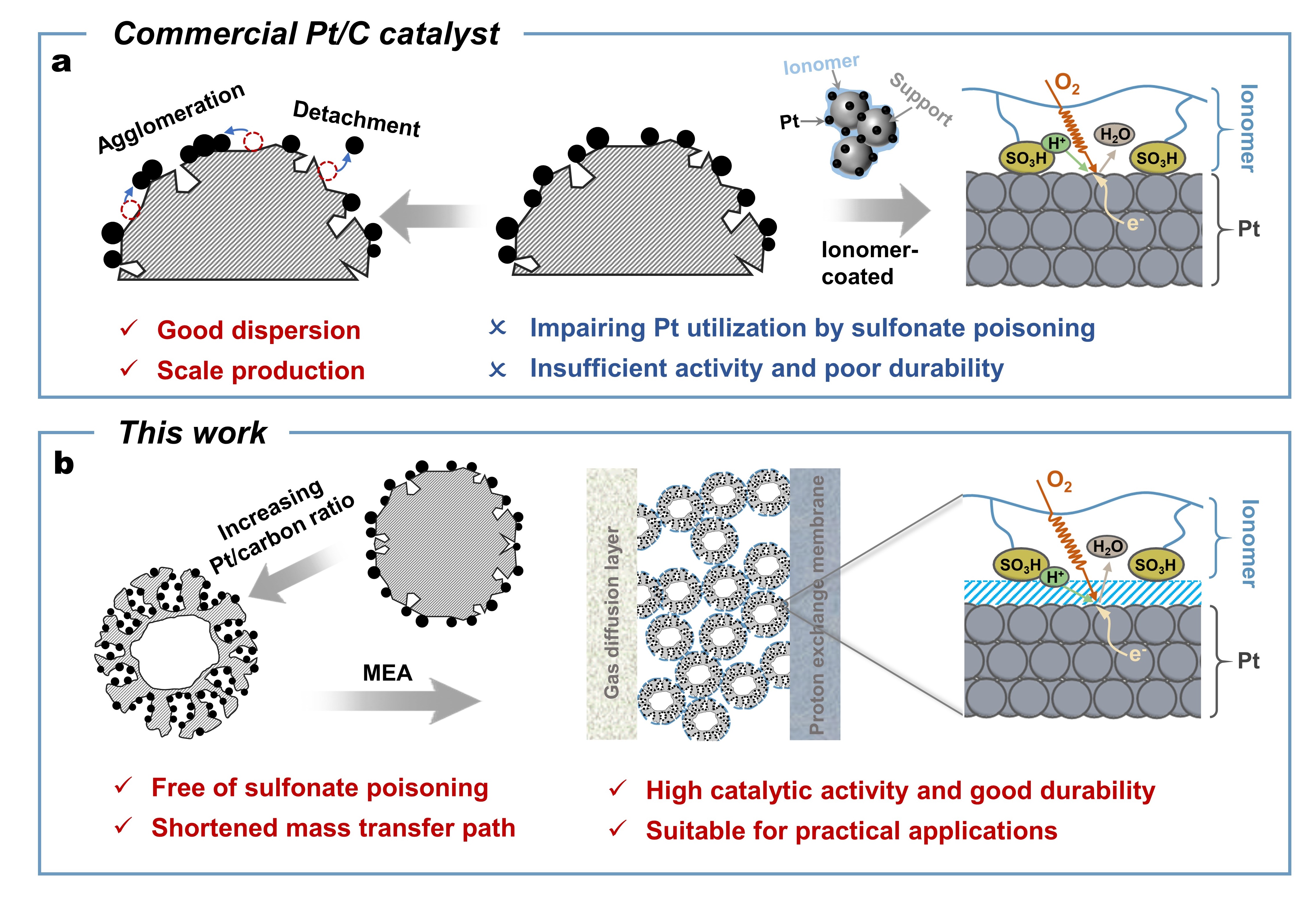
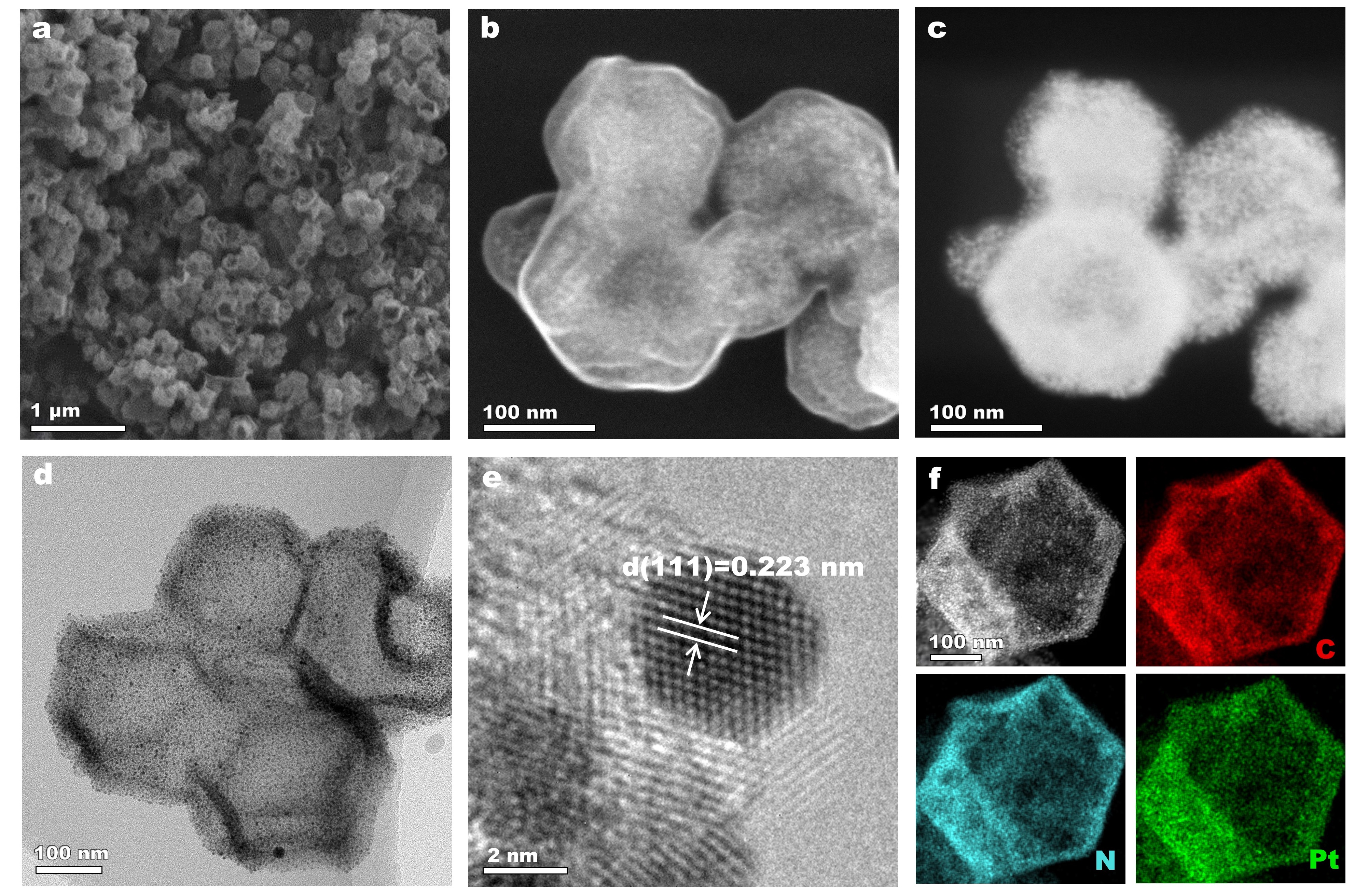
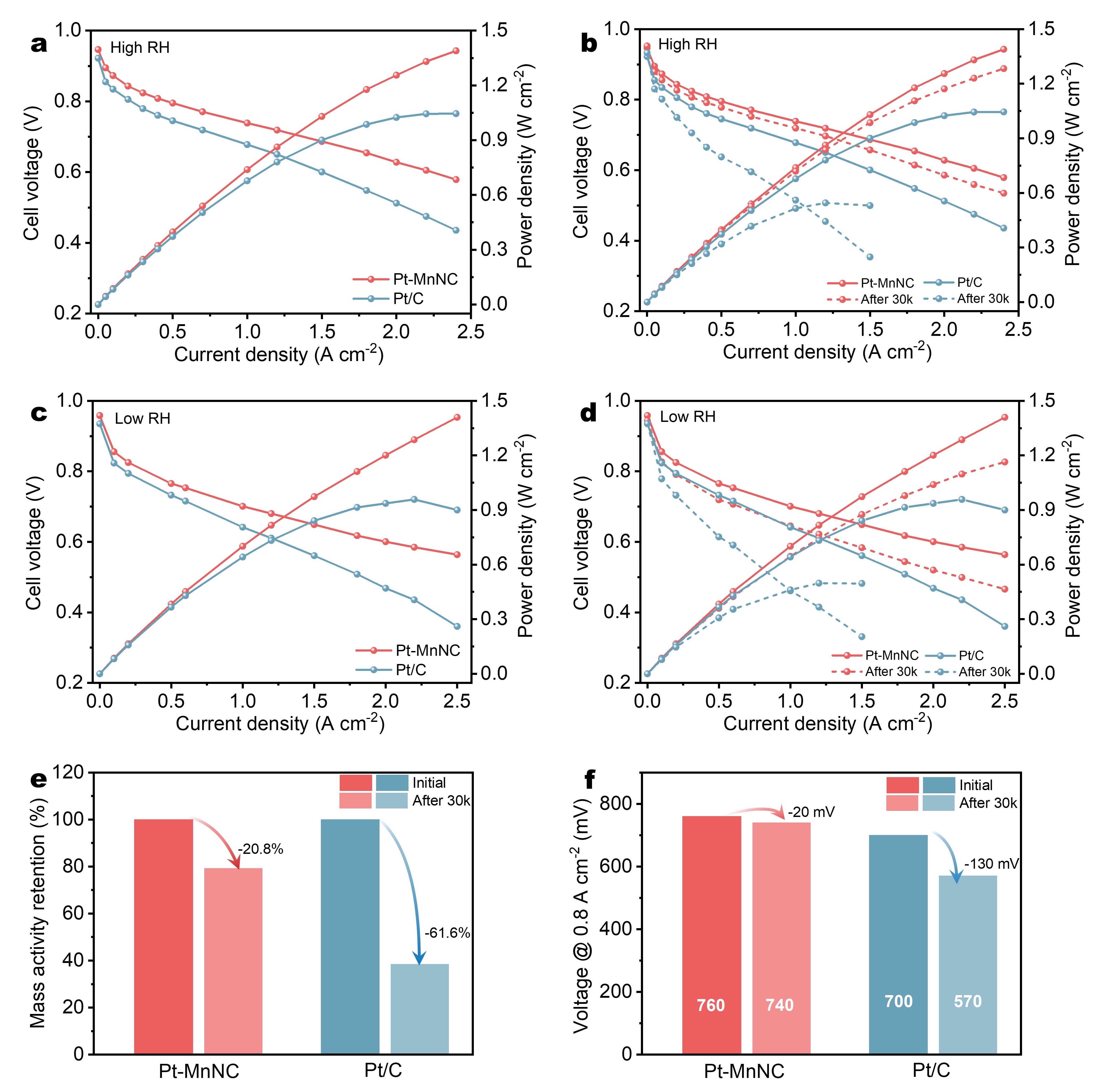
高负载铂(Pt)阴极催化层是实现重载型质子交换膜燃料电池高性能运行的关键,但其长期面临离聚物磺酸基团毒化与Pt纳米颗粒稳定性难以兼顾的矛盾。本文提出一种空间限域策略,通过将高含量Pt纳米颗粒(约51.8 wt%)封装于锰-氮-碳(Mn-N-C)纳米笼中,构筑了具有离聚物屏蔽微环境的Pt-MnNC催化剂。该介孔笼状结构可有效阻隔离聚物进入其内部,显著降低了磺酸基团对Pt活性位点的吸附毒化;同时,Mn-Nx位点与Pt之间的强金属-载体相互作用能够稳定锚定Pt纳米颗粒,抑制其迁移与团聚。在5 × 5 cm2膜电极测试中,Pt-MnNC催化剂在2.0 A·cm-2电流密度下实现1.26 W·cm-2的峰值功率密度。经过30000次加速老化测试后,其质量活性仅下降20.8%,显著优于商业Pt/C催化剂(衰减61.6%)。研究结果表明,空间限域构筑的离聚物屏蔽微环境能够有效缓解离聚物磺酸基团对Pt的毒化,并协同增强Pt纳米颗粒稳定性,为高功率密度、长寿命重载型质子交换膜燃料电池阴极催化剂的设计提供了新的思路。
赵磊, 曹振明, 左珈瑜, 杨明亮, 乔红艳, 陈俊松, 吴睿. 锰-氮-碳纳米笼限域的高密度铂纳米颗粒用于高耐久重载质子交换膜燃料电池[J]. 电化学(中英文), 2026, 32(9): 2603242.
Lei Zhao, Zhen-Min Cao, Jia-Yu Zuo, Ming-Liang Yang, Hong-Yan Qiao, Jun Song Chen, Rui Wu. Dense Platinum Nanoparticles Confined in Mn-N-C Nanocages for Robust Heavy-Duty PEMFCs[J]. Journal of Electrochemistry, 2026, 32(9): 2603242.
| [1] |
Bai Y M, Sang C C, Luo Z W, Huang R X, Zhang Z P, Yin Y N, Lu J P, Xu H, Huang YH, Gao W T, Liu X C, Chidziva S, Mao Z, Wang C. Simple, rapid, scalable confined synthesis of ultrafine Pt nanoclusters for fuel cells[J]. J. Energy Chem., 2026, 115: 421-428. http://doi.org/10.1016/j.jechem.2025.11.042.
doi: 10.1016/j.jechem.2025.11.042 URL |
| [2] |
Jiao K, Xuan J, Du Q, Bao Z M, Xie B, Wang B W, Zhao Y, Fan L H, Wang H Z, Hou Z J, Huo S, Brandon N P, Yin Y, Guiver M D. Designing the next generation of proton-exchange membrane fuel cells[J]. Nature, 2021, 595(7867): 361-369. http://doi.org/10.1038/s41586-021-03482-7.
doi: 10.1038/s41586-021-03482-7 URL |
| [3] |
Si J L, Zhang S, Zhao S, Li J, Feng X, Wang B. Covalent organic frameworks for proton exchange membrane fuel cells[J]. Energy Mater. Adv., 2025, 6: 0334. http://doi.org/10.34133/energymatadv.0334.
doi: 10.34133/energymatadv.0334 URL |
| [4] | Zhang C H, Hua H Y, Yang J H, Zhang Q, Yang C, Wang D L. Ordering degree regulation of Pt2NiCo intermetallics for efficient oxygen reduction reaction[J]. J. Electrochem., 2025, 31(4): 2411281. http://doi.org/10.61558/2993-074x.3519. |
| [5] |
Xu S, Fu X X, Xin L, Huang F X, Sheng T, Hua L. A review on nano-micro structure design of fuel cells for efficient heat and mass transport[J]. DeCarbon, 2025, 10: 100132. http://doi.org/10.1016/j.decarb.2025.100132.
doi: 10.1016/j.decarb.2025.100132 URL |
| [6] |
Li C Y, Liu D D, Qin P, Peng G G, Shui J L, Shang L, Zhang T R. Ultrafine PtFeMo intermetallic compound nanowires for efficient oxygen reduction reaction in proton exchange membrane fuel cells[J]. Nano Energy, 2024, 129: 110079. https://doi.org/10.1016/j.nanoen.2024.110079.
doi: 10.1016/j.nanoen.2024.110079 URL |
| [7] |
Du Y, Chen W X, Shi Z X, Zhou L N, Pan S, Xu X N, Liu Y F, Wang L Q, Xiong D B, Liu Y S, Guo X D, Dou S X, Xiao Y. In situ alloying strategy constructed Fe3Co-N-C electrocatalysts with designed 1D/3D hierarchical networks for rechargeable zinc-air battery[J]. InfoMat, 2025, 7(9): e70032. http://doi.org/10.1002/inf2.70032.
doi: 10.1002/inf2.v7.9 URL |
| [8] | He P P, Shi J H, Li X Y, Liu M J, Fang Z, He J, Li Z J, Peng X S, He Q G. A CNT intercalated Co porphyrin-based metal organic framework catalyst for oxygen reduction reaction[J]. J. Electrochem., 2025, 31(1): 2405241. http://doi.org/10.61558/2993-074x.3502. |
| [9] |
Wang X M, Hou T L, Ba X, Wang R X, Xu H P, Wang S R, Kong F P. Ultra-low Pt core-shell electrocatalysts: Noble metal core from irregular binarity to structure-shape-selectivity multielement[J]. J. Energy Chem., 2026, 115: 298-316. http://doi.org/10.1016/j.jechem.2025.11.023.
doi: 10.1016/j.jechem.2025.11.023 URL |
| [10] |
Yang G G, Cai H R, Xu Z R, Ji C C, Yang Z M, Zhang S L, Zhang Y, Wang B B, Mei B, Liang C, Yang S C. Spin polarization regulation of Fe-N4 by Fe3 atomic clusters for highly active oxygen reduction reaction[J]. Sci. Bull., 2025, 70(11): 1793-1803. https://doi.org/10.1016/j.scib.2025.02.041.
doi: 10.1016/j.scib.2025.02.041 URL |
| [11] |
Deng H, Liu J, Hou Z J. Understanding the morphology and mass transport resistance of mesoporous carbon-supported PEMFC based on modeling analysis[J]. J. Electrochem., 2025, 31(5): 2514001. http://doi.org/10.61558/2993-074x.3546.
doi: 10.61558/2993-074X.3546 URL |
| [12] |
Gao L, Sun T L, Chen X L, Yang Z L, Li M F, Lai W C, Zhang W H, Yuan Q, Huang H W. Identifying the distinct roles of dual dopants in stabilizing the platinum-nickel nanowire catalyst for durable fuel cell[J]. Nat. Commun., 2024, 15(1): 508. http://doi.org/10.1038/s41467-024-44788-0.
doi: 10.1038/s41467-024-44788-0 URL pmid: 38218946 |
| [13] |
Ke F S, Cheng Q Q, Tong D G, Liu D Y, Xu X, Chen Y B, Zou L L, Yang H. Mesoporous confined Pt-based intermetallic compound with wrinkled carbon to enhance the performance towards oxygen reduction reaction for proton exchange membrane fuel cells[J]. J. Power Sources, 2024, 603: 234357. http://doi.org/10.1016/j.jpowsour.2024.234357.
doi: 10.1016/j.jpowsour.2024.234357 URL |
| [14] |
Pan Y Y, Chen Y H, Li Y Z, Liu M Y, Yao L P, Zhao H Y, Zhao X Y, Yue Z Y, Gui S J, Chen Y B, Cheng Q Q, Yang H. Entropy‐increase assisted anti‐sintering for synthesis of high‐loaded Pt intermetallic compounds as electrocatalysts in PEMFCs[J]. Adv. Funct. Mater., 2025, 35(44): 2503628. http://doi.org/10.1002/adfm.202503628.
doi: 10.1002/adfm.v35.44 URL |
| [15] |
Zhang X, Wang Z, Lawan A M, Wang J H, Hsieh C Y, Duan C, Pang C H, Chu P K, Yu X F, Zhao H. Data‐driven structural descriptor for predicting platinum‐based alloys as oxygen reduction electrocatalysts[J]. InfoMat, 2023, 5(6): e12406. http://doi.org/10.1002/inf2.12406.
doi: 10.1002/inf2.v5.6 URL |
| [16] |
Chen F D, Guo L, Long D J, Luo S J, Song Y, Wang M, Li L, Chen S G, Wei Z D. Overcoming the limitation of ionomers on mass transport and Pt activity to achieve high-performing membrane electrode assembly[J]. J. Am. Chem. Soc., 2024, 146(44): 30388-30396. http://doi.org/10.1021/jacs.4c10742.
doi: 10.1021/jacs.4c10742 URL |
| [17] |
Cheng Q Q, Yang S, Fu C H, Zou L L, Zou Z Q, Jiang Z, Zhang J L, Yang H. High-loaded sub-6 nm Pt1Co1 intermetallic compounds with highly efficient performance expression in PEMFCs[J]. Energy Environ. Sci., 2022, 15(1): 278-286. http://doi.org/10.1039/d1ee02530a.
doi: 10.1039/D1EE02530A URL |
| [18] | Wang M, Zhang S L, Wang H, Sun E, Liu Y R, Wu M B, Liu D J, Li Z T. Regulating catalyst and ionomer interactions to promote oxygen transport in fuel cells[J]. Appl. Catal. B Environ. Energy, 2025, 365: 124894. http://doi.org/10.1016/j.apcatb.2024.124894. |
| [19] |
Yoo T Y, Lee J, Kim S, Her M, Kim S Y, Lee Y H, Shin H, Jeong H, Sinha A K, Cho S P, Sung Y E, Hyeon T. Scalable production of an intermetallic Pt-Co electrocatalyst for high-power proton-exchange-membrane fuel cells[J]. Energy Environ. Sci., 2023, 16(3): 1146-1154. http://doi.org/10.1039/d2ee04211h.
doi: 10.1039/D2EE04211H URL |
| [20] |
Peles Strahl L, Persky Y, Elbaz L. Design of advanced aerogel structures for oxygen reduction reaction electrocatalysis[J]. SusMat, 2023, 3(1): 44-57. http://doi.org/10.1002/sus2.104.
doi: 10.1002/sus2.v3.1 URL |
| [21] |
Yoo J M, Shin H, Chung D Y, Sung Y E. Carbon shell on active nanocatalyst for stable electrocatalysis[J]. Acc. Chem. Res., 2022, 55(9): 1278-1289. http://doi.org/10.1021/acs.accounts.1c00727.
doi: 10.1021/acs.accounts.1c00727 URL |
| [22] |
Fan J T, Chen M, Zhao Z L, Zhang Z, Ye S Y, Xu S Y, Wang H J, Li H. Bridging the gap between highly active oxygen reduction reaction catalysts and effective catalyst layers for proton exchange membrane fuel cells[J]. Nat. Energy, 2021, 6(5): 475-486. http://doi.org/10.1038/s41560-021-00824-7.
doi: 10.1038/s41560-021-00824-7 URL |
| [23] |
Kodama K, Nagai T, Kuwaki A, Jinnouchi R, Morimoto Y. Challenges in applying highly active Pt-based nanostructured catalysts for oxygen reduction reactions to fuel cell vehicles[J]. Nat. Nanotechnol., 2021, 16(2): 140-147. http://doi.org/10.1038/s41565-020-00824-w.
doi: 10.1038/s41565-020-00824-w URL pmid: 33479539 |
| [24] |
Chen F D, Chen S G, Wang A X, Wang M, Guo L, Wei Z D. Blocking the sulfonate group in Nafion to unlock platinum’s activity in membrane electrode assemblies[J]. Nat. Catal., 2023, 6(5): 392-401. http://doi.org/10.1038/s41929-023-00949-w.
doi: 10.1038/s41929-023-00949-w URL |
| [25] | Tang M H, Yan H L, Zhang X M, Zheng Z Y, Chen S L. Materials strategies tackling interfacial issues in catalyst layers of proton exchange membrane fuel cells[J]. Adv. Mater., 2025, 37(31): e2306387. http://doi.org/10.1002/adma.202306387. |
| [26] |
Jinnouchi R, Kudo K, Kodama K, Kitano N, Suzuki T, Minami S, Shinozaki K, Hasegawa N, Shinohara A. The role of oxygen-permeable ionomer for polymer electrolyte fuel cells[J]. Nat. Commun., 2021, 12(1): 4956. http://doi.org/10.1038/s41467-021-25301-3.
doi: 10.1038/s41467-021-25301-3 URL pmid: 34400643 |
| [27] |
Tang M H, Zhang S M, Chen S L. Pt utilization in proton exchange membrane fuel cells: Structure impacting factors and mechanistic insights[J]. Chem. Soc. Rev., 2022, 51(4): 1529-1546. http://doi.org/10.1039/d1cs00981h.
doi: 10.1039/d1cs00981h URL pmid: 35138316 |
| [28] |
Yu Y, Shah M A K Y, Wang H, Cheng X M, Guo L J, Huang J B, Lund P, Zhu B. Synergistic proton and oxygen ion transport in fluorite oxide-ion conductor[J]. Energy Mater. Adv., 2024, 5: 0081. http://doi.org/10.34133/energymatadv.0081.
doi: 10.34133/energymatadv.0081 URL |
| [29] |
Tang M H, Yan H L, Zheng Z Y, Zhang H, Yu C W, Liu B, Chen S L. A molecule assembly route to simultaneously detoxify platinum sites and disentangle reactant transport paths in proton exchange membrane fuel cells[J]. J. Am. Chem. Soc., 2025, 147(23): 19931-19940. http://doi.org/10.1021/jacs.5c04479.
doi: 10.1021/jacs.5c04479 URL pmid: 40452560 |
| [30] |
Wei X Q, Song S J, Cai W W, Kang Y Q, Fang Q, Ling L, Zhao Y J, Wu Z X, Song X K, Xu X T, Osman S M, Song W Y, Asahi T, Yamauchi Y, Zhu C Z. Pt nanoparticle-Mn single-atom pairs for enhanced oxygen reduction[J]. ACS Nano, 2024, 18(5): 4308-4319. http://doi.org/10.1021/acsnano.3c09819.
doi: 10.1021/acsnano.3c09819 URL |
| [31] |
Yarlagadda V, Carpenter M K, Moylan T E, Kukreja R S, Koestner R, Gu W, Thompson L, Kongkanand A. Boosting fuel cell performance with accessible carbon mesopores[J]. ACS Energy Lett., 2018, 3(3): 618-621. http://doi.org/10.1021/acsenergylett.8b00186.
doi: 10.1021/acsenergylett.8b00186 URL |
| [32] | Zhao L, Zhu Z Z, Wang J J, Zuo J Y, Chen H Y, Qi X Q, Niu X B, Blackwood D J, Chen J S, Wu R. Unlocking proton exchange membrane fuel cell performance with porous PtCoV alloy catalysts[J]. Adv. Mater., 2025, 37(34): e2502457. http://doi.org/10.1002/adma.202502457. |
| [33] | Yamaguchi M, Matsunaga T, Amemiya K, Ohira A, Hasegawa N, Shinohara K, Ando M, Yoshida T. Dispersion of rod-like particles of Nafion in salt-free water/1-propanol and water/ethanol solutions[J]. J. Phys. Chem. B, 2014, 118(51): 14922-14928. http://doi.org/10.1021/jp506814m. |
| [34] |
Ramaswamy N, Gu W, Ziegelbauer J M, Kumaraguru S. Carbon support microstructure impact on high current density transport resistances in PEMFC cathode[J]. J. Electrochem. Soc., 2020, 167(6): 064515. http://doi.org/10.1149/1945-7111/ab819c.
doi: 10.1149/1945-7111/ab819c URL |
| [35] |
Xu F, Zhang H Y, Ilavsky J, Stanciu L, Ho D, Justice M J, Petrache H I, Xie J. Investigation of a catalyst ink dispersion using both ultra-small-angle X-ray scattering and cryogenic TEM[J]. Langmuir, 2010, 26(24): 19199-19208. http://doi.org/10.1021/la1028228.
doi: 10.1021/la1028228 URL pmid: 21090580 |
| [36] |
Li J J, Xia W, Tang J, Gao Y, Jiang C, Jia Y N, Chen T, Hou Z F, Qi R J, Jiang D, Asahi T, Xu X T, Wang T, He J P, Yamauchi Y. Metal-organic framework-derived graphene mesh: A robust scaffold for highly exposed Fe-N4 active sites toward an excellent oxygen reduction catalyst in acid media[J]. J. Am. Chem. Soc., 2022, 144(21): 9280-9291. http://doi.org/10.1021/jacs.2c00719.
doi: 10.1021/jacs.2c00719 URL |
| [37] |
Lin Y X, Xia C F, Zhu Z Z, Wang J J, Niu H T, Gong S N, Li Z, Yang N, Song Chen J, Wu R, Xia B Y. Carbon nanocage supported asymmetrically coordinated nickle single-atom for enhanced CO2 electroreduction in membrane electrode assembly[J]. Angew. Chem. Int. Ed., 2025, 64(2): e202414569. http://doi.org/10.1002/anie.202414569.
doi: 10.1002/anie.v64.2 URL |
| [38] |
Li Q Y, Zhao L, Zhu Z Z, Xiong P, Zuo J Y, Chen J S, Li R, Wu R. Engineering atomically dispersed Mn and Fe sites on hollow nitrogen-doped carbon for high-performance Zn-air batteries[J]. J. Colloid Interface Sci., 2025, 682: 460-466. http://doi.org/10.1016/j.jcis.2024.11.208.
doi: 10.1016/j.jcis.2024.11.208 URL |
| [39] |
Ott S, Orfanidi A, Schmies H, Anke B, Nong H N, Hubner J, Gernert U, Gliech M, Lerch M, Strasser P. Ionomer distribution control in porous carbon-supported catalyst layers for high-power and low Pt-loaded proton exchange membrane fuel cells[J]. Nat. Mater., 2020, 19(1): 77-85. http://doi.org/10.1038/s41563-019-0487-0.
doi: 10.1038/s41563-019-0487-0 URL pmid: 31570820 |
| [40] |
Liu L N, Yan F, Li K Y, Zhu C L, Xie Y, Zhang X T, Chen Y J. Ultrasmall FeNi3N particles with an exposed active (110) surface anchored on nitrogen-doped graphene for multifunctional electrocatalysts[J]. J. Mater. Chem. A, 2019, 7(3): 1083-1091. http://doi.org/10.1039/c8ta10083g.
doi: 10.1039/C8TA10083G URL |
| [41] |
Zhang W L, Sun M L, Yin J, Lu K, Schwingenschlögl U, Qiu X Q, Alshareef H N. Accordion‐like carbon with high nitrogen doping for fast and stable K ion storage[J]. Adv. Energy Mater., 2021, 11(41): 2101928. http://doi.org/10.1002/aenm.202101928.
doi: 10.1002/aenm.v11.41 URL |
| [42] |
Dong Y D, Wang Y, Xie Z H, Yang S R, Sun S, Xiong Z K, Zhou P, He C S, Lai B. Coordination engineering breaks the inertness of Mn single-atom for ultrafast peracetic acid activation[J]. Sci. Bull., 2026, 71(6): 1369-1379. https://doi.org/10.1016/j.scib.2026.01.055.
doi: 10.1016/j.scib.2026.01.055 URL |
| [43] |
Zhan X X, Tong X, Ye H, Gao Z J, Tian J, Zhuang J L, Zhang G X, Sun S H. Atomically dispersed metal site materials for hydrogen energy utilization: Theoretical and experimental study in fuel cells and water electrolysis[J]. DeCarbon, 2025, 7: 100091. http://doi.org/10.1016/j.decarb.2024.100091.
doi: 10.1016/j.decarb.2024.100091 URL |
| [44] |
Guo L, Hwang S, Li B Y, Yang F, Wang M Y, Chen M J, Yang X X, Karakalos S G, Cullen D A, Feng Z X, Wang G F, Wu G, Xu H. Promoting atomically dispersed MnN4 sites via sulfur doping for oxygen reduction: Unveiling intrinsic activity and degradation in fuel cells[J]. ACS Nano, 2021, 15(4): 6886-6899. http://doi.org/10.1021/acsnano.0c10637.
doi: 10.1021/acsnano.0c10637 URL |
| [45] |
Ao X, Zhang W, Zhao B, Ding Y, Nam G, Soule L, Abdelhafiz A, Wang C D, Liu M L. Atomically dispersed Fe-N-C decorated with Pt-alloy core-shell nanoparticles for improved activity and durability towards oxygen reduction[J]. Energy Environ. Sci., 2020, 13(9): 3032-3040. http://doi.org/10.1039/D0EE00832J.
doi: 10.1039/D0EE00832J URL |
| [46] |
Zhao L, Qi X Q, Yang T T, Xiong P, Niu X B, Jiang J X, Xue Q, Yu L, Chen J S, Cabot A, Wu R. Coupling PtZn intermetallic and atomically dispersed cobalt towards efficient and stable oxygen reduction reaction catalysts[J]. J. Mater. Chem. A, 2023, 11(44): 24371-24378. http://doi.org/10.1039/D3TA04591A.
doi: 10.1039/D3TA04591A URL |
| [47] |
Karuppannan M, Kim Y, Gok S, Lee E, Hwang J Y, Jang J H, Cho Y H, Lim T, Sung Y E, Kwon O J. A highly durable carbon-nanofiber-supported Pt-C core-shell cathode catalyst for ultra-low Pt loading proton exchange membrane fuel cells: Facile carbon encapsulation[J]. Energy Environ. Sci., 2019, 12(9): 2820-2829. http://doi.org/10.1039/C9EE01000A.
doi: 10.1039/C9EE01000A URL |
| [48] |
Huang L, Wei M, Qi R, Dong C L, Dang D, Yang C C, Xia C, Chen C, Zaman S, Li F M, You B, Xia B Y. An integrated platinum-nanocarbon electrocatalyst for efficient oxygen reduction[J]. Nat. Commun., 2022, 13(1): 6703. http://doi.org/10.1038/s41467-022-34444-w.
doi: 10.1038/s41467-022-34444-w URL pmid: 36344552 |
| [49] |
Qin P, Liu D D, Li C Y, Peng G G, Waterhouse G I N, Han Y, Shui J, Luo M, Shang L, Guo S, Zhang T. Dense platinum-based intermetallic nanoparticles confined into hollow mesoporous carbon for durable high-power heavy-duty fuel cells[J]. J. Am. Chem. Soc., 2026, 148(9): 9563-9571. http://doi.org/10.1021/jacs.5c19791.
doi: 10.1021/jacs.5c19791 URL |
| [50] | Huang Z L, Wang Y R, Xia J, Hu S N, Chen N J, Ding T Y, Zhan C H, Pao C W, Hu Z, Huang W H, Shi T, Meng X M, Xu Y, Cao L, Huang X Q. Atom-glue stabilized Pt-based intermetallic nanoparticles[J]. Sci. Adv., 2024, 10(40): eadq6727. http://doi.org/10.1126/sciadv.adq6727. |
| [51] | Ni Z J, Han K, Chen X C, Wang L, Wang B. Experimental and numerical efforts to improve oxygen mass transport in porous catalyst layer of proton exchange membrane fuel cells[J]. Nano Res. Energy, 2023, 2: e9120085. http://doi.org/10.26599/NRE.2023.9120085. |
| [52] | Garrick T R, Moylan T E, Yarlagadda V, Kongkanand A. Characterizing electrolyte and platinum interface in PEM fuel cells using CO displacement[J]. J. Electrochem. Soc., 2016, 164(2): F60-F64. http://doi.org/10.1149/2.0551702jes. |
| [1] | 周石, Muhammad Tariq, Asif Nadeem Tabish, Muhammad Salman, 宁凡迪, Muhammad Rayyan Tayyab, 彭冉冉, 郝梦庚, 李文木, 周小春. 制备含有Fe-N-C催化剂的无贵金属阴极催化剂层以提升质子交换膜燃料电池性能[J]. 电化学(中英文), 2026, 32(4): 2511141-. |
| [2] | 丰紫薇, 陈海忠, 段骁, 唐玲, 赵云昆, 黄龙. 碳载铂镍八面体纳米粒子作为质子交换膜燃料电池阴极催化剂的性能研究[J]. 电化学(中英文), 2026, 32(1): 2515009-. |
| [3] | 兰畅, 柏景森, 关欣, 王烁, 张楠淑, 程雨晴, 陶金晶, 楚宇逸, 肖梅玲, 刘长鹏, 邢巍. 协同硼掺杂显著提升Co-N-C催化剂的氧还原反应活性[J]. 电化学(中英文), 2025, 31(9): 2506181-. |
| [4] | 陈浩杰, 唐美华, 陈胜利. 质子交换膜燃料电池阴极催化层疏水性优化[J]. 电化学(中英文), 2023, 29(9): 2207061-. |
| [5] | 黄龙, 徐海超, 荆碧, 李秋霞, 易伟, 孙世刚. 质子交换膜燃料电池铂基催化剂研究进展[J]. 电化学(中英文), 2022, 28(1): 2108061-. |
| [6] | 王睿卿, 隋升. PEMFC阴极催化层结构分析[J]. 电化学(中英文), 2021, 27(6): 595-604. |
| [7] | 魏荣强, 李世安, 刘艺辉, 杨治, 沈秋婉, 杨国刚. 流道与肋宽比对气体扩散层性能影响的数值研究[J]. 电化学(中英文), 2021, 27(5): 579-585. |
| [8] | 张焰峰, 肖菲, 陈广宇, 邵敏华. 基于非贵金属氧还原催化剂的质子交换膜燃料电池性能[J]. 电化学(中英文), 2020, 26(4): 563-572. |
| [9] | 杨智, 沈亚云, 周娥, 魏成玲, 秦好丽, 田娟. 前驱体中N含量对FeN/C催化剂氧还原活性的影响研究[J]. 电化学(中英文), 2020, 26(1): 130-135. |
| [10] | 刘勇, 丁涵, 司德春, 彭杰, 张剑波. 静电纺丝制备质子交换膜燃料电池催化剂层综述[J]. 电化学(中英文), 2018, 24(6): 639-654. |
| [11] | 郭建伟, 王建龙. 电化学阻抗谱在质子交换膜燃料电池动态的先导应用[J]. 电化学(中英文), 2018, 24(6): 687-696. |
| [12] | 何大平, 木士春. 质子交换膜燃料电池铂电催化剂稳定策略[J]. 电化学(中英文), 2018, 24(6): 655-663. |
| [13] | 池滨, 叶跃坤, 江世杰, 廖世军. 低温质子交换膜燃料电池自增湿膜电极研究进展[J]. 电化学(中英文), 2018, 24(6): 628-638. |
| [14] | 高燕燕,侯明,姜永燚,梁栋,艾军,郑利民. 质子交换膜燃料电池催化层化学稳定性研究[J]. 电化学(中英文), 2018, 24(3): 227-234. |
| [15] | 肖燕,常英杰,张伟,贾秋红. 启动工况下质子交换膜燃料电池动态性能仿真分析[J]. 电化学(中英文), 2018, 24(2): 166-173. |
| 阅读次数 | ||||||
|
全文 |
|
|||||
|
摘要 |
|
|||||