电化学(中英文) ›› 2026, Vol. 32 ›› Issue (10): 2614004. doi: 10.61558/2993-074X.3624
• 综述 • 上一篇
张曼*( )(
 ), 李雪, 彭馨玉, 王琳, 陈文文, 阳耀月*()
收稿日期:2026-06-11
修回日期:2026-07-20
接受日期:2026-09-07
发布日期:2026-09-07
出版日期:2026-10-28
Man Zhang*()(), Xue Li, Xin-Yu Peng, Lin Wang, Wen-Wen Chen, Yao-Yue Yang*()
Received:2026-06-11
Revised:2026-07-20
Accepted:2026-09-07
Online:2026-09-07
Published:2026-10-28
Contact:
*Yao-Yue Yang, Email address: yaoyueyoung@swun.edu.cn (Y. Y.); Man Zhang, Email address: zhangm289@swun.edu.cn (M. Z.)
About author:Author contributions
Man Zhang investigated information and wrote the original draft. Xue Li and Xin-Yu Peng prepared the figures. Lin Wang and Wen-Wen Chen investigated documents. Yao-Yue Yang wrote review and edited paper. All authors discussed the content and approved the final version.
摘要:
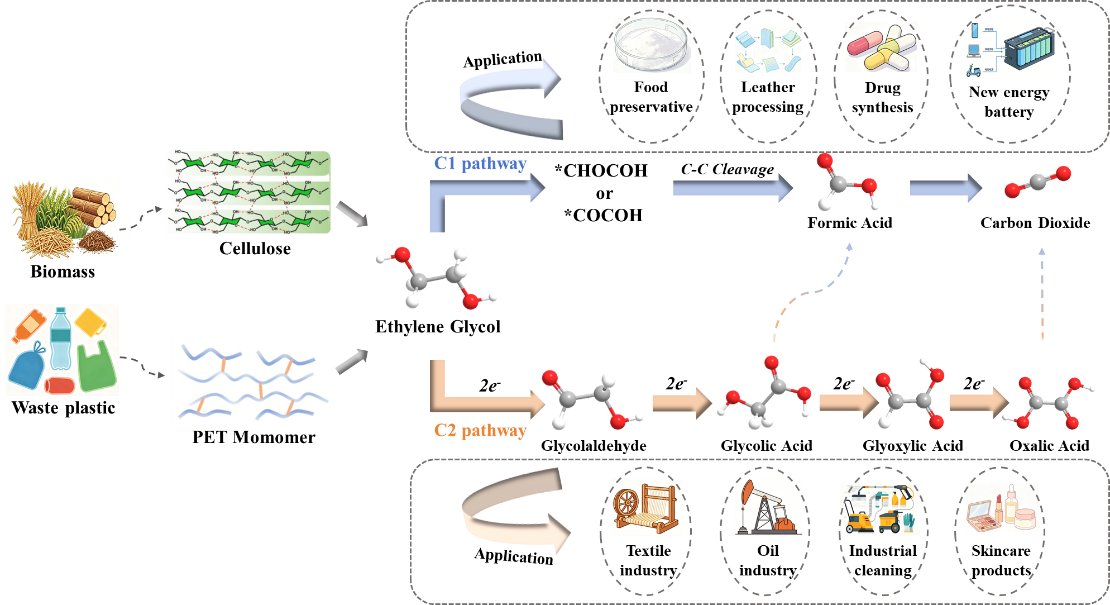
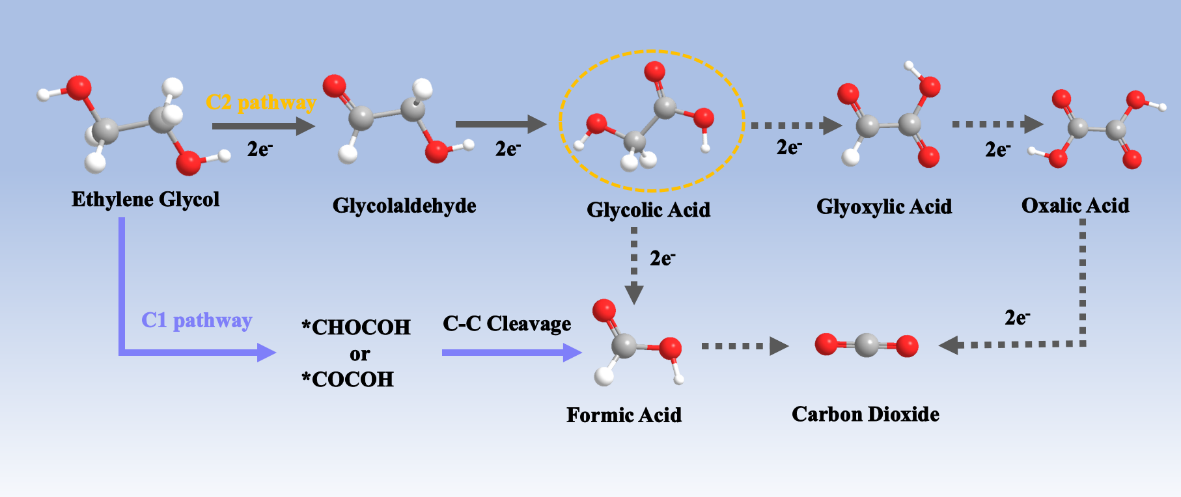
处理聚对苯二甲酸乙二醇酯废弃物既非环境友好,又损失碳资源。其经碱性解聚可得对苯二甲酸和乙二醇,利用可再生电力驱动乙二醇电催化氧化制取乙醇酸——即生物可降解聚乙醇酸的单体,是一条可持续转化路径。然而,乙二醇氧化反应存在多条竞争反应途径,既可能生成C2产物(乙醇酸和草酸),也可能生成C1产物(甲酸和二氧化碳),因此,如何实现高选择性生成乙醇酸是该领域的核心难题。本文综述了乙二醇选择性电氧化制乙醇酸的最新研究进展,重点涵盖催化剂设计策略、反应机理认识以及电解质体系的演变与发展。在催化剂设计方面,贵金属(铂、钯、金)及其复合物在碱性介质中可实现90%以上的乙醇酸选择性,法拉第效率接近95%,多主元合金为调控活性位点的电子结构提供了新机遇。借助原位衰减全反射表面增强红外吸收光谱、在线质谱和密度泛函理论计算等机理研究手段,阐明关键中间体(铂表面物种CH2OH-CHO、OCH2-CHO)及竞争活性位点,其中吸附态一氧化碳(COad)可作为反应路径的特征指示物。最后,本文讨论了该领域面临的关键挑战,指出了未来发展方向是通过开发低成本、高稳定性且高选择性的催化体系,并解决大规模生产与产物纯化关键问题。
张曼, 李雪, 彭馨玉, 王琳, 陈文文, 阳耀月. 电催化乙二醇氧化制乙醇酸:机理与策略[J]. 电化学(中英文), 2026, 32(10): 2614004.
Man Zhang, Xue Li, Xin-Yu Peng, Lin Wang, Wen-Wen Chen, Yao-Yue Yang. Electrocatalytic Oxidation of Ethylene Glycol to Glycolic Acid: From Mechanism and Catalyst Design to Emerging Neutral Electrolyte Systems[J]. Journal of Electrochemistry, 2026, 32(10): 2614004.
| [1] | Yoo C G, Kim T H. Advancements in catalytic conversion of biomass into biofuels and chemicals[J]. Energies, 2020, 13(20): 5438. https://doi.org/10.3390/en13205438. |
| [2] | Lee K, Jing Y X, Wang Y Q, Yan N. A unified view on catalytic conversion of biomass and waste plastics[J]. Nat. Rev. Chem., 2022, 6(9): 635-652. https://doi.org/10.1038/s41570-022-00411-8. |
| [3] | Osman A I, Nasr M, Aniagor C O, Farghali M, Huang M M, Chin B L F, Sun Z Q, Lock S S M, López-Maldonado E A, Yiin C L, Chinyelu C E, Farooqi A S, Chen Z H, Yap P S. Synergistic technologies for a circular economy: upcycling waste plastics and biomass[J]. Front. Chem. Sci. Eng., 2025, 19(1): 2. https://doi.org/10.1007/s11705-024-2507-0. |
| [4] | Rorrer N A, Nicholson S, Carpenter A, Biddy M J, Grundl N J, Beckham G T. Combining reclaimed PET with bio-based monomers enables plastics upcycling[J]. Joule, 2019, 3(4): 1006-1027. https://doi.org/10.1016/j.joule.2019.01.018. |
| [5] | Chen H, Wan K, Zhang Y Y, Wang Y Q. Waste to wealth: chemical recycling and chemical upcycling of waste plastics for a great future[J]. ChemSusChem, 2021, 14(19): 4123-4136. https://doi.org/10.1002/cssc.202100652. |
| [6] | Shi Q J, Yu M, Liu X, Xu G H, Liu W, Duan H H. The C-C bond-centric mechanism in electrocatalytic waste polyethylene terephthalate valorization[J]. Angew. Chem. Int. Ed., 2026, 65(22): e9944053. https://doi.org/10.1002/anie.9944053. |
| [7] | Ügdüler S, Van Geem K M, Denolf R, Roosen M, Mys N, Ragaert K, De Meester S. Towards closed-loop recycling of multilayer and coloured PET plastic waste by alkaline hydrolysis[J]. Green Chem., 2020, 22(16): 5376-5394. https://doi.org/10.1039/D0GC00894J. |
| [8] | Tian T Y, Zhou Y, Shen R, Xu Y, Yu H J, Wang H J, Wang Z Q, Wang L, Deng K. Synergistic OH-/H2O engineering and dynamic potential modulation for efficient upcycling of PET waste to glycolic acid using H2O as the oxygen source[J]. Angew. Chem. Int. Ed., 2026, 65(15): e21577. https://doi.org/10.1002/anie.202521577. |
| [9] | Liu K S, Gao X T, Liu C X, Shi R, Tse E C M, Liu F L, Chen Y. Energy-saving hydrogen production by seawater splitting coupled with PET plastic upcycling[J]. Adv. Energy Mater., 2024, 14(17): 2304065. https://doi.org/10.1002/aenm.202304065. |
| [10] | Shi Q J, Tang W G, Kong K J, Liu X, Wang Y, Duan H H. Electrocatalytic upgrading of plastic and biomass-derived polyols to formamide under ambient conditions[J]. Angew. Chem. Int. Ed., 2024, 63(33): e202407580. https://doi.org/10.1002/anie.202407580. |
| [11] | Lin X A, Chen X Y, Fu P, Tang B B, Bi D M. Highly efficient production of monocyclic aromatics from catalytic co-pyrolysis of biomass and plastic with nitrogen-doped activated carbon catalyst[J]. Chem. Eng. J., 2023, 474: 145783. https://doi.org/10.1016/j.cej.2023.145783. |
| [12] | Shi K, Si D, Teng X, Chen L S, Shi J L. Pd/NiMoO4/NF electrocatalysts for the efficient and ultra-stable synthesis and electrolyte-assisted extraction of glycolate[J]. Nat. Commun., 2024, 15(1): 2899. https://doi.org/10.1038/s41467-024-47179-7. |
| [13] | Chen J, Li J, Wei Z D. Recent advances in the preparation of glycolic acid by selective electrocatalytic oxidation of ethylene glycol[J]. Chinese J. Catal., 2025, 73: 79-98. https://doi.org/10.1016/S1872-2067(25)64710-3. |
| [14] | Liu Y, Wang L, Zhang Y, Xie J, Li J H, Wei J C, Zhang M, Yang Y Y. From ethylene glycol to glycolic acid: electrocatalytic conversion on Pt-group metal surfaces[J]. Inorg. Chem., 2024, 63(31): 14794-14803. https://doi.org/10.1021/acs.inorgchem.4c02799. |
| [15] | Zhou H, Ren Y, Li Z H, Xu M, Wang Y, Ge R X, Kong X G, Zheng L R, Duan H H. Electrocatalytic upcycling of polyethylene terephthalate to commodity chemicals and H2 fuel[J]. Nat. Commun., 2021, 12(1): 4679. https://doi.org/10.1038/s41467-021-25048-x. |
| [16] | Liu J K, Kang M, Huang K, Xu H G, Wu Y X, Zhang X Y, Zhu Y, Fan H, Fang S R, Zhou Y, Lian C, Liu P F, Yang H G. Stable Ni(II) sites in Prussian blue analogue for selective, ampere-level ethylene glycol electrooxidation[J]. Nat. Commun., 2025, 16(1): 3458. https://doi.org/10.1038/s41467-025-58203-9. |
| [17] | Zhao G, Lin J Y, Lu M Y, Li L N, Xu P T, Liu X, Chen L W. Potential cycling boosts the electrochemical conversion of polyethylene terephthalate-derived alcohol into valuable chemicals[J]. Nat. Commun., 2024, 15(1): 8463. https://doi.org/10.1038/s41467-024-52789-2. |
| [18] | Zhang R, Liu X, Li Z, Kong X Y, Mao H M, Qin J F, Chi J Q, Liu X B, Wang L. Mechanism-oriented catalyst design strategies for ethylene glycol electrooxidation[J]. ACS Catal., 2026, 16(6): 5309-5345. https://doi.org/10.1021/acscatal.5c08868. |
| [19] | Zhang W J, Wang B R, Li J, Wei Z D. Noble metal-based electrocatalysts for selective alcohol oxidation to high-value chemicals: from C-C bond retention mechanism to catalyst design[J]. Chem. Sci., 2026, 17: 13344. https://doi.org/10.1039/D6SC03223K. |
| [20] | Ren T L, Duan Z Y, Wang H Z, Yu H J, Deng K, Wang Z Q, Wang H J, Wang L, Xu Y. Electrochemical co-production of ammonia and biodegradable polymer monomer glycolic acid via the co-electrolysis of nitrate wastewater and waste plastic[J]. ACS Catal., 2023, 13(15): 10394-10404. https://doi.org/10.1021/acscatal.3c02740. |
| [21] | Yan Y F, Zhou H, Xu S M, Yang J R, Hao P J, Cai X, Ren Y, Xu M, Kong X G, Shao M F, Li Z H, Duan H H. Electrocatalytic upcycling of biomass and plastic wastes to biodegradable polymer monomers and hydrogen fuel at high current densities[J]. J. Am. Chem. Soc., 2023, 145(11): 6144-6155. https://doi.org/10.1021/jacs.2c11861. |
| [22] | Li Y, Sun B, Li Y, Zhang C, Jin P J, Wang X, Xia B Y, Chen Y, Ai X. Enhancing C-C bond cleavage in ethylene glycol electrooxidation via d-p orbital hybridization at PtBi nanodendrites with ultrathin bimetallene subunits[J]. Adv. Powder Mater., 2026, 5(4): 100392. https://doi.org/10.1016/j.apmate.2025.100392. |
| [23] | Han S, Wang J N, Li Y P, Wang C L, Wu Y F, Liu B. Strategies for electrochemical recycling of plastic polyethylene terephthalate-derived ethylene glycol into high-value chemicals[J]. Adv. Energy Mater., 2025, 15(34): 2502368. https://doi.org/10.1002/aenm.202502368. |
| [24] | Wang Y X, Liu F L, Chen J, Tse E C M, Shi R, Chen Y. Scale-up upcycling of waste polyethylene terephthalate plastics to biodegradable polyglycolic acid plastics[J]. Nat. Commun., 2025, 16(1): 4440. https://doi.org/10.1038/s41467-025-59667-5. |
| [25] | Liu F L, Gao X T, Shi R, Guo Z X, Tse E C M, Chen Y. Concerted and selective electrooxidation of polyethylene-terephthalate-derived alcohol to glycolic acid at an industry-level current density over a Pd-Ni(OH)2 catalyst[J]. Angew. Chem. Int. Ed., 2023, 62(11): e202300094. https://doi.org/10.1002/anie.202300094. |
| [26] | Shi R, Wang Y X, Chen J, Liu F L, Sun T, Tse E C M, Chen Y. Electrooxidation of ethylene glycol to glycolic acid in a neutral electrolyte via enhanced *OH generation and directional spillover[J]. J. Am. Chem. Soc., 2026, 148(9): 10216-10224. https://doi.org/10.1021/jacs.6c01709. |
| [27] | Bard A J. Inner-sphere heterogeneous electrode reactions. Electrocatalysis and photocatalysis: The challenge[J]. J. Am. Chem. Soc., 2010, 132(22): 7559-7567. https://doi.org/10.1021/ja101578m. |
| [28] | Xia T, Yang J R, Ren Q H, Fu Y, Zhang Z Y, Li Z H, Shao M F, Duan X. Promoting alcohols electrooxidation coupled with hydrogen production via asymmetric pulse potential strategy[J]. Angew. Chem. Int. Ed., 2025, 64(9): e202420992. https://doi.org/10.1002/anie.202420992. |
| [29] | Yan W, Li G, Cui S S, Park G S, Oh R, Chen W X, Cheng X Y, Zhang J M, Li W Z, Ji L F, Akdim O, Huang X Y, Lin H X, Yang J, Jiang Y X, Sun S G. Ga-modification near-surface composition of Pt-Ga/C catalyst facilitates high-efficiency electrochemical ethanol oxidation through a C2 intermediate[J]. J. Am. Chem. Soc., 2023, 145(31): 17220-17231. https://doi.org/10.1021/jacs.3c04320. |
| [30] | He P. Preparation of glyoxal from ethylene glycol[J]. Innov. Technol. Adv., 2023, 1(2): 63-70. https://doi.org/10.61187/ita.v1i2.52. |
| [31] | Lin J L, Ren J, Tian N, Zhou Z Y, Sun S G. In situ FTIR spectroscopic studies of ethylene glycol electrooxidation on Pd electrode in alkaline solution: the effects of concentration[J]. J. Electroanal. Chem., 2013, 688: 165-171. https://doi.org/10.1016/j.jelechem.2012.08.027. |
| [32] | Lei H, Ma N G, Li K K, Wang Y, Yuan Q H, Fan J, Shui J L, Huang Y. Low Pt loading with lattice strain for direct ethylene glycol fuel cells[J]. Energy Environ. Sci., 2024, 17(20): 7792-7802. https://doi.org/10.1039/D4EE01255K. |
| [33] | Wang H, Yang B, Smith Jr R L, Su Y, Qi X. Electro-reconstructed transition metal electrodes for coupled-upgrading of nitrate pollution and waste poly(ethylene terephthalate) plastics[J]. Adv. Funct. Mater., 2025, 35(25): 2425333. https://doi.org/10.1002/adfm.202425333. |
| [34] | Lum Y, Huang J E, Wang Z, Luo M, Nam D-H, Leow W R, Chen B, Wicks J, Li Y C, Wang Y, Dinh C T, Li J, Zhuang T T, Li F, Sham T K, Sinton D, Sargent E H. Tuning OH binding energy enables selective electrochemical oxidation of ethylene to ethylene glycol[J]. Nat. Catal., 2020, 3(1): 14-22. https://doi.org/10.1038/s41929-019-0386-4. |
| [35] | Zhao Y, Deng C, Tang D, Ding L, Zhang Y, Sheng H, Ji H, Song W, Ma W, Chen C, Zhao J. α-Fe2O3 as a versatile and efficient oxygen atom transfer catalyst in combination with H2O as the oxygen source[J]. Nat. Catal., 2021, 4(8): 684-691. https://doi.org/10.1038/s41929-021-00659-1. |
| [36] | Ferreira de Araújo J, Dionigi F, Merzdorf T, Oh H S, Strasser P. Evidence of Mars-van Krevelen mechanism in the electrochemical oxygen evolution on Ni-based catalysts[J]. Angew. Chem. Int. Ed., 2021, 60(27): 14981-14988. https://doi.org/10.1002/anie.202101698. |
| [37] | Zope B N, Hibbitts D D, Neurock M, Davis R J. Reactivity of the gold/water interface during selective oxidation catalysis[J]. Science, 2010, 330(6000): 74-78. https://doi.org/10.1126/science.1195055. |
| [38] | Yan H, He K, Samek I A, Jing D, Nanda M G, Stair P C, Notestein J M. Tandem In2O3-Pt/Al2O3 catalyst for coupling of propane dehydrogenation to selective H2 combustion[J]. Science, 2021, 371(6535): 1257-1260. https://doi.org/10.1126/science.abd4441. |
| [39] | Tao H B, Xu Y, Huang X, Chen J, Pei L, Zhang J, Chen J G, Liu B. A general method to probe oxygen evolution intermediates at operating conditions[J]. Joule, 2019, 3(6): 1498-1509. https://doi.org/10.1016/j.joule.2019.03.012. |
| [40] | Chen W, Xie C, Wang Y, Zou Y, Dong C L, Huang Y C, Xiao Z, Wei Z, Du S, Chen C, Zhou B, Ma J, Wang S. Activity origins and design principles of nickel-based catalysts for nucleophile electrooxidation[J]. Chem, 2020, 6(11): 2974-2993. https://doi.org/10.1016/j.chempr.2020.07.022. |
| [41] | Liu Y, Wang L, Yang Y Y. Low-coordination PtBi heterogeneous interface boosting the selective electrooxidation of ethylene glycol to value-added glycolic acid[J]. J. Energy Chem., 2026, 113: 155-164. https://doi.org/10.1016/j.jechem.2025.09.041. |
| [42] | Wei R L, Sun Y N, Liu Y, Cai W B, Yang Y Y. Which catalyst exhibits superior C-C bond cleavage ability in ethanol electrooxidation: an in situ ATR-SEIRAS investigation[J]. J. Am. Chem. Soc., 2026, 148(9): 9185-9191. https://doi.org/10.1021/jacs.5c20407. |
| [43] | Xin L, Zhang Z, Qi J, Chadderdon D, Li W. Electrocatalytic oxidation of ethylene glycol (EG) on supported Pt and Au catalysts in alkaline media: reaction pathway investigation in three-electrode cell and fuel cell reactors[J]. Appl. Catal. B-Environ. Energy, 2012, 125: 85-94. https://doi.org/10.1016/j.apcatb.2012.05.024. |
| [44] | Matsuoka K, Iriyama Y, Abe T, Matsuoka M, Ogumi Z. Electro-oxidation of methanol and ethylene glycol on platinum in alkaline solution: poisoning effects and product analysis[J]. Electrochim. Acta, 2005, 51(6): 1085-1090. https://doi.org/10.1016/j.electacta.2005.06.002. |
| [45] | Chang S C, Ho Y, Weaver M J. Applications of real-time FTIR spectroscopy to the elucidation of complex electroorganic pathways: electrooxidation of ethylene glycol on gold, platinum, and nickel in alkaline solution[J]. J. Am. Chem. Soc., 1991, 113(25): 9506-9513. https://doi.org/10.1021/ja00025a014. |
| [46] | Ma X Y, Ding C, Li H, Jiang K, Duan S, Cai W B. Revisiting the acetaldehyde oxidation reaction on a Pt electrode by high-sensitivity and wide-frequency infrared spectroscopy[J]. J. Phys. Chem. Lett., 2020, 11(20): 8727-8734. https://doi.org/10.1021/acs.jpclett.0c02558. |
| [47] | Yang Y Y, Zhang H X, Cai W B. Recent experimental progresses on electrochemical ATR-SEIRAS[J]. J. Electrochem., 2013, 19(1): 6-16. https://doi.org/10.61558/2993-074X.2094. |
| [48] | Schnaidt J, Heinen M, Jusys Z, Behm R J. Mechanistic aspects of the electro-oxidation of ethylene glycol on a Pt-film electrode: a combined in situ IR spectroscopy and online mass spectrometry study of kinetic isotope effects[J]. Catal. Today, 2013, 202: 154-162. https://doi.org/10.1016/j.cattod.2012.05.019. |
| [49] | Yang Y Y, Ren J, Li Q X, Zhou Z Y, Sun S G, Cai W B. Electrocatalysis of ethanol on a Pd electrode in alkaline media: an in situ attenuated total reflection surface-enhanced infrared absorption spectroscopy study[J]. ACS Catal., 2014, 4(3): 798-803. https://doi.org/10.1021/cs401198t. |
| [50] | Ma H Z, He S H, Zhang Y, Wang L, Yi Y N, Yang Y Y. Selective electrocatalytic oxidation of ethylene glycol into glycolic acid at coin-group electrodes: an investigation on catalytic activity and selectivity[J]. ACS Sustain. Chem. Eng., 2024, 12(32): 12249-12259. https://doi.org/10.1021/acssuschemeng.4c04928. |
| [51] | Ma X Y, Ma H Z, He S H, Zhang Y, Yi Y N, Yang Y Y. The electrocatalytic activity and selectivity of ethylene glycol oxidation into value-added chemicals at iron-group electrodes in alkaline media[J]. Mater. Today Phys., 2023, 37: 101191. https://doi.org/10.1016/j.mtphys.2023.101191. |
| [52] | Wu H J, Zheng X Y, Liu J J, Yuan Y R, Yang Y Q, Wang C J, Zhou L, Wang L L, Jia B B, Fan X Y, Zheng J L. Research progress of transition metal catalysts for electrocatalytic EG oxidation[J]. Nanoscale, 2025, 17(21): 13145-13173. https://doi.org/10.1039/D4NR05000B. |
| [53] | Zhang M Q, Wang M, Sun B, Hu C Q, Xiao D Q, Ma D. Catalytic strategies for upvaluing plastic wastes[J]. Chem, 2022, 8(11): 2912-2923. https://doi.org/10.1016/j.chempr.2022.08.004. |
| [54] | Xue Q, Wang Z, Ding Y, Li F M, Chen Y. Chemical functionalized noble metal nanocrystals for electrocatalysis[J]. Chinese J. Catal., 2023, 45: 6-16. https://doi.org/10.1016/S1872-2067(22)64186-X. |
| [55] | Munoz F, Hua C, Kwong T, Tran L, Nguyen T Q, Haan J L. Palladium-copper electrocatalyst for the promotion of the electrochemical oxidation of polyalcohol fuels in the alkaline direct alcohol fuel cell[J]. Appl. Catal. B-Environ. Energy, 2015, 174-175: 323-328. https://doi.org/10.1016/j.apcatb.2015.03.027. |
| [56] | Hagheh Kavousi Z, Badie C, Kannampalli V, Ghorbanloo M, Wang Q, Guesmi H, Santinacci L, Holade Y, Bechelany M. Atomically bridged palladium between nickel species and carbon microfibers and the subsequent conversion into free-standing and electrocatalytically active multifunctional electrodes[J]. J. Mater. Chem. A, 2025, 13(40): 34231-34248. https://doi.org/10.1039/D5TA02374B. |
| [57] | Yang Y, Cao X, Huang L, Li Q, Gu L, Yan Z, Li M, Cheng R, Lu Z, Wang A J, Yang W. Hybrid oxidization of ethylene glycol on defective Ag-PtPd electrocatalyst beyond 3000 h stability at an industrial-scale current density[J]. Adv. Funct. Mater., 2025, 35(14): 2418588. https://doi.org/10.1002/adfm.202418588. |
| [58] | Li S, Lai J, Luque R, Xu G. Designed multimetallic Pd nanosponges with enhanced electrocatalytic activity for ethylene glycol and glycerol oxidation[J]. Energy Environ. Sci., 2016, 9(10): 3097-3102. https://doi.org/10.1039/C6EE02229D. |
| [59] | Zhang N, Liang W, Wei K, Li Y, Li J, Wu Z, Du Y. Controlled synthesis of three palladium-stannum nanocatalysts with enhanced electrocatalytic performance for alcohol oxidation reaction via a kinetic-induced method[J]. J. Colloid Interface Sci., 2025, 692: 137516. https://doi.org/10.1016/j.jcis.2025.137516. |
| [60] | Li Y W, Huang Q W, Zhang J L, Fu Y. PtPd alloy catalyst promotes the selective electrocatalytic upgrading of ethylene glycol toward glycolic acid[J]. Colloids Surf. A, 2026, 732: 139196. https://doi.org/10.1016/j.colsurfa.2025.139196. |
| [61] | Huang C M, Chen X, Zhang W J, Wang F Z, Tu Y C, Li J, Wei Z D. PdGa nanoalloys loaded on single atom Co dispersed nitrogen doped carbon for ethanol electrooxidation: improved C1 pathway selectivity and durability[J]. Chem. Sci., 2025, 16(42): 20012-20020. https://doi.org/10.1039/D5SC05140A. |
| [62] | Dong K Y, Yuan Q. High-index facet-rich quaternary PtCuFeCo octopods as anti-CO poisoning bifunctional electrocatalysts for direct methanol/ethylene glycol fuel cells[J]. Chem. Sci., 2025, 16(22): 9854-9862. https://doi.org/10.1039/D5SC00525F. |
| [63] | Si D, Xiong B Y, Chen L S, Shi J L. Highly selective and efficient electrocatalytic synthesis of glycolic acid in coupling with hydrogen evolution[J]. Chem Catalysis, 2021, 1(4): 941-955. https://doi.org/10.1016/j.checat.2021.08.001. |
| [64] | Liu F L, Zhou J T, Gao X T, Shi R, Guo Z X, Tse E C M, Chen Y. Modulating adsorption behavior by single-site Pt on RuO2 for efficient electrosynthesis of glycolic acid from plastic wastes[J]. Angew. Chem. Int. Ed., 2025, 64(20): e202422183. https://doi.org/10.1002/anie.202422183. |
| [65] | Yan H, Yao S, Wang J Y, Zhao S M, Sun Y H, Liu M Y, Zhou X, Zhang G Y, Jin X, Feng X, Liu Y B, Chen X B, Chen D, Yang C H. Engineering Pt-Mn2O3 interface to boost selective oxidation of ethylene glycol to glycolic acid[J]. Appl. Catal. B-Environ. Energy, 2021, 284: 119803. https://doi.org/10.1016/j.apcatb.2020.119803. |
| [66] | Peng Z H, Guan X D, Yi Y N, Yang Y Y. Electronic interaction of highly-dispersed Pd with defect-rich nickel disulfide nanoarrays for selective ethylene glycol-to-glycolate electroconversion[J]. Nano Res., 2026, 19(3): 94908315. https://doi.org/10.26599/NR.2026.94908315. |
| [67] | Wang Z, Li J H, Zhang Q, Wu C, Meng H Y, Tang Y, Zou A Q, Zhang Y M, Ma R, Lv X, Yu Z G, Xi S B, Xue J M, Wang X P, Wu J G. Facilitating formate selectivity via optimizing eg* band broadening in NiMn hydroxides for ethylene glycol electro-oxidation[J]. Angew. Chem. Int. Ed., 2024, 63(44): e202411517. https://doi.org/10.1002/anie.202411517. |
| [68] | Ma Y, Ge H, Zhang Y, Jian N, Yu J, Arbiol J, Li C H, Zhong Y, Li L M, Kang H, Wang J, Cabot A, Li J S. Selective electrooxidation of ethylene glycol to formate with hydrogen cogeneration in Ni3S2 nanodomains on NiFeMn-LDH nanosheet arrays[J]. ACS Sustain. Chem. Eng., 2025, 13(15): 5601-5612. https://doi.org/10.1021/acssuschemeng.4c10750. |
| [69] | Kang H X, He D, Yan X X, Dao B, Williams N B, Elliott G I, Streater D, Nyakuchena J, Huang J E, Pan X Q, Xiao X H, Gu J. Cu promoted the dynamic evolution of Ni-based catalysts for polyethylene terephthalate plastic upcycling[J]. ACS Catal., 2024, 14(7): 5314-5325. https://doi.org/10.1021/acscatal.3c05509. |
| [70] | Qiu J H, Jing Z X, Zhan D P, Peng J. Boosted production of formate via paired electro-reforming of poly (ethylene terephthalate) plastic and CO2 reduction[J]. Chem. Eng. J., 2025, 519: 165447. https://doi.org/10.1016/j.cej.2025.165447. |
| [71] | Li J S, Li L M, Ma X Y, Han X, Xing C C, Qi X Q, He R, Arbiol J, Pan H Y, Zhao J, Deng J, Zhang Y, Yang Y Y, Cabot A. Selective ethylene glycol oxidation to formate on nickel selenide with simultaneous evolution of hydrogen[J]. Adv. Sci., 2023, 10(15): 2300841. https://doi.org/10.1002/advs.202300841. |
| [72] | Wu X, Wu J S, Hu Y X, Zhu L S, Cao B X, Reddy K M, Wang Z B, Qiu H J. Multi-component and nanoporous design toward RuO2-based electrocatalyst with enhanced performance for acidic water splitting[J]. Small, 2024, 20(45): 2404019. https://doi.org/10.1002/smll.202404019. |
| [73] | Maulana A L, Han S, Shan Y, Chen P C, Lizandara-Pueyo C, De S, Schierle-Arndt K, Yang P D. Stabilizing Ru in multicomponent alloy as acidic oxygen evolution catalysts with machine learning-enabled structural insights and screening[J]. J. Am. Chem. Soc., 2025, 147(12): 10268-10278. https://doi.org/10.1021/jacs.4c16638. |
| [74] | Ao Y Y, Ling X Y, Zheng J Y, Han M, Xu D D. Effective PdPtMoCrCoNi alloy nanosheets boost electrocatalytic activity and stability for ethylene glycol oxidation[J]. Surf. Interfaces, 2024, 45: 103928. https://doi.org/10.1016/j.surfin.2024.103928. |
| [75] | Miao L L, Cheng Y S, Liu Y H, Li X, Zhang L W, Wang W. Developing high-effective Pt-based high-entropy-alloy electrocatalyst for direct ethylene glycol fuel cells[J]. J. Alloy. Compd., 2024, 984: 173951. https://doi.org/10.1016/j.jallcom.2024.173951. |
| [76] | Cheng Y S, Sun Y, Deng X M, Zhang M, Zhang L W, Wang W. High-performance high-entropy quinary-alloys as anode catalysts for direct ethylene glycol fuel cells[J]. Int. J. Hydrog. Energy, 2023, 48(22): 8156-8164. https://doi.org/10.1016/j.ijhydene.2022.11.214. |
| [77] | Hao J C, Wang T D, Cai J, Gao G H, Zhuang Z C, Yu R H, Wu J S, Wu G M, Lu S L, Wang X F, Du M L, Wang D S, Zhu H. Suppression of structural heterogeneity in high-entropy intermetallics for electrocatalytic upgrading of waste plastics[J]. Angew. Chem. Int. Ed., 2025, 64(7): e202419369. https://doi.org/10.1002/anie.202419369. |
| [78] | Wang Z Q, Lin H, Wang W X, Yu H J, Xu Y, Deng K, Wang H J, Wang L. High-entropy PdPtRhFeCuMo metallene nanoribbons for electro-reforming PET plastic into glycolic acid[J]. Chin. J. Struct. Chem., 2025, 44(12): 100745. https://doi.org/10.1016/j.cjsc.2025.100745. |
| [79] | Wang L Q, Meng H, Shen P K, Bianchini C, Vizza F, Wei Z D. In situ FTIR spectroelectrochemical study on the mechanism of ethylene glycol electrocatalytic oxidation at a Pd electrode[J]. Phys. Chem. Chem. Phys., 2011, 13(7): 2667-2673. https://doi.org/10.1039/C0CP01913E. |
| [80] | Shi Q J, Zhu Y Q, Liu X, Yuan B J, Tang W G, Wang X, Li R P, Duan H H. Electrocatalytic ethylene glycol to long-chain C3+ α-hydroxycarboxylic acids via cross-coupling with primary alcohols[J]. J. Am. Chem. Soc., 2025, 147(16): 14004-14014. https://doi.org/10.1021/jacs.5c04034. |
| [81] | Koul A, Chandra S, Schuhmann W. Selective lactic acid synthesis via ethylene glycol electrooxidation in borate buffer[J]. Chem. Commun., 2024, 60(61): 7902-7905. https://doi.org/10.1039/D4CC02556C. |
| [82] | Jiang X Y, Zhao K, Feng H Z, Ke L, Wang X D, Liu Y C, Li L J, Sun P F, Chen Z, Sun Y F, Wang Z P, Yu L, Yan N. Unraveling side reactions in paired CO2 electrolysis at operando conditions: a case study of ethylene glycol oxidation[J]. J. Am. Chem. Soc., 2025, 147(16): 13471-13482. https://doi.org/10.1021/jacs.5c00325. |
| [83] | Shi K, Ren Y W, Zhou B, Chen L S, Shi J L. Electrocatalytic alcohol oxidation to aldehyde through direct dehydrogenation mechanism using a high-performance Pt/Co3O4 catalyst[J]. Angew. Chem. Int. Ed., 2025, 64(51): e202518122. https://doi.org/10.1002/anie.202518122. |
| [84] | Shi K, Liu T Y, Zhou B, Ren Y W, Chen L S, Shi J L. Controllable electrocatalytic synthesis of aldehydes from alcohols on Co-based catalysts: a redox cycling-mediated indirect oxidation mechanism[J]. Angew. Chem. Int. Ed., 2026, 65(28): e4948095. https://doi.org/10.1002/anie.4948095. |
| [1] | 刘鹏博, 翟盛良, 黄继, 张衷硕, 曾杰, 李少锋. 水诱导固体电解质界面调控的连续流电化学合成氨[J]. 电化学(中英文), 2026, 32(4): 2517001-. |
| [2] | 华炎波, 倪宝鑫, 蒋昆. 固态电解质反应器驱动的大气环境CO2捕集与电催化转化[J]. 电化学(中英文), 2025, 31(6): 2504082-. |
| [3] | 王鹏程, 李定昌, 李君涛, 卢光波, 王铈汶. 吡啶添加剂改善磷酸铁锂储能电池循环性能研究[J]. 电化学(中英文), 2025, 31(12): 2506131-. |
| [4] | 杜澳, 张娟, 徐攀, 李亚捷, 易康宇, 沈珍珍, 葛慧琳, 章广文, 张超辉, 王昱昊, 赵辰孜, 徐萌扬, 揭育林, 文锐, 焦淑红, 施思齐, 张强, 杨春鹏, 郭玉国. 对电化学十大科学问题之二“如何理解和调控金属Li负极成核/生长及枝晶抑制策略?”的回应——调控锂金属成核与生长以抑制枝晶:从液态电解质电池到固态电池[J]. 电化学(中英文), 2025, 31(11): 2516001-. |
| [5] | 杨诚, 梁子欣, 张茗赟, 陈明哲, 张凯, 周丽敏. 高压固态锂电池:电解质设计、界面工程和未来前景综述[J]. 电化学(中英文), 2025, 31(10): 2515003-. |
| [6] | 邓以诚, 游梓畅, 林耿忠, 唐果, 吴敬华, 周志民, 庄想春, 杨立萱, 张振杰, 温兆银, 姚霞银, 王长虹, 周倩, 崔光磊, 何平, 李惠, 艾新平. 对十大科学问题之三“如何获得满足固态电池应用需求的高性能碱金属离子固体电解质?”的深度思考——获得满足固态电池应用需求的高性能锂离子固体电解质策略[J]. 电化学(中英文), 2025, 31(10): 2516002-. |
| [7] | 杨方令, 佐藤龙平, 程建锋, 木須一彰, 王倩, 贾雪, 折茂慎一, 李昊. 数据驱动发展下一代镁离子固态电解质[J]. 电化学(中英文), 2024, 30(7): 2415001-. |
| [8] | 方建军, 杜宇豪, 李子健, 樊文光, 任恒宇, 易浩聪, 赵庆贺, 潘锋. 高电压LiCoO2的表面结构与性能:回顾与展望[J]. 电化学(中英文), 2024, 30(6): 2314005-. |
| [9] | 刘晨希, 邹泽萍, 胡梅雪, 丁宇, 谷宇, 刘帅, 南文静, 马溢昌, 陈招斌, 詹东平, 张秋根, 庄林, 颜佳伟, 毛秉伟. 电极/碱性聚电解质界面的微分电容曲线和零电荷电位测定[J]. 电化学(中英文), 2024, 30(3): 2303151-. |
| [10] | 朱瑞杰, 李泽辰, 张伟, 奈須滉, 小林弘明, 松井雅樹. 全固态钠离子电池:次世代电池竞赛中的领先竞争者[J]. 电化学(中英文), 2024, 30(12): 2415002-. |
| [11] | 吴刚, 杨武海, 杨洋, 杨慧军. 水性锌离子电池的无枝晶策略:结构、电解质和隔膜[J]. 电化学(中英文), 2024, 30(12): 2415003-. |
| [12] | 马世花, 尹起, 赵金平. 电解质杂化效应衍生的高性能水系超级电容器[J]. 电化学(中英文), 2024, 30(11): 2408051-. |
| [13] | 杨丽芳, 陈俊杰, 陈灵玉, 金思琪, 方韬雄, 何思佳, 沈粮骏, 黄新建, 孙霄航, 邓海强. 微纳米尺度两互不相溶电解质溶液界面的单颗粒碰撞电化学[J]. 电化学(中英文), 2024, 30(11): 2414005-. |
| [14] | 丑佳, 王雅慧, 王文鹏, 辛森, 郭玉国. 面向高性能锂-硫二次电池应用的非对称电极-电解质界面[J]. 电化学(中英文), 2023, 29(9): 2217009-. |
| [15] | 罗宇, 马如琴, 龚正良, 杨勇. 固态锂硫电池研究进展[J]. 电化学(中英文), 2023, 29(3): 2217007-. |
| 阅读次数 | ||||||
|
全文 |
|
|||||
|
摘要 |
|
|||||