电化学(中英文) ›› 2025, Vol. 31 ›› Issue (11): 2417004. doi: 10.61558/2993-074X.3572
所属专题: “生物电化学与电分析化学”专题文章
Kayla Elliotta,c, Sarah Jane Payneb,c,*( ), Zhe Shea,c,*()
收稿日期:2025-04-03
修回日期:2025-06-10
接受日期:2025-07-04
发布日期:2025-07-04
出版日期:2025-07-04
通讯作者:
Sarah Jane Payne,Zhe She
E-mail:sarahjane.payne@queensu.ca;zhe.she@queensu.ca
Kayla Elliotta,c, Sarah Jane Payneb,c,*(), Zhe Shea,c,*()
Received:2025-04-03
Revised:2025-06-10
Accepted:2025-07-04
Online:2025-07-04
Published:2025-07-04
Contact:
Sarah Jane Payne, Zhe She
E-mail:sarahjane.payne@queensu.ca;zhe.she@queensu.ca
摘要:
开发饮用水中污染物的检测方法对于确保向消费者提供安全的饮用水至关重要。尽管锰(Mn)过去仅被认为是影响外观的问题,但近年来的流行病学数据表明,锰对人体神经系统具有负面影响,尤其是对儿童的。这一发现促使加拿大卫生部和世界卫生组织(WHO)制定了新的健康风险的管理指南。在饮用水中,锰主要以二价锰(Mn(II))和四价锰(Mn(IV))的形式存在,并通常依据总锰含量进行监管。目前尚无文献报道使用电分析方法对颗粒态锰进行检测。在这份研究中,我们优化了一种使用亚铁离子(Fe²⁺)消解不溶性二氧化锰(MnO2)颗粒的程序,以便使用循环伏安法(CV)进行锰的检测。研究并优化了Fe²⁺浓度、pH值及消解时间等条件。研究发现,在化学计量比理想与非理想的条件下均可实现MnO2的消解,但在化学计量比恰当时效果最佳。循环伏安法在使用玻碳电极的条件下,能良好的检测不同浓度的颗粒态锰。经过4.5小时消解后,CV的检出限为0.3 mmol·L-1;而在24小时消解后,检出限达到0.1 mmol·L-1。Cu²⁺和Fe³⁺离子的存在会影响该消解和检测方法的效果,表明该方法可能具有多重检测的潜力。同时发现Mn²⁺的存在会增强锰检测信号,说明这个方法具有同时检测可溶性与不溶性锰的潜力。该消解及检测方法简便,为饮用水中总锰的检测提供了新的方法。
Kayla Elliott, Sarah Jane Payne, Zhe She. 消解和电化学检测饮用水二氧化锰颗粒的方法[J]. 电化学(中英文), 2025, 31(11): 2417004.
Kayla Elliott, Sarah Jane Payne, Zhe She. Development of a Digestion Procedure Using Fe2+ ions for Electrochemical Detection of MnO2 Particles in Drinking Water[J]. Journal of Electrochemistry, 2025, 31(11): 2417004.
| Reducing Agent (RA) | MnO2 : RA | MnO2 Source | Acid | [Acid] (mol·L–1) | Temperature (oC) | Time (mins) | Detection Method | Reference |
|---|---|---|---|---|---|---|---|---|
| Fe2+ | 1:2 | Mn Nodule | H2SO4 | 0.1 | 25 oC | 30 | AAS | [ |
| Fe2+ | 1:2 | Mn Nodule | H2SO4 | Excess | 90 oC | 180 | AAS | [ |
| Fe0 | 1:2 | Mn Nodule | H2SO4 | 1 | 25 oC | 30 | AAS | [ |
| Fe2O3 | 1:2 | Mn Nodule | H2SO4 | 1 | 25 oC | 40 | AAS | [ |
| Fe2+ | 1:2 | MnO2 Particles | H2SO4 | 0.016 | 25 oC | 1440 | CV | This study |
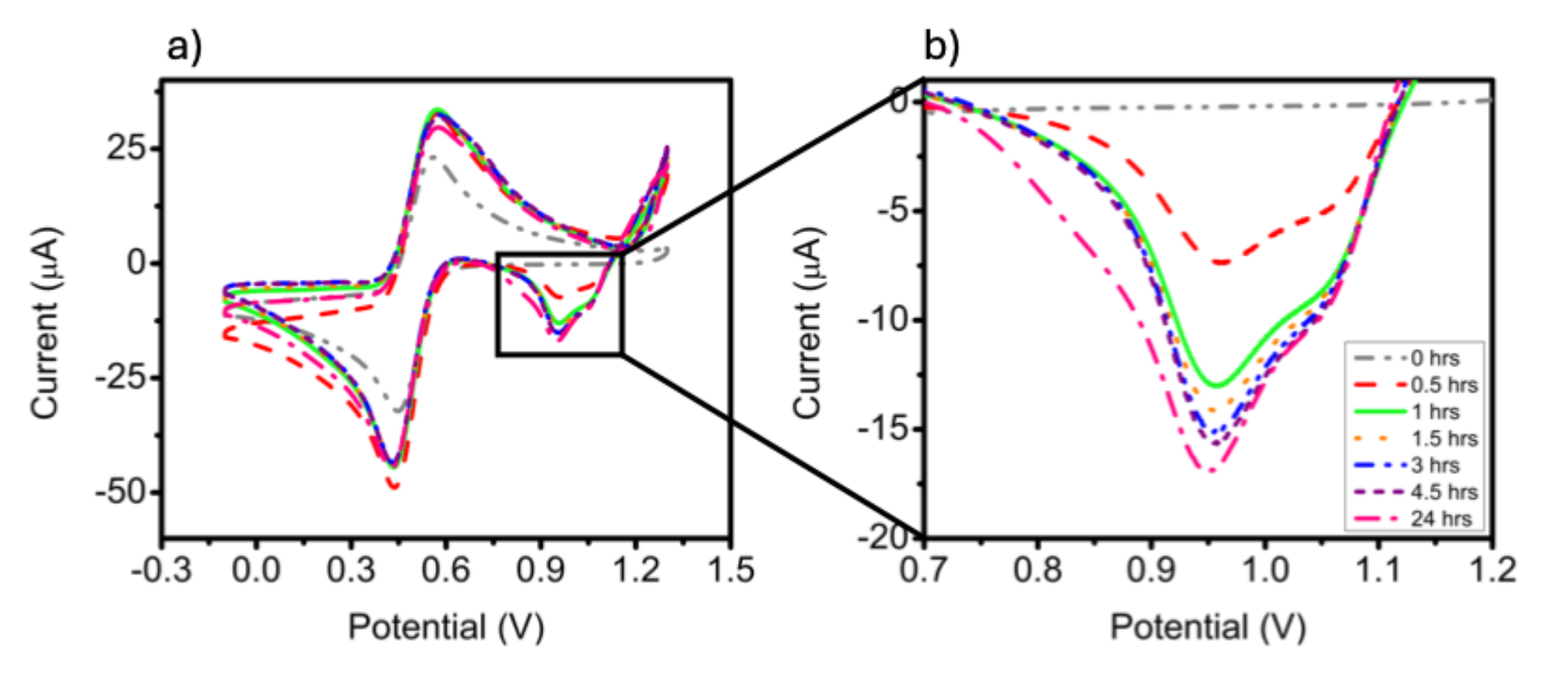
| [Fe2+] (mmol·L-1) | [MnO2] (mmol·L-1) | Current (i) after 4.5-h digestion (μA) | Current (i) after 24-h digestion (μA) |
|---|---|---|---|
| 5 | 2 | ||
| 5 | 4 | ||
| 8 | 2 | ||
| 8 | 4 | ||
| 10 | 2 | ||
| 10 | 4 | ||
| 16 | 2 | ||
| 16 | 4 |
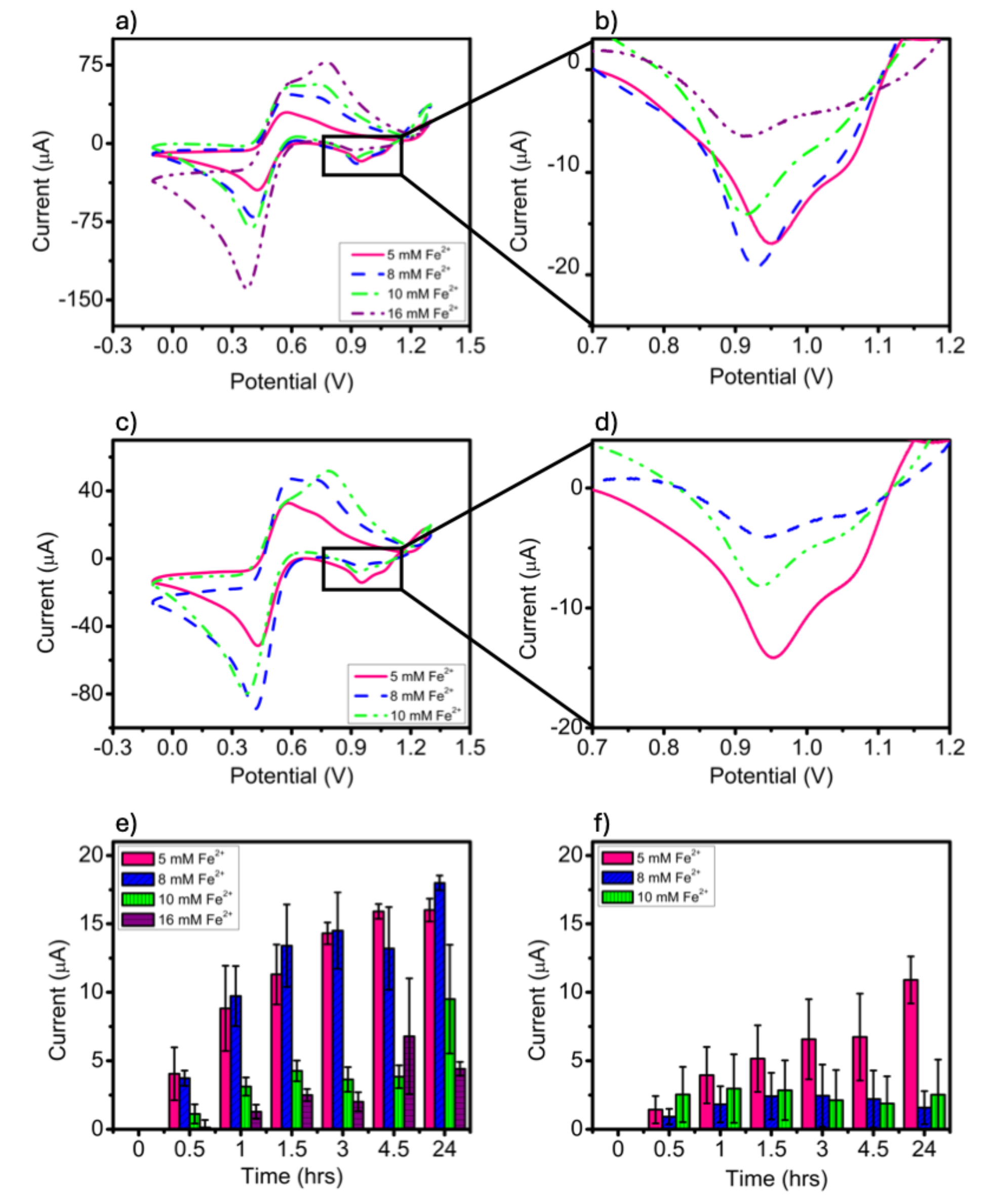
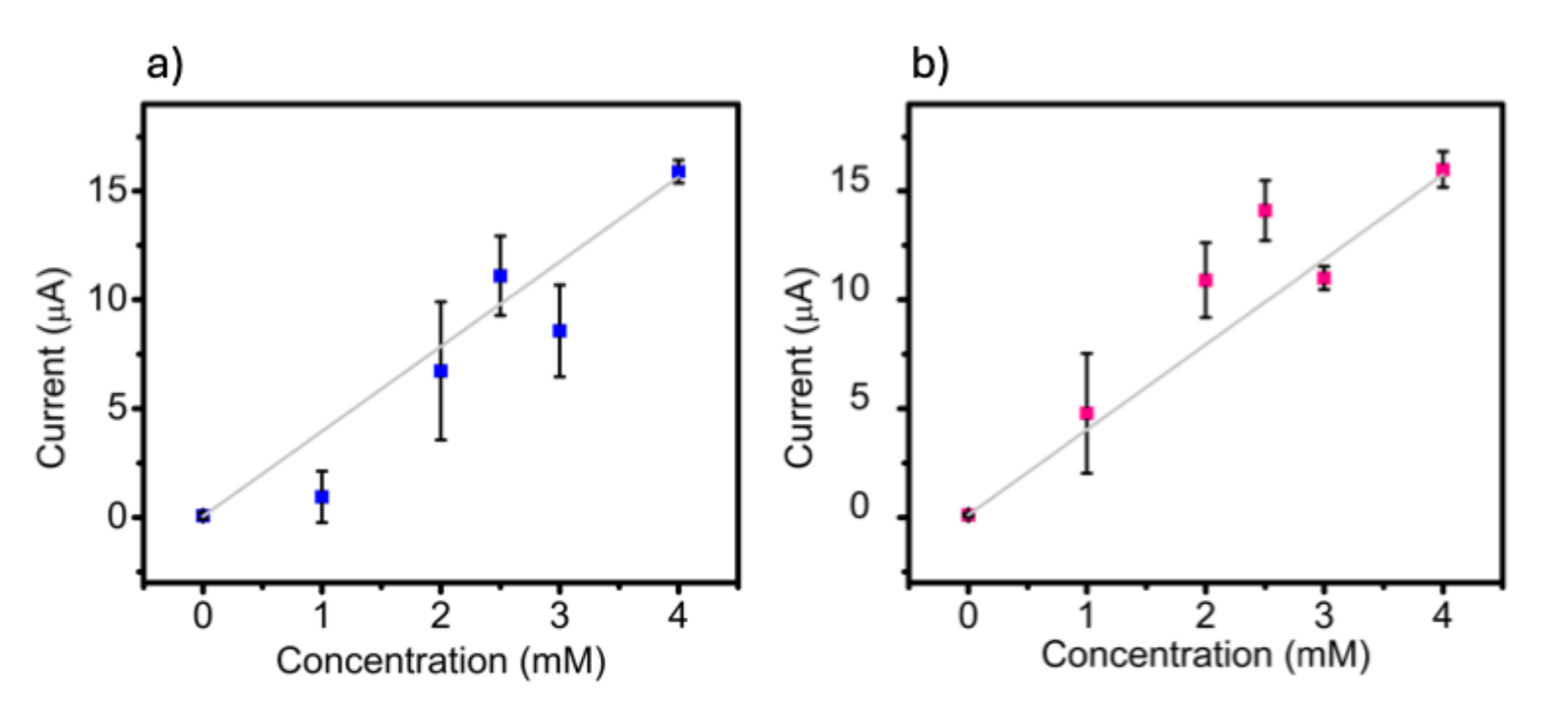
| [MnO2] (mol·L-1) | [MnO2] (mg·L-1) | Current (i) after 4.5-h digestion (μA) | Current (i) after 24-h digestion (μA) |
|---|---|---|---|
| 0 | 0 | ||
| 1 | 87 | ||
| 2 | 174 | ||
| 2.5 | 217 | ||
| 3 | 261 | ||
| 4 | 347 |
| [1] | Water and Air Quality Bureau, Healthy environments and consumer safety branch. Guidelines for canadian drinking water quality: Guideline technical document—manganese[EB/OL]. Health Canada, 2019. https://www.canada.ca/content/dam/hc-sc/documents/services/publications/healthy-living/guidelines-canadian-drinking-water-quality-guideline-technical-document-manganese/pub-manganese-0212-2019-eng.pdf. |
| [2] | Pei Y, Prepas‐Strobeck N S, Payne S J, She Z. Considerations for new manganese analytical techniques for drinking water quality management[J]. AWWA Water Sci., 2022, 4(3): e1285. https://doi.org/10.1002/aws2.1285. |
| [3] | Bouchard M F, Surette C, Cormier P, Foucher D. Low level exposure to manganese from drinking water and cognition in school-age children[J]. NeuroToxicology, 2018, 64: 110-117. https://doi.org/10.1016/j.neuro.2017.07.024. |
| [4] | Bouchard M, Laforest F, Vandelac L, Bellinger D, Mergler D. Hair manganese and hyperactive behaviors: Pilot study of school-age children exposed through tap water[J]. Environ. Health Perspect., 2007, 115(1): 122-127. https://doi.org/10.1289/ehp.9504. |
| [5] | World Health Organization. Background document for development of who guidelines for drinking water quality:Manganese in drinking water[EB/OL]. WHO, 2021. https://www.who.int/docs/default-source/wash-documents/wash-chemicals/manganese-background-document.pdf. |
| [6] | Kohl P, Medlar S. Occurence of manganese in drinking water and manganese control[EB/OL]. American Water Works Association, 2006. https://www.waterrf.org/research/projects/occurrence-manganese-drinking-water-and-manganese-control. |
| [7] | Gerke T L, Little B J, Barry Maynard J. Manganese deposition in drinking water distribution systems[J]. Sci. Total Environ., 2016, 541: 184-193. https://doi.org/10.1016/j.scitotenv.2015.09.054. |
| [8] | Zhou X Y, Kosaka K, Nakanishi T, Welfringer T, Itoh S. Manganese accumulation on pipe surface in chlorinated drinking water distribution system: Contributions of physical and chemical pathways[J]. Water Res., 2020, 184: 116201. https://doi.org/10.1016/j.watres.2020.116201. |
| [9] | Friedman M, Hill S, Reiber S, Valentine R, Larsen G, Young A, Korshin G, Peng C. Assessment of inorganics accumulation in drinking water systems scales and sediments[EB/OL]. Water Research Foundation, 2010. https://www.waterrf.org/research/projects/assessment-inorganics-accumulation-drinking-water-system-scales-and-sediments. |
| [10] | Brandhuber P, Clark S, Knocke W, Tobiason J. Guidance for the treatment of manganese[EB/OL]. Water Research Foundation, 2013. https://www.waterrf.org/research/projects/guidance-treatment-manganese. |
| [11] | Torres D, Ayala L, Saldaña M, Cánovas M, Jeldres RI, Nieto S, Castillo J, Robles P, Toro N. Leaching manganese nodules in an acid medium and room temperature comparing the use of different Fe reducing agents[J]. Metals, 2019, 9(12): 1316. https://doi.org/10.3390/met9121316. |
| [12] | Vu H, Jandová J, Lisá K, Vranka F. Leaching of manganese deep ocean nodules in FeSO4-H2SO4-H2O solutions[J]. Hydrometallurgy, 2005, 77(1-2): 147-153. https://doi.org/10.1016/j.hydromet.2004.09.012. |
| [13] | Toro N, Herrera N, Castillo J, Torres C M, Sepúlveda R. Initial investigation into the leaching of manganese from nodules at room temperature with the use of sulfuric acid and the addition of foundry slag—Part I[J]. Minerals, 2018, 8(12): 565. https://doi.org/10.3390/min8120565. |
| [14] | Toro N, Saldaña M, Castillo J, Higuera, Freddy, Acosta, Roxana. Leaching of manganese from marine nodules at room temperature with the use of sulfuric acid and the addition of tailings[J]. 2019, 9(5): 289. https://doi.org/10.3390/min9050289. |
| [15] | Martin T D. Method 200.5 Determination of trace elements in drinking water by axially viewed inductively coupled plasma-atomic emission spectrometry[EB/OL]. US Environmental Protection Agency, 2003. https://19january2017snapshot.epa.gov/sites/production/files/2015-08/documents/method_200-5_rev_4-2_2003.pdf. |
| [16] | Creed J T, Martin T D, Lobring L B, O’Dell J B. Method 200.9 Determination of Trace Elements by stabilized temperature graphite furnace atomic absorption[EB/OL]. US Environmental Protection Agency, 1994. https://www.epa.gov/sites/default/files/2015-08/documents/method_200-9_rev_2-2_1994.pdf. |
| [17] | Crapnell R D, Banks C E. Electroanalytical overview: The determination of manganese[J]. Sensors and Actuators Reports, 2022, 4, 100110. https://doi.org/10.1016/j.snr.2022.100110. |
| [18] | Boselli E, Wu Z Z, Friedman A, Claus Henn B, Papautsky I. Validation of electrochemical sensor for determination of manganese in drinking water[J]. Environ. Sci. Technol., 2021, 55(11): 7501-7509. https://doi.org/10.1021/acs.est.0c05929. |
| [19] | Kang W J, Pei X, Bange A, Haynes E N, Heineman W R, Papautsky I. Copper-based electrochemical sensor with palladium electrode for cathodic stripping voltammetry of manganese[J]. Anal. Chem., 2014, 86(24): 12070-12077. https://doi.org/10.1021/ac502882s. |
| [20] | Lamothe N, Elliott K, Pei Y, Shi Y C, Macdonald K, Payne S J, She Z. Electrochemical detection of manganese in drinking water with chronoamperometry[J]. Electrocatalysis, 2024, 15(4): 353-362. https://doi.org/10.1007/s12678-024-00878-7. |
| [21] | Pei Y, McLeod J F, Payne S J, She Z. A Comparative study of electroanalytical methods for detecting manganese in drinking water distribution systems[J]. Electrocatalysis, 2021, 12(2): 176-187. https://doi.org/10.1007/s12678-020-00639-2. |
| [22] | Ducret J, Barbeau B. A revised digestion method to characterize manganese content in solids[J]. MethodsX, 2024, 12: 102731. https://doi.org/10.1016/j.mex.2024.102731. |
| [23] | El Hazek M N, Lasheen T A, Helal A S. Reductive leaching of manganese from low grade Sinai ore in HCl using H2O2 as reductant[J]. Hydrometallurgy, 2006, 84(3-4): 187-191. https://doi.org/10.1016/j.hydromet.2006.05.006. |
| [24] | Yan W B, Qiu X L, Peng S Q, Zhang C H, Shen K Y, Peng M M, Li F. Kinetics and mechanism of manganese reductive leaching from electrolytic manganese anode slag with elemental sulfur in sulfuric acid solution[J]. Results Eng., 2023, 18: 101137. https://doi.org/10.1016/j.rineng.2023.101137. |
| [25] | Anothairungrat S, Ouajai S, Piyamongkala K. Screening test of evaluation thermal hazard for H2O2 by DSC[J]. IOP Conference Series: Earth and Environ. Sci., 2019, 219: 012017. https://doi.org/10.1088/1755-1315/219/1/012017. |
| [26] | Cieszynska-Semenowicz M, Rogowska J, Ratajczyk W, Ratajczyk J, Wolska L. Toxicity studies of elemental sulfur in marine sediments[J]. Int. J. Sediment Res., 2018, 33(2): 191-197. https://doi.org/10.1016/j.ijsrc.2017.12.004. |
| [27] | Tekin T, Bayramoǧlu M. Kinetics of the reduction of MnO2 with Fe2+ ions in acidic solutions[J]. Hydrometallurgy, 1993, 32(1): 9-20. https://doi.org/10.1016/0304-386X(93)90053-G. |
| [28] | Toro N, Rodríguez F, Rojas A, Robles P, Ghorbani Y. Leaching manganese nodules with iron-reducing agents - A critical review[J]. Miner. Eng., 2021, 163: 106748. https://doi.org/10.1016/j.mineng.2020.106748. |
| [29] | Kang J X, Feng Y L, Li H R, Du Z W, Deng X Y, Wang H J. New understanding of the reduction mechanism of pyrolusite in the acidithiobacillus ferrooxidans bio-leaching system[J]. Electrochim. Acta, 2019, 297: 443-451. https://doi.org/10.1016/j.electacta.2018.12.031. |
| [30] | Chabre Y, Pannetier J. Structural and electrochemical properties of the proton/γ-MnO2 system[J]. Prog. Solid State Chem., 1995, 23(1): 1-130. https://doi.org/10.1016/0079-6786(94)00005-2. |
| [31] | Nijjer S, Thonstad J, Haarberg G M. Oxidation of manganese(II) and reduction of manganese dioxide in sulphuric acid[J]. Electrochim. Acta, 2000, 46(2-3): 395-399. https://doi.org/10.1016/S0013-4686(00)00597-1. |
| [32] | Huang J Z, Zhang H C. Redox reactions of iron and manganese oxides in complex systems[J]. Front. Environ. Sci. Eng., 2020, 14(5): 76. https://doi.org/10.1007/s11783-020-1255-8. |
| [33] | Huang S, Zhou L X. Fe2+ oxidation rate drastically affect the formation and phase of secondary iron hydroxysulfate mineral occurred in acid mine drainage[J]. Mater. Sci. Eng. C, 2012, 32(4): 916-921. https://doi.org/10.1016/j.msec.2012.02.012. |
| [34] | Pilla A S, Duarte M M E, Mayer C E. Manganese dioxide electrodeposition in sulphate electrolytes: the influence of ferrous ions[J]. J. Electroanal. Chem., 2004, 569(1): 7-14. https://doi.org/10.1016/j.jelechem.2004.01.032. |
| [35] | Kang J X, Wang Y Y, Qiu Y F. The effect of Fe3+ ions on the electrochemical behaviour of ocean manganese nodule reduction leaching in sulphuric acid solution[J]. RSC Adv., 2022, 12(2): 1121-1129. https://doi.org/10.1039/D1RA08440B. |
| [36] | Larssen T A, Senk D, Tangstad M. Reaction rate analysis of manganese ore prereduction in CO-CO2 atmosphere[J]. Metall. Mater. Trans. B, 2021, 52(4): 2087-2100. https://doi.org/10.1007/s11663-021-02162-1. |
| [37] | Amatucci G G, Schmutz C N, Blyr A, Sigala C, Gozdz A S, Larcher D, Tarascon J M. Materials’ effects on the elevated and room temperature performance of CLiMn2O4 Li-ion batteries[J]. J. Power Sources, 1997, 69(1-2): 11-25. https://doi.org/10.1016/S0378-7753(97)02542-1. |
| [38] | Sinha M K, Purcell W, Van Der Westhuizen W A. Recovery of manganese from ferruginous manganese ore using ascorbic acid as reducing agent[J]. Miner. Eng., 2020, 154: 106406. https://doi.org/10.1016/j.mineng.2020.106406. |
| [39] | Das S C, Sahoo P K, Rao P K. Extraction of manganese from low-grade manganese ores by FeSO4 leaching[J]. Hydrometallurgy, 1982, 8(1): 35-47. https://doi.org/10.1016/0304-386x(82)90029-9. |
| [40] | Shi Y C, Pei Y, Lamothe N, Macdonald K, Payne S J, She Z. Electrochemical interference study of manganese and iron by multiplex method and the application for manganese analysis in drinking water[J]. Electrochem. Sci. Adv., 2024, 4(3): e2300011. https://doi.org/10.1002/elsa.202300011. |
| [41] | Davison W. Iron and manganese in lakes[J]. Earth-Sci. Rev., 1993, 34(2): 119-163. https://doi.org/10.1016/0012-8252(93)90029-7. |
| [42] | Berg K E, Adkins J A, Boyle S E, Henry C S. Manganese detection using stencil‐printed carbon ink electrodes on transparency film[J]. Electroanalysis, 2016, 28(4): 679-684. https://doi.org/10.1002/elan.201500474. |
| [43] | Hanf L, Henschel J, Diehl M, Winter M, Nowak S. Mn2+ or Mn3+? Investigating transition metal dissolution of manganese species in lithium ion battery electrolytes by capillary electrophoresis[J]. Electrophoresis, 2020, 41(9): 697-704. https://doi.org/10.1002/elps.201900443. |
| [44] | Chotkowski M, Rogulski Z, Czerwiński A. Spectroelectrochemical investigation of MnO2 electro-generation and electro-reduction in acidic media[J]. J. Electroanal. Chem., 2011, 651(2): 237-242. https://doi.org/10.1016/j.jelechem.2010.11.016. |
| [45] | Walczak M M, Dryer D A, Jacobson D D, Foss M G, Flynn N T. pH dependent redox couple: An illustration of the nernst equation[J]. J. Chem. Educ., 1997, 74(10): 1195. https://doi.org/10.1021/ed074p1195. |
| [46] | Shah A H, Zaid W, Shah A, Rana U A, Hussain H, Ashiq M N, Qureshi R, Badshah A, Zia M A, Kraatz H B. pH dependent electrochemical characterization, computational studies and evaluation of thermodynamic, kinetic and analytical parameters of two phenazines[J]. J. Electrochem. Soc., 2015, 162(3): H115-H123. https://doi.org/10.1149/2.0481503jes. |
| [47] | Water and Air Quality Bureau, Healthy Environments and Consumer Safety Branch. Guidelines for Canadian drinking water quality: Guideline technical document — Copper[EB/OL]. Health Canada, 2019. https://www.canada.ca/content/dam/hc-sc/documents/services/environmental-workplace-health/reports-publications/water-quality/copper/copper-2019-eng.pdf. |
| [48] | Water and Air Quality Bureau, Healthy Environments and Consumer Safety Branch. Guidelines for Canadian drinking water quality: Guideline technical document — Iron[EB/OL]. Health Canada, 2024. https://www.canada.ca/content/dam/hc-sc/documents/services/publications/healthy-living/guidelines-canadian-drinking-water-quality-guideline-technical-document-iron/guidelines-canadian-drinking-water-quality-guideline-technical-document-iron.pdf. |
| [49] | Taxén C, Letelier M V, Lagos G. Model for estimation of copper release to drinking water from copper pipes[J]. Corros. Sci., 2012, 58: 267-277. https://doi.org/10.1016/j.corsci.2012.02.005. |
| [50] | Zhang H, Liu Y K, Wang L B, Liu S S. Iron release and characteristics of corrosion scales and bacterial communities in drinking water supply pipes of different materials with varied nitrate concentrations[J]. Chemosphere, 2022, 301: 134652. https://doi.org/10.1016/j.chemosphere.2022.134652. |
| [51] | Guidelines for Canadian drinking water quality:Guideline technical document- operational parameters[EB/OL]. Health Canada, 2025. https://www.canada.ca/content/dam/hc-sc/documents/programs/guidelines-canadian-drinking-water-quality-operational-parameters/guidelines-canadian-drinking-water-quality-operational-parameters.pdf. |
| [52] | Godskesen B, Hauschild M, Rygaard M, Zambrano K, Albrechtsen H J. Life cycle assessment of central softening of very hard drinking water[J]. J. Environ. Manage., 2012, 105: 83-89. https://doi.org/10.1016/j.jenvman.2012.03.030. |
| [53] | Maree J P, Du Plessis P. Neutralization of acid mine water with calcium carbonate[J]. Water Sci. Technol., 1994, 29(9): 285-296. https://doi.org/10.2166/wst.1994.0496. |
| [54] | Zvimba J N, Mulopo J, Bologo L T, Mathye M. An evaluation of waste gypsum-based precipitated calcium carbonate for acid mine drainage neutralization[J]. Water Sci. Technol., 2012, 65(9): 1577-1582. https://doi.org/10.2166/wst.2012.049. |
| [55] | Health Canada. Guidance on natural organic matter in drinking water[EB/OL]. Health Canada, 2019. https://www.canada.ca/content/dam/hc-sc/documents/services/publications/healthy-living/guidance-natural-organic-matter-drinking-water/guidance-natural-organic-matter-drinking-water-eng.pdf. |
| [56] | Peng X X, Gai S, Cheng K, Yang F. Roles of humic substances redox activity on environmental remediation[J]. J. Hazard. Mater., 2022, 435: 129070. https://doi.org/10.1016/j.jhazmat.2022.129070. |
| [1] | 骆晨旭, 师晨光, 余志远, 黄令, 孙世刚. 富锂锰基层状正极材料的合成及其首周过充下的结构演化[J]. 电化学(中英文), 2022, 28(1): 2006131-. |
| [2] | 蔡雪凡, 孙升. 多孔电极电池的循环伏安法模拟[J]. 电化学(中英文), 2021, 27(6): 646-657. |
| [3] | 郭静如, 张雪娇, 廖帅, 陈雪明. Ti/RuO2-IrO2-SnO2-Sb2O5阳极在农村饮用水消毒中的应用[J]. 电化学(中英文), 2021, 27(5): 549-557. |
| [4] | 刘芳艳, 张倩, 李玥琨, 黄丰, 王梦晔. Co1-xS-MnS@CNTs/CNFs的制备及其氧还原电催化性能[J]. 电化学(中英文), 2021, 27(3): 301-310. |
| [5] | 邢逸飞, 李娜, 温晓芳, 韩宏彦, 崔敏, 张聪, 任聚杰, 籍雪平. 基于取代型多酸复合材料的多巴胺电化学检测[J]. 电化学(中英文), 2020, 26(6): 890-899. |
| [6] | 李明雪, 史 杭, 刘 佳, 张 檬, 周剑章, 吴德印, 田中群. 金电极上偶氮腺嘌呤的电化学行为研究[J]. 电化学(中英文), 2019, 25(6): 651-659. |
| [7] | 彭劲骥, 郑 红, 邹义松, 刘国坤, 袁东星. 基于电化学方法测定饮用水源水中的痕量铜离子[J]. 电化学(中英文), 2019, 25(6): 699-707. |
| [8] | 凌 云, 汤 儆, 刘国坤, 宗 铖. 暂态电化学表面增强拉曼光谱研究对硝基苯硫酚分子的电化学还原过程[J]. 电化学(中英文), 2019, 25(6): 731-739. |
| [9] | 杨 娟, 郎俊伟, 张 鹏, 刘 宝. 高温驱动氧化锰刻蚀制备纳米氧化锰-多孔石墨烯及其锂空气电池性能研究[J]. 电化学(中英文), 2019, 25(5): 621-630. |
| [10] | 董鹏飞, 李娜, 赵海燕, 崔敏, 张聪, 任聚杰, 藉雪平. Keggin 型磷钨酸盐修饰碳糊电极传感多巴胺的研究[J]. 电化学(中英文), 2018, 24(5): 555-562. |
| [11] | 李乐,王虹,马荣花,惠洪森,梁小平,李建新. 纳米氧化锰负载钛基电催化膜制备及处理含酚废水性能研究[J]. 电化学(中英文), 2018, 24(4): 309-318. |
| [12] | 张伶潇,赵惠慧,张丽娟,付予. Ag-TiO2-MnO2复合材料的制备与电化学性能研究[J]. 电化学(中英文), 2018, 24(3): 292-299. |
| [13] | 周田田, 邬冰, 邓超, 高颖. 锰氧化物聚苯胺复合电极材料的制备与性能[J]. 电化学(中英文), 2018, 24(2): 137-142. |
| [14] | 张鼎,朱芹,王瑛,赵成龙,刘世斌,徐守冬. 二氟草酸硼酸钠作为钠离子电池非水电解液添加剂的电化学性能[J]. 电化学(中英文), 2017, 23(4): 473-479. |
| [15] | 郑艳洁,姚宏,翁少煌,彭花萍,龚仕文,黄莉,戴强,林新华. 硫酸特布他林在聚铬黑T修饰电极上的电化学行为及其测定[J]. 电化学(中英文), 2016, 22(6): 617-623. |
| 阅读次数 | ||||||
|
全文 |
|
|||||
|
摘要 |
|
|||||