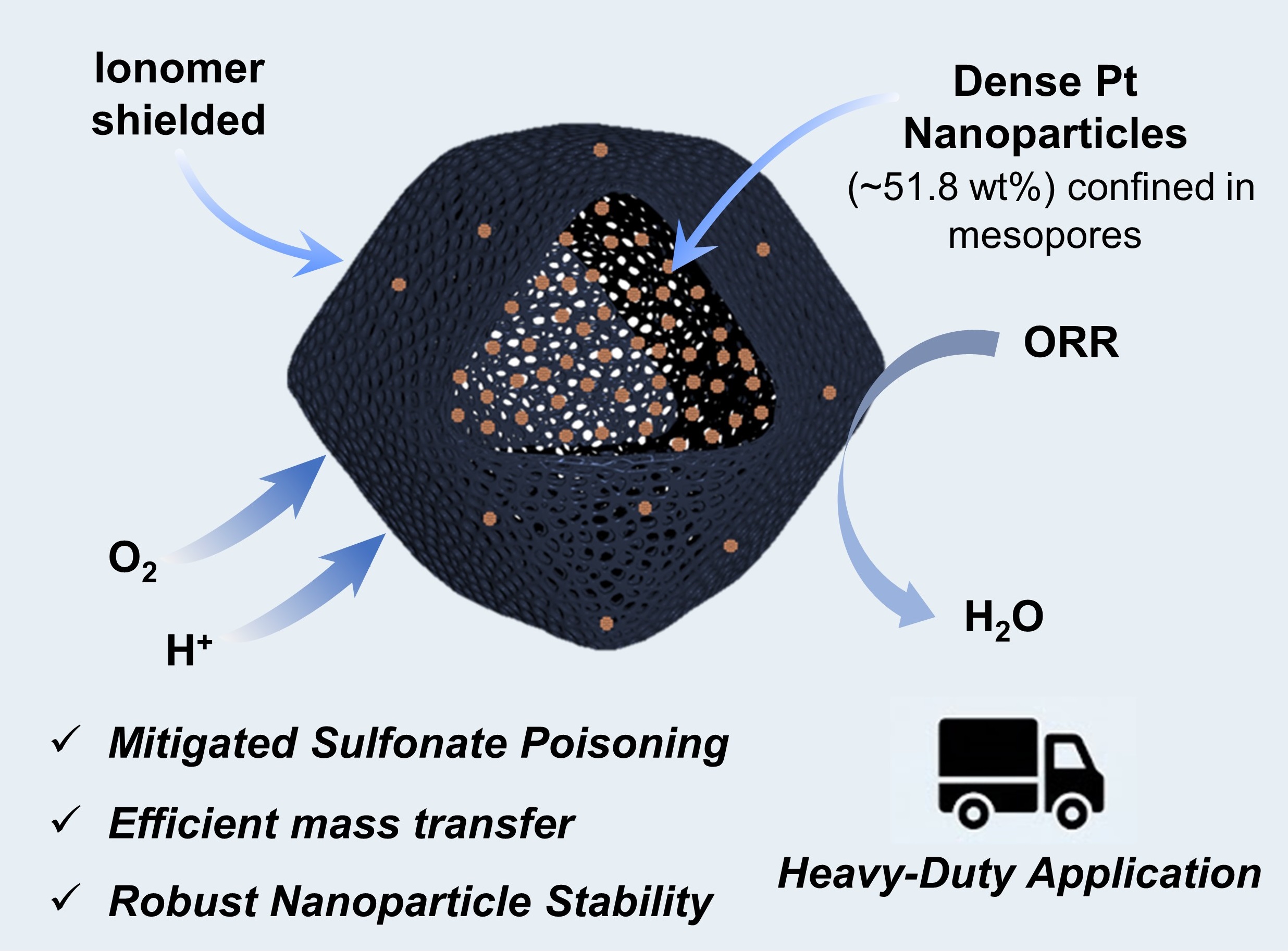
高负载铂(Pt)阴极催化层是实现重载型质子交换膜燃料电池(PEMFCs)高性能运行的关键,但其长期面临离聚物磺酸基团毒化与Pt纳米颗粒稳定性难以兼顾的矛盾。本文提出一种空间限域策略,通过将高含量Pt纳米颗粒(约51.8 wt%)封装于锰-氮-碳(Mn-N-C)纳米笼中,构筑了具有离聚物屏蔽微环境的Pt-MnNC催化剂。该介孔笼状结构可有效阻隔离聚物进入其内部,显著降低了磺酸基团对Pt活性位点的吸附毒化;同时,Mn–Nx位点与Pt之间的强金属-载体相互作用能够稳定锚定Pt纳米颗粒,抑制其迁移与团聚。在5 × 5 cm2膜电极测试中,Pt-MnNC催化剂在2.0 A·cm-2电流密度下实现1.26 W·cm-2的峰值功率密度。经过30000次加速耐久性测试后,其质量活性仅下降20.8%,显著优于商业Pt/C催化剂(衰减61.6%)。研究结果表明,空间限域构筑的离聚物屏蔽微环境能够有效缓解离聚物磺酸基团对Pt的毒化,并协同增强Pt纳米颗粒稳定性,为高功率密度、长寿命重载型PEMFC阴极催化剂的设计提供了新的思路。
赵磊, 曹振明, 左珈瑜, 杨明亮, 乔红艳, 陈俊松, 吴睿
. 锰-氮-碳纳米笼限域的高密度铂纳米颗粒用于高耐久重载质子交换膜燃料电池[J]. 电化学, 0
: 0
-0
.
DOI: 10.61558/2993-074X.3618
High-loading Pt cathodes are essential for heavy-duty proton exchange membrane fuel cells (PEMFCs) but suffer from a critical trade-off between ionomer sulfonate poisoning and nanoparticle instability. Herein, we report a spatial confinement strategy to encapsulate dense Pt nanoparticles (~51.8 wt%) within Mn/N-co-doped mesoporous carbon nanocages (denoted as Pt-MnNC). This architecture excludes bulky ionomers to create an ionomer-shielded environment against sulfonate poisoning, while Mn-Nx-mediated strong metal-support interactions anchor the Pt nanoparticles to prevent agglomeration and further boost durability. In 5×5 cm2 membrane electrode assembly (MEA) tests, the Pt-MnNC catalyst delivers an exceptional peak power density of 1.26 W·cm-2 at 2.0 A·cm-2. Notably, it exhibits superior durability with only a 20.8% mass activity loss after 30,000 cycles, significantly outperforming commercial Pt/C, which suffers a 61.6% loss. This work provides a robust pathway to decouple ionomer poisoning from catalyst loading, advancing the development of high-power, durable heavy-duty fuel cells.