磷酸电解液中铝阳极氧化过程中孔隙成核与重排动力学的控制
收稿日期: 2025-07-09
修回日期: 2025-10-14
录用日期: 2025-12-10
网络出版日期: 2025-12-10
Control of Pore Nucleation and Rearrangement Kinetics During Aluminium Anodizing in Phosphoric Acid Electrolyte
Received date: 2025-07-09
Revised date: 2025-10-14
Accepted date: 2025-12-10
Online published: 2025-12-10
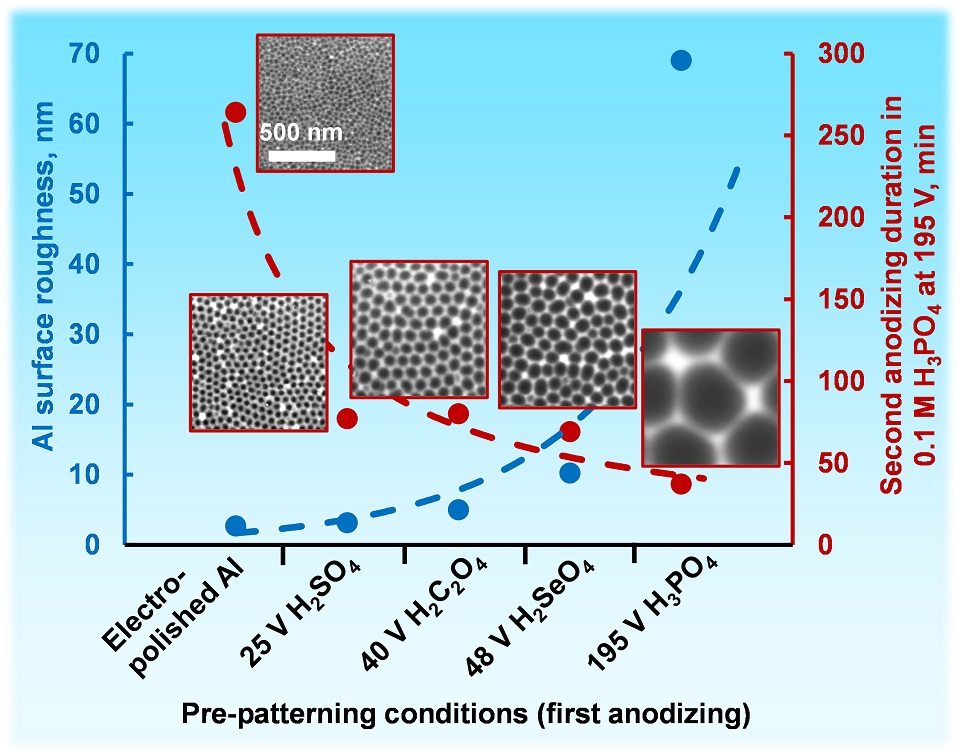
孔间距为几百纳米的阳极氧化铝多孔膜因其与可见光和近红外光的独特相互作用以及高达1500 °C的高热稳定性而备受关注。这些多孔膜是在弱酸中以高电压对铝进行阳极氧化制备的,这导致多孔结构形成的初始阶段动力学较慢。在此,我们提出了一种在基于弱酸(如磷酸)的电解质中加速阳极氧化铝形成的方法。使用铝箔作为基材,铝箔在不同条件下通过第一次阳极氧化预先形成图案,然后选择性溶解牺牲阳极氧化铝层。铝表面的形貌,包括表面粗糙度和金字塔尖峰的高度,在第二次阳极氧化过程中的孔成核和重排过程中起着至关重要的作用。具体而言,通过在低电压(如25 V)下强酸电解液(如0.3 mol·L-1硫酸)中进行首次阳极氧化,可以使在磷酸中进行第二次阳极氧化时孔隙成核和随后达到稳态的速度加倍。因此,如果在第一次阳极氧化过程中使用强酸电解液对铝表面进行预图案化,则在磷酸中的两步阳极氧化过程中可以节省约2小时。
Ilya V. Roslyakov , Nikita A. Shirin , Dmitry M. Tsymbarenko , Sergei N. Pavlov , Sergey E. Kushnir , Nikolay V. Lyskov , Kirill S. Napolskii . 磷酸电解液中铝阳极氧化过程中孔隙成核与重排动力学的控制[J]. 电化学, 2026 , 32(2) : 2507091 . DOI: 10.61558/2993-074X.3600
Anodic aluminium oxide (AAO) porous films with an interpore distance of several hundred nanometers are of great interest due to their unique interaction with visible and near-infrared light, and high thermal stability up to 1500 °C. These porous films are prepared by aluminium anodizing at high voltages in weak acids, leading to a slow kinetics of initial stages of porous structure formation. Here, we propose an approach to accelerate AAO formation in electrolytes based on weak acids such as phosphoric acid. Aluminium foils, pre-patterned using first anodizing under different conditions and subsequent selective dissolution of a sacrificial AAO layer, were utilized as substrates. The morphology of the aluminium surface, including surface roughness and height of pyramidal spikes, plays a crucial role in the pore nucleation and rearrangement process during the second anodizing. In particular, by first anodizing in strong acid electrolytes at low voltages (such as 0.3 mol·L–1 sulfuric acid at 25 V), it is possible to double the rate of pore nucleation and subsequent reach of the steady-state regime during second anodizing in phosphoric acid. As a result, about 2 hours can be saved during the two-step anodizing process in phosphoric acid if a strong acid electrolyte is used for the first anodizing to pre-pattern aluminium surface.
| [1] | Ruiz-Clavijo A, Caballero-Calero O, Martin-Gonzalez M. Revisiting anodic alumina templates: from fabrication to applications[J]. Nanoscale, 2021, 13(5): 2227-2265. https://doi.org/10.1039/D0NR07582E. |
| [2] | Domagalski J T, Xifre-Perez E, Marsal L F. Recent advances in nanoporous anodic alumina: principles, engineering, and applications[J]. Nanomaterials, 2021, 11(2): 430-447. https://doi.org/10.3390/nano11020430. |
| [3] | Roslyakov I V, Gordeeva E O, Napolskii K S. Role of electrode reaction kinetics in self-ordering of porous anodic alumina[J]. Electrochim. Acta, 2017, 241: 362-369. https://doi.org/10.1016/j.electacta.2017.04.140. |
| [4] | Gordeeva E O, Roslyakov I V, Napolskii K S. Aluminium anodizing in selenic acid: electrochemical behaviour, porous structure, and ordering regimes[J]. Electrochim. Acta, 2019, 307: 13-19. https://doi.org/10.1016/j.electacta.2019.03.098. |
| [5] | Roslyakov I V, Sotnichuk E O, Sotnichuk S V, Kushnir S E, Napolskii K S. Kinetic and crystallographic control of self-ordering of pores in anodic aluminium oxide[J]. J. Solid State Electrochem., 2025, 29: 1341-1373. https://doi.org/10.1007/s10008-024-06132-w. |
| [6] | Chen X, Yu D L, Cao L, Zhu X F, Song Y, Huang H T, Lu L F, Chen X Y. Fabrication of ordered porous anodic alumina with ultra-large interpore distances using ultrahigh voltages[J]. Mater. Res. Bull., 2014, 57: 116-124. https://doi.org/10.1016/j.materresbull.2014.05.037 |
| [7] | Norek M. Self-ordered porous anodic alumina with large pore intervals: review on experimental and theoretical research[J]. J. Electrochem. Soc., 2022, 169(12): 123503. https://doi.org/10.1149/1945-7111/aca937. |
| [8] | Akiya S, Kikuchi T, Natsui S, Sakaguchi N, Suzuki R O. Self-ordered porous alumina fabricated via phosphonic acid anodizing[J]. Electrochim. Acta, 2016, 190: 471-479. https://doi.org/10.1016/j.electacta.2015.12.162. |
| [9] | Gordeeva E O, Vitkovskii V V, Roslyakov I V, Kostyukov I A, Napolskii K S. New insights into aluminium anodizing in phosphonic acid[J]. Electrochim. Acta, 2024, 502: 144818. https://doi.org/10.1016/j.electacta.2024.144818. |
| [10] | Ono S, Saito M, Asoh H. Self-ordering of anodic porous alumina formed in organic acid electrolytes[J]. Electrochim. Acta, 2005, 51(5): 827-833. https://doi.org/10.1016/j.electacta.2005.05.058. |
| [11] | Masuda H, Yada K, Osaka A. Self-ordering of cell configuration of anodic porous alumina with large-size pores in phosphoric acid solution[J]. Jpn. J. Appl. Phys., 1998, 37(11A): L1340-L1342. https://doi.org/10.1143/JJAP.37.L1340. |
| [12] | Martín J, Manzano C V, Martín-González M. In-depth study of self-ordered porous alumina in the 140-400 nm pore diameter range[J]. Micropor. Mesopor. Mater., 2012, 151: 311-316. https://doi.org/10.1016/j.micromeso.2011.10.018. |
| [13] | Zajaczkowska L, Siemiaszko D, Norek M. Towards self-organized anodizing of aluminum in malic acid solutions-new aspects of anodizing in the organic acid[J]. Materials, 2020, 13(17): 3899-3912. https://doi.org/10.3390/ma13173899. |
| [14] | Takenaga A, Kikuchi T, Natsui S, Suzuki R O. Self-ordered aluminum anodizing in phosphonoacetic acid and its structural coloration[J]. ECS Solid State Lett., 2015, 4(8): 55-58. https://doi.org/10.1149/2.0021508ssl. |
| [15] | Kikuchi T, Nishinaga O, Natsui S, Suzuki R O. Fabrication of self-ordered porous alumina via etidronic acid anodizing and structural color generation from submicrometer-scale dimple array[J]. Electrochim. Acta, 2015, 156: 235-243. https://doi.org/10.1016/j.electacta.2014.12.171. |
| [16] | Akiya S, Kikuchi T, Natsui S, Suzuki R O. Nanostructural characterization of large-scale porous alumina fabricated via anodizing in arsenic acid solution[J]. Appl. Surf. Sci., 2017, 403: 652-661. https://doi.org/10.1016/j.apsusc.2017.01.243. |
| [17] | Ma Y J, Wen Y H, Li J, Li Y X, Zhang Z Y, Feng C C, Sun R G. Fabrication of self-ordered alumina films with large interpore distance by Janus anodizing in citric acid[J]. Sci. Rep., 2016, 6: 39165. https://doi.org/10.1038/srep39165. |
| [18] | Masuda H, Hasegwa F, Ono S. Self-ordering of cell arrangement of anodic porous alumina formed in sulfuric acid solution[J]. J. Electrochem. Soc., 1997, 1449(5): L127-L130. https://doi.org/10.1149/1.1837634. |
| [19] | Masuda H, Fukuda K. ordered metal nanohole arrays made by a two-step replication of honeycomb structures of anodic alumina[J] Science, 1995, 268(5216): 1466-1468. https://doi.org/10.1126/science.268.5216.1466. |
| [20] | Gao H L, Zhou K L, Wang C, Li S J, Zhang H, Xia X H. Protonization of amino functional groups confined in nanochannels[J] J. Electrochem., 2012, 18(3): 229-234. https://doi.org/10.61558/2993-074X.2908. |
| [21] | Zhang Y, Wang H J, Wang J, Li L L, Sun H J, Wang C. Asymmetric nanoporous alumina membranes for nanofluidic osmotic energy conversion[J] Chem. Asian J., 2023, 18(23): e202300876. https://doi.org/10.1002/asia.202300876. |
| [22] | Roslyakov I V, Petukhov D I, Napolskii K S. Permeability of anodic alumina membranes grown on low-index aluminium surfaces[J] Nanotechnology, 2021, 32(33): 33LT01. https://doi.org/10.1088/1361-6528/abfeea. |
| [23] | Inada T, Uno N, Kato T, Iwamoto Y. Meso-porous alumina capillary tube as a support for high-temperature gas separation membranes by novel pulse sequential anodic oxidation technique[J] J. Mater. Res., 2005, 20(1): 114-120. https://doi.org/10.1557/JMR.2005.0016. |
| [24] | Yuan J H, Wang F B, Xia X H. Influence of Pt:Ru ratio in nanotubes array structures on the electrocatalytic activity of methanol oxidation[J] J. Electrochem., 2014, 20(5): 416-425. https://doi.org/10.13208/j.electrochem.131174. |
| [25] | Yuan L J, Zhao Z C, Wang W Q, Wang Y F, Liu Y J. Review of catalysts, substrates, and fabrication methods in catalytic hydrogen combustion with further challenges and applications[J] Energy Fuels, 2024, 38(6): 4881-4903. https://doi.org/10.1021/acs.energyfuels.3c04923. |
| [26] | Kolmychek I A, Malysheva I V, Novikov V B, Maydykovskiy A I, Leontiev A P, Napolskii K S, Murzina T V. Optical properties of hyperbolic metamaterials (brief review)[J] JETP Lett., 2021, 114(11): 653-664. https://doi.org/10.1134/S0021364021230089. |
| [27] | Gunenthiran S, Wang J, Law C S, Abell A D, Alwahabi Z T, Santos A. Nanoporous anodic alumina photonic crystals for solid-state lasing systems: state-of-the-art and perspectives[J] J. Mater. Chem. C., 2025, 13(3): 985-1012. https://doi.org/10.1039/D4TC04166F. |
| [28] | Abd-Elnaiem A M, Mohamed Z E A, Elshahat S, Almokhtar M, Norek M. Recent progress in the fabrication of photonic crystals based on porous anodic materials[J] Energies, 2023, 16(10): 4032. https://doi.org/10.3390/en16104032. |
| [29] | Li S G, Xuan X, Liu S Q. Recent progresses of enzymes assembled in nanochannels for catalytic reaction[J] J. Electrochem., 2019, 25(3): 302-311. https://doi.org/10.13208/j.electrochem.181057. |
| [30] | Li Z Q, Wu Z Q, Xia X H. Recent advances in nanofluidic electrochemistry for biochemical analysis[J] J. Electrochem., 2019, 25(3): 291-301. https://doi.org/10.13208/j.electrochem.181059. |
| [31] | Tran K N, Tran H N Q, Abell A D, Law C S, Santos A. Nanoporous anodic alumina-based gas sensors: insights into advances and perspectives[J]. Microchim. Acta., 2025, 192(7): 441. https://doi.org/10.1007/s00604-025-07234-6. |
| [32] | Masuda T, Asoh H, Haraguchi S, Ono S. Fabrication and characterization of single phase α-alumina membranes with tunable pore diameters[J]. Materials, 2015, 8(3): 1350-1368. https://doi.org/10.3390/ma8031350. |
| [33] | Shirin N A, Roslyakov I V, Berekchiian M V, Shatalova T B, Lukashin A V, Napolskii K S. Thermal modification of porous oxide films obtained by anodizing of aluminum-magnesium alloy[J]. Russ. J. Inorg. Chem., 2022, 67: 926-933. https://doi.org/10.1134/S0036023622060262. |
| [34] | Shirin N A, Roslyakov I V, Kushnir S E, Napolskii K S. One-dimensional photonic crystals based on porous anodic alumina: optical and morphology changes under thermal and chemical treatments[J]. Opt. Mater., 2024, 152: 115518. https://doi.org/10.1016/j.optmat.2024.115518. |
| [35] | Khatko V, Gorokh G, Mozalev A, Solovei D, Llobet E, Vilanova X, Correig X. Tungsten trioxide sensing layers on highly ordered nanoporous alumina template[J]. Sens. Actuators B: Chem., 2006, 118(1-2): 255-263. https://doi.org/10.1016/j.snb.2006.04.030. |
| [36] | Kalinin I A, Roslyakov I V, Tsymbarenko D M, Bograchev D A, Krivetskiy V V, Napolskii K S. Microhotplates based on Pt and Pt-Rh films: the impact of composition, structure, and thermal treatment on functional properties[J]. Sens. Actuators A: Phys., 2021, 317: 112457. https://doi.org/10.1016/j.sna.2020.112457. |
| [37] | Tang W Y, Chen Z S, Song Z L, Wang C, Wan Z A, Chan C L J, Chen Z, Ye W H, Fan Z. Microheater integrated nanotube array gas sensor for parts-per-trillion level gas detection and single sensor-based gas discrimination[J]. ACS Nano, 2022, 16(7): 10968-10978. https://doi.org/10.1021/acsnano.2c03372 |
| [38] | Park Y I, Su P C, Cha S W, Saito Y, Prinz F B. Thin-film SOFCs using gastight YSZ thin films on nanoporous substrates[J]. J. Electrochem. Soc., 2006, 153(2): A431-A436. https://doi.org/10.1149/1.2147318. |
| [39] | Lee Y H, Ren H, Wu E A, Fullerton E A, Meng Y S, Minh N Q. All-sputtered, superior power density thin-film solid oxide fuel cells with a novel nanofibrous ceramic cathode[J]. Nano Lett., 2020, 20(5): 2943-2949. https://doi.org/10.1021/acs.nanolett.9b02344. |
| [40] | Ryu S, Choi I W, Kim Y J, Lee S, Jeong W, Yu W, Cho G Y, Cha S W. Nanocrystal engineering of thin-film yttria-stabilized zirconia electrolytes for low-temperature solid-oxide fuel cells[J]. ACS Appl. Mater. Interfaces, 2023, 15(36): 42659-42666. https://doi.org/10.1021/acsami.3c09025. |
| [41] | Pligovka A, Poznyak A, Norek M. Optical properties of porous alumina assisted niobia nanostructured films — designing 2-D photonic crystals based on hexagonally arranged nanocolumns[J]. Micromachines, 2021, 12(6): 589. https://doi.org/10.3390/mi12060589. |
| [42] | Roslyakov I V, Kushnir S E, Novikov V B, Dotsenko A A, Tsymbarenko D M, Sapoletova N A, Murzina T V, Stolyarov V S, Napolskii K S. Three-dimensional photonic crystals based on porous anodic aluminum oxide[J]. J. Phys. Chem. Lett., 2024, 15(16): 4319-4326. https://doi.org/10.1021/acs.jpclett.4c00537. |
| [43] | Sun M X, Huang H J, Jiang M L, Cheng L, Dong L. Influence of oxalic additive on etidronic acid anodizing of aluminum alloy[J]. J. Electroanal. Chem., 2023, 944: 117641. https://doi.org/10.1016/j.jelechem.2023.117641. |
| [44] | Asoh H, Ota S, Hagiwara K. Communication—anodization of aluminum in phosphoric acid containing glycerol at 30 °C[J]. J. Electrochem. Soc., 2024, 171(3): 033502. https://doi.org/10.1149/1945-7111/ad318f. |
| [45] | Zaraska L, Szuwarzyński M, ?wierkula A, Brzózka A. Effect of Al polishing conditions on the growth and morphology of porous anodic alumina films[J]. ACS Omega, 2023, 8(38): 34564-34574. https://doi.org/10.1021/acsomega.3c03412. |
| [46] | Magnard N P L, Abbondanza G, Junkers L S, Glatthaar L, Grespi A, Spriewald Luciano A, Igoa Salda?a F, Dippel A C, Vinogradov N, Over H, Jensen K M ?, Lundgren E. In situ grazing incidence X-ray total scattering reveals the effect of the “two-step” method for the anodization of aluminum surfaces[J]. ACS Appl. Mater. Interfaces, 2025, 17(33): 46887-46898. https://doi.org/10.1021/acsami.5c05251. |
| [47] | Roslyakov I V, Kushnir S E, Tsymbarenko D M, Sapoletova N A, Trusov L A, Napolskii K S. New insight into anodizing aluminium with focused-ion-beam pre-patterning[J]. Nanotechnology, 2022, 33(49): 495301. https://doi.org/10.1088/1361-6528/ac8e75. |
| [48] | Schneider C A, Rasband W S, Eliceiri K W. NIH Image to ImageJ: 25 years of image analysis[J]. Nature Meth., 2012, 9(7): 671-675. https://doi.org/10.1038/nmeth.2089. |
| [49] | Software for analysis of pore ordering in anodic alumina[CP/OL]. http://www.eng.fnm.msu.ru/en/software/.. |
| [50] | Parkhutik V P. Theoretical modelling of porous oxide growth on aluminium[J]. J. Phys. D: Appl. Phys., 1992, 25(8): 1258-1263. https://doi.org/10.1088/0022-3727/25/8/017. |
| [51] | Thompson G E, Furneaux R C, Wood G C, Richardson J A, Goode J S. Nucleation and growth of porous anodic films on aluminum[J]. Nature, 1978, 272: 433-435. https://doi.org/10.1038/272433a0. |
| [52] | Hebert K R, Albu S P, Paramasivam I, Schmuki P. Morphological instability leading to formation of porous anodic oxide films[J]. Nature Mater., 2012, 11(2): 162-166. https://doi.org/10.1038/nmat3185. |
| [53] | Kim M, Kim H, Bae C, Lee J, Yoo H, Moreno J M M, Shin H. Initial self-ordering of porous anodic alumina: transition from polydispersity to monodispersity[J]. J. Phys. Chem. C, 2014, 118(46): 26789-26795. https://doi.org/10.1021/jp507576c. |
| [54] | Lide D R. CRC handbook of chemistry and physics (84th ed.)[M]. BocaRaton, USA: CRC Press LLC, 2003. |
| [55] | Masuda H, Satoh M. Fabrication of gold nanodot array using anodic porous alumina as an evaporation mask[J]. Jpn. J. Appl. Phys., 1996, 35(18): L126-L129. https://doi.org/10.1143/JJAP.35.L126. |
| [56] | Nishinaga O, Kikuchi T, Natsui S, Suzuki R O. Rapid fabrication of self-ordered porous alumina with 10-/sub-10-nm-scale nanostructures by selenic acid anodizing[J]. Sci. Rep., 2013, 3: 2748. https://doi.org/10.1038/srep02748. |
| [57] | Pendyala P, Bobji M S, Madras G. Evolution of surface roughness during electropolishing[J]. Tribology Lett., 2014, 55(2): 93-101. https://doi.org/10.1007/s11249-014-0336-x. |
| [58] | Iwai M, Kikuchi T. A novel polishing process for ultra-smooth aluminum surfaces via anodizing in sodium metaborate[J]. J. Electrochem. Soc., 2023, 170(7): 073506. https://doi.org/10.1149/1945-7111/ace65a. |
| [59] | Mirzoev R A, Davydov A D, Vystupov S I, Kabanova T B. Mathematical model of current-voltage characteristic of steady-state aluminum anodization[J]. Electrochim. Acta, 2021, 371: 137823. https://doi.org/10.1016/j.electacta.2021.137823. |
| [60] | O’Sullivan J P, Wood G C. The morphology and mechanism of formation of porous anodic films on aluminium[J]. Proc. R. Soc. Lond. A, 1970, 317(1531): 511-543. https://doi.org/10.1098/rspa.1970.0129. |
| [61] | Wankhede S, Pillai D S. A hybrid model for electrokinetic and stress-induced flow mechanisms in porous anodic oxide formation[J]. J. Electrochem. Soc., 2025, 172(8): 083501. https://doi.org/10.1149/1945-7111/adf670. |
| [62] | Zhai P Q, Li P Z, Li B W, Liu L, Li C Y, Qin L Y, Ma J J, Zhu X F. Factors affecting pore length during anodizing of aluminum in phosphoric acid electrolytes[J]. Int. J. Electrochem. Sci., 2025, 20(7): 101048. https://doi.org/10.1016/j.ijoes.2025.101048. |
/
| 〈 |
|
〉 |