全钒液流电池用电极材料的研究进展
收稿日期: 2025-07-08
修回日期: 2025-09-25
录用日期: 2025-10-13
网络出版日期: 2025-10-13
Current Research Progress on Electrode Materials for All-Vanadium Redox Flow Batteries
Received date: 2025-07-08
Revised date: 2025-09-25
Accepted date: 2025-10-13
Online published: 2025-10-13
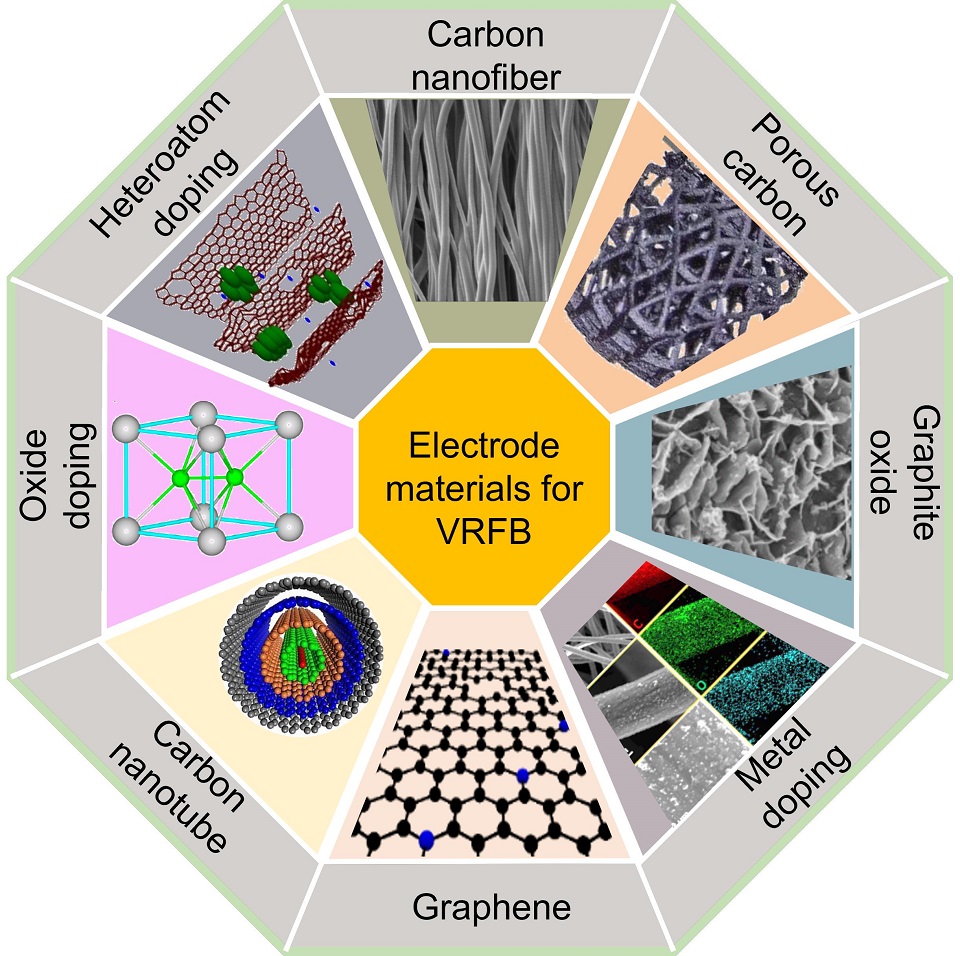
全钒液流电池的活性物质存在于电解质中,电极不参与反应,但电极是VO2+/VO2+ 和V2+/V3+活性物质吸附,进行电子传递与离子转换的有效场所。促进VO2+/VO2+和V2+/V3+反应的缓慢电荷转移特性是目前全钒液流电池电极材料研究工作的瓶颈,这主要是由于电极催化性能差以及催化剂与电极的附着力弱造成的。针对课题研究进展及以上关键科学问题,本文对当前全钒液流电池用电极材料的设计与制备方法进行了综述。首先,综述了全钒液流电池的发展历史、工作原理、应用现状以及具有的优缺点;其次,就全钒液流电池在国内外的研究现状,以及发展至今存在的问题进行了归纳分析;再次总结了全钒液流电池电极材料的分类,详述了各类电极的优缺点;最后,梳理了碳基电极材料的制备及在全钒液流电池中的应用,为未来构筑高效双功能催化剂提供借鉴和实现高效、稳定的全钒液流电池提供方法和基础。
王文琪 , 金杰 , 汪丽敏 , 刘馨月 , 程涛 , 厚镛 , 薛涵 , 王志宇 , 刘博 , 刘佳保 , 路旭斌 . 全钒液流电池用电极材料的研究进展[J]. 电化学, 2026 , 32(2) : 2507081 . DOI: 10.61558/2993-074X.3589
The redox active species in all-vanadium redox flow batteries (VRFBs) reside in the electrolyte, while the heterogeneous reactions occur on the electrode surface; the electrode is therefore the decisive platform for dynamic adsorption, electron transfer, and ion conversion, especially for the VO2+/VO2+ and V2+/V3+ couples. One of the major challenges for VRFBs is the slow charge transfer in VO2+/VO2+ and V2+/V3+ reactions, mainly caused by poor catalytic performance of electrodes and weak adhesion of catalysts to electrodes. This review focuses on the key challenges and recent advancements in VRFBs. It begins with an overview of VRFBs, including their history, working principles, applications, and the advantages and limitations associated with their use. One persistent, under-addressed trade-off is that strategies that boost apparent activity (e.g., high defect density or surface area) can degrade adhesion and cycling durability under flow shear; activity should therefore be co-reported with adhesion and durability descriptors. Addressing this trade-off is critical to improving overall efficiency and stability in VRFBs systems. A comprehensive discussion of various electrode materials is presented, categorized by their properties and preparation methods. Special emphasis is placed on the synthesis and application of carbon-based electrode materials, highlighting their potential in addressing these challenges. Finally, we map materials-level gains to stack- and system-level metrics, and outline strategies, with a focus on bifunctional and in-situ grown catalysts, for achieving high-efficiency, high-stability VRFBs.
| [1] | Chinese Society of Electrochemistry. The top ten scientific questions in electrochemistry[J]. J. Electrochem., 2024, 30(1): 2024121. https://doi.org/10.61558/2993-074X.3444. |
| [2] | Han M S, Zheng K X, Hu H Y, Liu J, Zou Z Y, Yu F H, Mu Y B, Li W J, Wei L, Zeng L, Zhao T S. Long-duration energy-storage technologies: A stabilizer for new power systems[J]. Innovation Energy, 2025, 2: 100077. https://doi.org/10.59717/j.xinn-energy.2025.100077. |
| [3] | Pérez-Díaz J I, Chazarra M, García-González J, Cavazzini G, Stoppato A. Trends and challenges in the operation of pumped-storage hydropower plants[J]. Renew. Sustain. Energy Rev., 2015, 44: 767-784. https://doi.org/10.1016/j.rser.2015.01.029. |
| [4] | Cavallo A. Controllable and affordable utility-scale electricity from intermittent wind resources and compressed air energy storage (CAES)[J]. Energy, 2007, 32(2): 120-127. https://doi.org/10.1016/j.energy.2006.03.018. |
| [5] | Krishan O, Suhag S. An updated review of energy storage systems: Classification and applications in distributed generation power systems incorporating renewable energy resources[J]. Int. J. Energy Res., 2019, 43(12): 6171-6210. https://doi.org/10.1002/er.4285. |
| [6] | Wang W, Luo Q T, Li B, Wei X L, Li L Y, Yang Z G. Recent progress in redox flow battery research and development[J]. Adv. Funct. Mater., 2013, 23(8): 970-986. https://doi.org/10.1002/adfm.201200694. |
| [7] | Pugach M, Parsegov S, Gryazina E, Bischi A. Output feedback control of electrolyte flow rate for vanadium redox flow batteries[J]. J. Power Sources, 2020, 455: 227916. https://doi.org/10.1016/j.jpowsour.2020.227916. |
| [8] | Zhang K Y, Xiong J, Yan C W, Tang A. In-situ measurement of electrode kinetics in porous electrode for vanadium flow batteries using symmetrical cell design[J]. Appl. Energy, 2020, 272: 115093. https://doi.org/10.1016/j.apenergy.2020.115093. |
| [9] | Song Y X, Li X R, Yan C W, Tang A. Unraveling the viscosity impact on volumetric transfer in redox flow batteries[J]. J. Power Sources, 2020, 456: 228004. https://doi.org/10.1016/j.jpowsour.2020.228004. |
| [10] | Liu B J, Liu S Q, He Z, Zhao K M, Li J C, Wei X L, Huang R J, Yang Y L. Improving the performance of negative electrode for vanadium redox flow battery by decorating bismuth hydrogen edetate complex on carbon felt[J]. Ionics, 2019, 25: 4231-4241. https://doi.org/10.1007/s11581-019-02988-5. |
| [11] | Skyllas-Kazacos M, Kazacos M. State of charge monitoring methods for vanadium redox flow battery control[J]. J. Power Sources, 2011, 196(20): 8822-8827. https://doi.org/10.1016/j.jpowsour.2011.06.080. |
| [12] | Corcuera S, Skyllas-Kazacos M. State-of-charge monitoring and electrolyte rebalancing methods for the vanadium redox flow battery[J]. Eur. Chem. Bull, 2012, 1(12): 511-519. https://doi.org/10.17628/ecb.2012.1.511-519. |
| [13] | Lourenssen K, Williams J, Ahmadpour F, Clemmer R, Tasnim S. Vanadium redox flow batteries: A comprehensive review[J]. J. Energy Storage, 2019, 25: 100844. https://doi.org/10.1016/j.est.2019.100844. |
| [14] | Yuan X Z, Song C J, Platt A, Zhao N N, Wang H J, Li H, Fatih K, Jang D. A review of all‐vanadium redox flow battery durability: Degradation mechanisms and mitigation strategies[J]. Int. J. Energy Res., 2019, 43(13): 6599-6638. https://doi.org/10.1002/er.4607. |
| [15] | Yang X B, Zhao L, Goh K, Sui X L, Meng L H, Wang Z B. A highly proton-/vanadium-selective perfluorosulfonic acid membrane for vanadium redox flow batteries[J]. New J. Chem., 2019, 43(28): 11374-11381. https://doi.org/10.1039/C9NJ01453E. |
| [16] | Liu Q B, Li X R, Yan C W, Tang A. A dopamine-based high redox potential catholyte for aqueous organic redox flow battery[J]. J. Power Sources, 2020, 460: 228124. https://doi.org/10.1016/j.jpowsour.2020.228124. |
| [17] | Wang W, Kim S, Chen B W, Nie Z M, Zhang J J, Xia G G, Li L Y, Yang Z G. A new redox flow battery using Fe/V redox couples in chloride supporting electrolyte[J]. Energy Environ. Sci., 2011, 4(10): 4068-4073. https://doi.org/10.1039/C0EE00765J. |
| [18] | Zhang H, Tan Y, Luo X D, Sun C Y, Chen N. Polarization effects of a rayon and polyacrylonitrile based graphite felt for iron-chromium redox flow batteries[J]. ChemElectroChem, 2019, 6(12): 3175-3188. https://doi.org/10.1002/celc.201900518. |
| [19] | Singh P, Jonshagen B. Zinc-bromine battery for energy storage[J]. J. Power Sources, 1991, 35(4): 405-410. https://doi.org/10.1016/0378-7753(91)80059-7. |
| [20] | Sum E, Rychcik M, Skyllas-Kazacos M. Investigation of the V (V)/V (IV) system for use in the positive half-cell of a redox battery[J]. J. Power Sources, 1985, 16(2): 293-302. https://doi.org/10.1016/0378-7753(85)80082-3. |
| [21] | Sum E, Skyllas-Kazacos M. A study of the V (II)/V (III) redox couple for redox flow cell applications[J]. J. Power Sources, 1985, 15(2-3): 179-190. https://doi.org/10.1016/0378-7753(85)80071-9. |
| [22] | Skyllas-Kazacos M, Rychcik M, Robins RG, Fane A, Green M. New all-vanadium redox flow cell[J]. J. Electrochem. Soc., 1986, 133(5): 1057. https://doi.org/10.1149/1.2108706. |
| [23] | Skyllas‐Kazacos M, Grossmith F. Efficient vanadium redox flow cell[J]. J. Electrochem. Soc., 1987, 134(12): 2950. https://doi.org/10.1149/1.2100321. |
| [24] | Skyllas-Kazacos M, Chakrabarti M, Hajimolana S, Mjalli F, Saleem M. Progress in flow battery research and development[J]. J. Electrochem. Soc., 2011, 158(8): R55. https://doi.org/10.1149/1.3599565. |
| [25] | Schwenzer B, Zhang J L, Kim S, Li L Y, Liu J, Yang Z G. Membrane development for vanadium redox flow batteries[J]. ChemSusChem, 2011, 4(10): 1388-1406. https://doi.org/10.1002/cssc.201100068. |
| [26] | Parasuraman A, Lim TM, Menictas C, Skyllas-Kazacos M. Review of material research and development for vanadium redox flow battery applications[J]. Electrochim. Acta, 2013, 101: 27-40. https://doi.org/10.1016/j.electacta.2012.09.067. |
| [27] | Zhong S, Padeste C, Kazacos M, Skyllas-Kazacos M. Comparison of the physical, chemical and electrochemical properties of rayon-and polyacrylonitrile-based graphite felt electrodes[J]. J. Power Sources, 1993, 45(1): 29-41. https://doi.org/10.1016/0378-7753(93)80006-B. |
| [28] | Zhang M Q, Moore M, Watson J, Zawodzinski TA, Counce RM. Capital cost sensitivity analysis of an all-vanadium redox-flow battery[J]. J. Electrochem. Soc., 2012, 159(8): A1183. https://doi.org/10.1149/2.041208jes. |
| [29] | Watt-Smith M J, Ridley P, Wills R, Shah A A, Walsh F. The importance of key operational variables and electrolyte monitoring to the performance of an all vanadium redox flow battery[J]. J. Chem. Technol. Biotechnol., 2013, 88(1): 126-138. https://doi.org/10.1002/jctb.3870. |
| [30] | Puleston T, Clemente A, Costa-Castelló R, Serra M. Modelling and estimation of vanadium redox flow batteries: A review[J]. Batteries, 2022, 8(9): 121. https://doi.org/10.3390/batteries8090121. |
| [31] | Sun B T, Skyllas-Kazacos M. Chemical modification of graphite electrode materials for vanadium redox flow battery application—part II. Acid treatments[J]. Electrochim. Acta, 1992, 37(13): 2459-2465. https://doi.org/10.1016/0013-4686(92)87084-D. |
| [32] | Deng Q, Huang P, Zhou W X, Ma Q, Zhou N, Xie H, Ling W, Zhou C J, Yin Y X, Wu X W. A high‐performance composite electrode for vanadium redox flow batteries[J]. Adv. Energy Mater., 2017, 7(18): 1700461. https://doi.org/10.1002/aenm.201700461. |
| [33] | Choi C, Noh H, Kim S, Kim R, Lee J, Heo J, Kim H T. Understanding the redox reaction mechanism of vanadium electrolytes in all-vanadium redox flow batteries[J]. J. Energy Storage, 2019, 21: 321-327. https://doi.org/10.1016/j.est.2018.11.002. |
| [34] | Radinger H, Pfisterer J, Scheiba F, Ehrenberg H. Influence and electrochemical stability of oxygen groups and edge sites in vanadium redox reactions[J]. ChemElectroChem, 2020, 7(23): 4745-4754. https://doi.org/10.1002/celc.202001387. |
| [35] | Yuan R L, Dong Y, Zhang S, Chen X H, Song H H. Efficient utilization of the active sites in defective graphene blocks through functionalization synergy for compact capacitive energy storage[J]. ACS Appl. Mater. Interfaces, 2021, 13(48): 57092-57099. https://doi.org/10.1021/acsami.1c15147. |
| [36] | Taylor S M, Pa?tru A, Perego D, Fabbri E, Schmidt T J. Influence of carbon material properties on activity and stability of the negative electrode in vanadium redox flow batteries: a model electrode study[J]. ACS Appl. Energy Mater., 2018, 1(3): 1166-1174. https://doi.org/10.1021/acsaem.7b00273. |
| [37] | Zhang G H, Cuharuc AS, Güell A G, Unwin P R. Electrochemistry at highly oriented pyrolytic graphite (HOPG): lower limit for the kinetics of outer-sphere redox processes and general implications for electron transfer models[J]. Phys. Chem. Chem. Phys., 2015, 17(17): 11827-11838. https://doi.org/10.1039/C5CP00383K. |
| [38] | Pour N, Kwabi DG, Carney T, Darling RM, Perry ML, Shao-Horn Y. Influence of edge-and basal-plane sites on the vanadium redox kinetics for flow batteries[J]. J. Phys. Chem. C, 2015, 119(10): 5311-5318. https://doi.org/10.1021/jp5116806. |
| [39] | Choi GB, Hong S, Wee J-H, Kim D-W, Seo TH, Nomura K, Nishihara H, Kim YA. Quantifying carbon edge sites on depressing hydrogen evolution reaction activity[J]. Nano Lett., 2020, 20(8): 5885-5892. https://doi.org/10.1021/acs.nanolett.0c01842. |
| [40] | Ding C, Shen Z F, Zhu Y, Cheng Y H. Insights into the modification of carbonous felt as an electrode for vanadium redox flow batteries[J]. Materials, 2023, 16(10): 3811. https://doi.org/10.3390/ma16103811. |
| [41] | Rahman F, Skyllas-Kazacos M. Vanadium redox battery: Positive half-cell electrolyte studies[J]. J. Power Sources, 2009, 189(2): 1212-1219. https://doi.org/10.1016/j.jpowsour.2008.12.113. |
| [42] | Zhang J L, Li L Y, Nie Z M, Chen B W, Vijayakumar M, Kim S, Wang W, Schwenzer B, Liu J, Yang Z G. Effects of additives on the stability of electrolytes for all-vanadium redox flow batteries[J]. J. Appl. Electrochem., 2011, 41: 1215-1221. https://doi.org/10.1007/s10800-011-0312-1. |
| [43] | Choi C, Kim S, Kim R, Choi Y, Kim S, Jung H-y, Yang J H, Kim H T. A review of vanadium electrolytes for vanadium redox flow batteries[J]. Renewable Sustainable Energy Rev., 2017, 69: 263-274. https://doi.org/10.1016/j.rser.2016.11.188. |
| [44] | Cunha á, Brito F, Martins J, Rodrigues N, Monteiro V, Afonso J L, Ferreira P. Assessment of the use of vanadium redox flow batteries for energy storage and fast charging of electric vehicles in gas stations[J]. Energy, 2016, 115: 1478-1494. https://doi.org/10.1016/j.energy.2016.02.118. |
| [45] | Maghsoudy S, Rahimi M, Dehkordi A M. Investigation on various types of ion-exchange membranes in vanadium redox flow batteries: Experiment and modeling[J]. J. Energy Storage, 2022, 54: 105347. https://doi.org/10.1016/j.est.2022.105347. |
| [46] | Sreenath S, PS N, Krebsz M, Andrews J, Nagarale RK. Ion exchange membranes: latest developments toward high-performance vanadium redox flow batteries[J]. ACS Appl. Energy Mater., 2024, 7(23): 10846-10876. https://doi.org/10.1021/acsaem.4c01714. |
| [47] | Huynh TTK, Yang T, PS N, Yang Y, Ye J Y, Wang H X. Construction of high-performance membranes for vanadium redox flow batteries: challenges, development, and perspectives[J]. Nano-Micro Lett., 2025, 17(1): 260. https://doi.org/10.1007/s40820-025-01736-x. |
| [48] | Ikhsan M M, Abbas S, Do X H, Ha H Y, Azizi K, Henkensmeier D. Sulfonated polystyrene/polybenzimidazole bilayer membranes for vanadium redox flow batteries[J]. Adv. Energy Mater., 2025, 15(25): 2400139. https://doi.org/10.1002/aenm.202400139. |
| [49] | Bui TT, Shin M, Abbas S, Ikhsan M M, Do X H, Dayan A, Almind M R, Park S, Aili D, Hjelm J. Sulfonated para‐polybenzimidazole membranes for use in vanadium redox flow batteries[J]. Adv. Energy Mater., 2025, 15(25): 2401375. https://doi.org/10.1002/aenm.202401375. |
| [50] | Vrána J, Charvát J, Mazúr P, Bělsky P, Dundálek J, Pocedi? J, Kosek J. Commercial perfluorosulfonic acid membranes for vanadium redox flow battery: Effect of ion-exchange capacity and membrane internal structure[J]. J. Membr. Sci., 2018, 552: 202-212. https://doi.org/10.1016/j.memsci.2018.02.011. |
| [51] | Prifti H, Parasuraman A, Winardi S, Lim T M, Skyllas-Kazacos M. Membranes for redox flow battery applications[J]. Membranes, 2012, 2(2): 275-306. https://doi.org/10.3390/membranes2020275. |
| [52] | Li X F, Zhang H, M Mai Z S, Zhang H Z, Vankelecom I. Ion exchange membranes for vanadium redox flow battery (VRB) applications[J]. Energy Environ. Sci., 2011, 4(4): 1147-1160. https://doi.org/10.1039/C0EE00770F. |
| [53] | Huang Z B, Mu A L, Wu L X, Yang B, Qian Y, Wang J H. Comprehensive analysis of critical issues in all-vanadium redox flow battery[J]. ACS Sustainable Chem. Eng., 2022, 10(24): 7786-7810. https://doi.org/10.1021/acssuschemeng.2c01372. |
| [54] | Nibel O, Rojek T, Schmidt TJ, Gubler L. Amphoteric ion‐exchange membranes with significantly improved vanadium barrier properties for all‐vanadium redox flow batteries[J]. ChemSusChem, 2017, 10(13): 2767-2777. https://doi.org/10.1002/cssc.201700610. |
| [55] | Xi J Y, Wu Z H, Qiu X P, Chen L Q. Nafion/SiO2 hybrid membrane for vanadium redox flow battery[J]. J. Power Sources, 2007, 166(2): 531-536. https://doi.org/10.1016/j.jpowsour.2007.01.069. |
| [56] | Jeong J M, Dai J, Acauan L, Jeong K I, Lee J, Li C X, Hong H, Wardle B L, Kim S S. Aligned carbon nanotube polymer nanocomposite bipolar plates technology for vanadium redox flow batteries[J]. Energy Environ. Mater., 2025: e70030. https://doi.org/10.1002/eem2.70030. |
| [57] | Gautam R K, Kumar A. A review of bipolar plate materials and flow field designs in the all-vanadium redox flow battery[J]. J. Energy Storage, 2022, 48: 104003. https://doi.org/10.1016/j.est.2022.104003 |
| [58] | Hao H H, Zhang Q A, Feng Z Y, Tang A. Regulating flow field design on carbon felt electrode towards high power density operation of vanadium flow batteries[J]. Chem. Eng. J., 2022, 450: 138170. https://doi.org/10.1016/j.cej.2022.138170. |
| [59] | Wang T H, Yuan Z. Enhanced performance and reduced pumping loss in vanadium flow battery enabled by a leaf-vein-inspired flow field design[J]. J. Energy Storage, 2025, 114: 115720. https://doi.org/10.1016/j.est.2025.115720. |
| [60] | Yang T F, Chen Y K, Lin C Y, Yan W M, Rashidi S. Effects of flow field designs on performance characteristics of vanadium redox flow battery[J]. J. Taiwan Inst. Chem. Eng., 2025, 171: 106043. https://doi.org/10.1016/j.jtice.2025.106043. |
| [61] | Kim K J, Park M S, Kim Y J, Kim J H, Dou S X, Skyllas-Kazacos M. A technology review of electrodes and reaction mechanisms in vanadium redox flow batteries[J]. J. Mater. Chem. A, 2015, 3(33): 16913-16933. https://doi.org/10.1039/C5TA02613J. |
| [62] | Rychcik M, Skyllas-Kazacos M. Evaluation of electrode materials for vanadium redox cell[J]. J. Power Sources, 1987, 19(1): 45-54. https://doi.org/10.1016/0378-7753(87)80006-X. |
| [63] | Hossain M H, Abdullah N, Tan K H, Saidur R, Mohd Radzi M A, Shafie S. Evolution of vanadium redox flow battery in electrode[J]. Chem. Rec., 2024, 24(1): e202300092. https://doi.org/10.1002/tcr.202300092. |
| [64] | Gencten M, Sahin Y. A critical review on progress of the electrode materials of vanadium redox flow battery[J]. Int. J. Energy Res., 2020, 44(10): 7903-7923. https://doi.org/10.1002/er.5487. |
| [65] | Raghu S C, Ulaganathan M, Lim T M, Kazacos M S. Electrochemical behaviour of titanium/iridium (IV) oxide: Tantalum pentoxide and graphite for application in vanadium redox flow battery[J]. J. Power Sources, 2013, 238: 103-108. https://doi.org/10.1016/j.jpowsour.2013.03.084. |
| [66] | Xu J, Zhang Y Q, Huang Z F, Jia C K, Wang S Y. Surface modification of carbon-based electrodes for vanadium redox flow batteries[J]. Energy Fuels, 2021, 35(10): 8617-8633. https://doi.org/10.1021/acs.energyfuels.1c00722. |
| [67] | Dai L, Chen X R, Cheng T K, Qi S T, Zhu J, Feng Z M, Wang L, Jiang Y Q, Li Y H, He Z X. Major obstacles and optimization strategies for the electrode of vanadium redox flow battery[J]. ACS Mater. Lett., 2024, 6(7): 2816-2836. https://doi.org/10.1021/acsmaterialslett.4c00517. |
| [68] | Zhang X H, Liu L S, Hou S Y, Zhou Q, Zhang Y B, Chen X H, Pu N W, Liu J G, Yan C W. Nitrogen, Nitrogen, phosphorus, and sulfur co-doped carbon nanotubes/melamine foam composite electrode for high-performance vanadium redox flow battery[J]. J. Mater. Sci. Technol., 2024, 190: 127-134. https://doi.org/10.1016/j.jmst.2023.12.029. |
| [69] | Bao J J, Yang W, Xu K, Li Z H, Kong Y M, Sun L C, Shi Y. Hierarchical carbon shell@C3N4 incorporated graphite felt as electrode for vanadium redox flow batteries[J]. J. Power Sources, 2025, 642: 236741. https://doi.org/10.1016/j.jpowsour.2025.236741. |
| [70] | Jiang Q C, Ren Y J, Yang Y J, Wang L, Dai L, He Z X. Recent advances in carbon-based electrocatalysts for vanadium redox flow battery: Mechanisms, properties, and perspectives[J]. Composites Part B, 2022, 242: 110094. https://doi.org/10.1016/j.compositesb.2022.110094. |
| [71] | Wei G J, Jing M H, Fan X Z, Liu J G, Yan C W. A new electrocatalyst and its application method for vanadium redox flow battery[J]. J. Power Sources, 2015, 287: 81-86. https://doi.org/10.1016/j.jpowsour.2015.04.041. |
| [72] | Kaur A, Singh G, Lim J W. High-performance composite electrode based on polyaniline/graphene oxide carbon network for vanadium redox flow batteries[J]. Compos. Struct., 2025, 351: 118606. https://doi.org/10.1016/j.compstruct.2024.118606. |
| [73] | Wu X W, Yamamura T, Ohta S, Zhang Q X, Lv F C, Liu C M, Shirasaki K, Satoh I, Shikama T, Lu D. Acceleration of the redox kinetics of VO2+/VO2+ and V3+/V2+ couples on carbon paper[J]. J. of Appl. Electrochem., 2011, 41: 1183-1190. https://doi.org/10.1021/acsami.8b05864. |
| [74] | He Z X, Chen Z S, Meng W, Jiang Y Q, Cheng G, Dai L, Wang L. Modified carbon cloth as positive electrode with high electrochemical performance for vanadium redox flow batteries[J]. J. Energy Chem., 2016, 25(4): 720-725. https://doi.org/10.1016/j.jechem.2016.04.002. |
| [75] | Eifert L, Banerjee R, Jusys Z, Zeis R. Characterization of carbon felt electrodes for vanadium redox flow batteries: impact of treatment methods[J]. J. Electrochem. Soc., 2018, 165(11): A2577. https://doi.org/10.1149/2.0531811jes. |
| [76] | Caiado A A, Chaurasia S, Aravamuthan S R, Howell B R, Inalpolat M, Gallaway J W, Agar E. Exploring the effectiveness of carbon cloth electrodes for all-vanadium redox flow batteries[J]. J. Electrochem. Soc., 2023, 170(11): 110525. https://doi.org/10.1149/1945-7111/ad0a80. |
| [77] | Lee M E, Jin H J, Yun Y S. Synergistic catalytic effects of oxygen and nitrogen functional groups on active carbon electrodes for all-vanadium redox flow batteries[J]. RSC Adv., 2017, 7(68): 43227-43232. https://doi.org/10.1039/C7RA08334C. |
| [78] | Jiang Y Q, Wang Y H, Cheng G, Li Y H, Dai L, Zhu J, Meng W, Xi J Y, Wang L, He Z X. Multiple‐dimensioned defect engineering for graphite felt electrode of vanadium redox flow battery[J]. Carbon Energy, 2024, 6(2): e537. https://doi.org/10.1002/cey2.537. |
| [79] | Moghim MH, Eqra R, Babaiee M, Zarei-Jelyani M, Loghavi M M. Role of reduced graphene oxide as nano-electrocatalyst in carbon felt electrode of vanadium redox flow battery[J]. J. Electroanal. Chem., 2017, 789: 67-75. https://doi.org/10.1016/j.jelechem.2017.02.031. |
| [80] | Melke J, Jakes P, Langner J, Riekehr L, Kunz U, Zhao-Karger Z, Nefedov A, Sezen H, W?ll C, Ehrenberg H. Carbon materials for the positive electrode in all-vanadium redox flow batteries[J]. Carbon, 2014, 78: 220-230. https://doi.org/10.1016/j.carbon.2014.06.075. |
| [81] | Schilling M, Ershov A, Debastiani R, Duan K, K?ble K, Scherer S, Lan L, Rampf A, Faragó T, Zuber M. Bamboo charcoal as electrode material for vanadium redox flow batteries[J]. Energy Adv., 2024, 3(5): 997-1008. https://doi.org/10.1039/D4YA00166D. |
| [82] | Zhou X L, Zhao T S, Zeng Y K, An L, Wei L. A highly permeable and enhanced surface area carbon-cloth electrode for vanadium redox flow batteries[J]. J. Power Sources, 2016, 329: 247-254. https://doi.org/10.1016/j.jpowsour.2016.08.085. |
| [83] | Xing F, Wang S, Fu Q, Liu T, Li X F. Heteroatom-tuned Bi pz-orbital hybridization of single-atom catalysts for high-power density vanadium flow batteries[J]. Energy Storage Mater., 2025: 104472. https://doi.org/10.1016/j.ensm.2025.104472. |
| [84] | Guo J C, Pan L, Sun J, Wei D B, Dai Q X, Xu J H, Li Q L, Han M S, Wei L, Zhao T S. Metal-free fabrication of nitrogen-doped vertical graphene on graphite felt electrodes with enhanced reaction kinetics and mass transport for high-performance redox flow batteries[J]. Adv. Energy Mater., 2024, 14(1): 2302521. https://doi.org/10.1002/aenm.202302521. |
| [85] | Zhang X Y, Valencia A, Li W L, Ao K, Shi J H, Yue X, Zhang R Q, Daoud W A. Decoupling activation and transport by electron-regulated atomic‐Bi harnessed surface-to-pore interface for vanadium redox flow battery[J]. Adv. Mater., 2024, 36(6): 2305415. https://doi.org/10.1002/adma.202305415. |
| [86] | Sun J, Wu M C, Fan X Z, Wan Y H, Chao C Y H, Zhao T S. Aligned microfibers interweaved with highly porous carbon nanofibers: A Novel electrode for high-power vanadium redox flow batteries[J]. Energy Storage Mater., 2021, 43: 30-41. https://doi.org/10.1016/j.ensm.2021.08.034. |
| [87] | Xing F, Liu T, Yin Y B, Bi R, Zhang Q, Yin L K, Li X F. Highly active hollow porous carbon spheres@graphite felt composite electrode for high power density vanadium flow batteries[J]. Adv. Funct. Mater., 2022, 32(18): 2111267. https://doi.org/10.1002/adfm.202111267. |
| [88] | Deng Q, Zhou W B, Wang H R, Fu N, Wu X W, Wu Y P. Aspergillus niger derived wrinkle‐like carbon as superior electrode for advanced vanadium redox flow batteries[J]. Adv. Sci., 2023, 10(18): 2300640. https://doi.org/10.1002/advs.202300640. |
| [89] | Xing F, Fu Q, Xing F, Zhao J, Long H Y, Liu T, Li X F. Bismuth single atoms regulated graphite felt electrode boosting high power density vanadium flow batteries[J]. J. Am. Chem. Soc., 2024, 146(38): 26024-26033. https://doi.org/10.1021/jacs.4c04951. |
| [90] | Huangyang X Y, Wang H R, Zhou W B, Deng Q, Liu Z, Zeng X X, Wu X W, Ling W. In situ growth of amorphous MnO2 on graphite felt via mild etching engineering as a powerful catalyst for advanced vanadium redox flow batteries[J]. ACS Appl. Mater. Interfaces, 2024, 16(25): 32189-32197. https://doi.org/10.1021/acsami.4c02971. |
| [91] | Liu L S, Zhang X H, Zhang D H, Zhang K Y, Hou S Y, Wang S L, Zhang Y F, Peng H Q, Liu J G, Yan C W. Regulating the N/B ratio to construct B, N co-doped carbon nanotubes on carbon felt for high-performance vanadium redox flow batteries[J]. Chem. Eng. J., 2023, 473: 145454. https://doi.org/10.1016/j.cej.2023.145454 |
| [92] | Shi X Y, Esan O C, Huo X Y, Ma Y N, Pan Z F, An L, Zhao T S. Polymer electrolyte membranes for vanadium redox flow batteries: fundamentals and applications[J]. Prog. Energy Combust. Sci., 2021, 85: 100926. https://doi.org/10.1016/j.pecs.2021.100926. |
| [93] | Yue L, Li W, Sun F, Zhao L, Xing L. Highly hydroxylated carbon fibres as electrode materials of all-vanadium redox flow battery[J]. Carbon, 2010, 48(11): 3079-3090. https://doi.org/10.1016/j.carbon.2010.04.044. |
| [94] | Kaur A, Jeong K I, Kim S S, Lim J W. Optimization of thermal treatment of carbon felt electrode based on the mechanical properties for high-efficiency vanadium redox flow batteries[J]. Compos. Struct., 2022, 290: 115546. https://doi.org/10.1016/j.compstruct.2022.115546. |
| [95] | Li X G, Huang K L, Liu S Q, Ning T, Chen L Q. Characteristics of graphite felt electrode electrochemically oxidized for vanadium redox battery application[J]. Trans. Nonferrous Met. Soc. China, 2007, 17(1): 195-199. https://doi.org/10.1016/S1003-6326(07)60071-5. |
| [96] | Zhang G X, Sun S H, Yang D Q, Dodelet J P, Sacher E. The surface analytical characterization of carbon fibers functionalized by H2SO4/HNO3 treatment[J]. Carbon, 2008, 46(2): 196-205. https://doi.org/10.1016/j.carbon.2007.11.002. |
| [97] | Zhang W G, Xi J Y, Li Z H, Zhou H P, Liu L, Wu Z H, Qiu X P. Electrochemical activation of graphite felt electrode for VO2+/VO2+ redox couple application[J]. Electrochim. Acta, 2013, 89: 429-435. https://doi.org/10.1016/j.electacta.2012.11.072. |
| [98] | Li W W, Chu Y Q, Ma C A. Highly hydroxylated graphite felts used as electrodes for a vanadium redox flow battery[J]. Adv. Mater. Res., 2014, 936: 471-475. https://doi.org/10.4028/www.scientific.net/AMR.936.471. |
| [99] | Zhang P F, Gong Y T, Li H R, Chen Z R, Wang Y. Solvent-free aerobic oxidation of hydrocarbons and alcohols with Pd@N-doped carbon from glucose[J]. Nat. Commun., 2013, 4(1): 1593. https://doi.org/10.1038/ncomms2586. |
| [100] | Di Blasi A, Busaccaa C, Di Blasia O, Briguglioa N, Squadritoa G, Antonuccia V. Synthesis of flexible electrodes based on electrospun carbon nanofibers with Mn3O4 nanoparticles for vanadium redox flow battery application[J]. Appl. Energy, 2017, 190: 165-171. https://doi.org/10.1016/j.apenergy.2016.12.129. |
| [101] | Chang Y C, Chen J Y, Kabtamu D M, Lin G Y, Hsu N Y, Chou Y S, Wei H J, Wang C H. High efficiency of CO2-activated graphite felt as electrode for vanadium redox flow battery application[J]. J. Power Sources, 2017, 364: 1-8. https://doi.org/10.1016/j.jpowsour.2017.07.103. |
| [102] | Liu Y C, Shen Y, Yu L H, Liu L, Liang F, Qiu X P, Xi J Y. Holey-engineered electrodes for advanced vanadium flow batteries[J]. Nano Energy, 2018, 43: 55-62. https://doi.org/10.1016/j.nanoen.2017.11.012. |
| [103] | Li T, Zhang W L, Zhi L, Yu H, Dang L P, Shi F, Xu H, Hu F Y, Liu Z H, Lei Z B. High-energy asymmetric electrochemical capacitors based on oxides functionalized hollow carbon fibers electrodes[J]. Nano Energy, 2016, 30: 9-17. https://doi.org/10.1016/j.nanoen.2016.09.023. |
| [104] | Jiang H R, Shyy W, Wu M C, Zhang R H, Zhao T S. A bi-porous graphite felt electrode with enhanced surface area and catalytic activity for vanadium redox flow batteries[J]. Appl. Energy, 2019, 233: 105-113. https://doi.org/10.1016/j.apenergy.2018.10.033. |
| [105] | Amini K, Gostick J, Pritzker M D. Metal and metal oxide electrocatalysts for redox flow batteries[J]. Adv. Funct. Mater., 2020, 30(23): 1910564. https://doi.org/10.1002/adfm.201910564. |
| [106] | Li B, Gu M, Nie Z M, Shao Y Y, Luo Q T, Wei X L, Li X L, Xiao J, Wang C M, Sprenkle V. Bismuth nanoparticle decorating graphite felt as a high-performance electrode for an all-vanadium redox flow battery[J]. Nano Lett., 2013, 13(3): 1330-1335. https://doi.org/10.1021/nl400223v. |
| [107] | Liu Y C, Liang F, Zhao Y, Yu L H, Liu L, Xi J Y. Broad temperature adaptability of vanadium redox flow battery-part 4: unraveling wide temperature promotion mechanism of bismuth for V2+/V3+ couple[J]. J. Energy Chem., 2018, 27(5): 1333-1340. https://doi.org/10.1016/j.jechem.2018.01.028. |
| [108] | Abbas S, Lee H, Hwang J, Mehmood A, Shin H J, Mehboob S, Lee J Y, Ha H Y. A novel approach for forming carbon nanorods on the surface of carbon felt electrode by catalytic etching for high-performance vanadium redox flow battery[J]. Carbon, 2018, 128: 31-37. https://doi.org/10.1016/j.carbon.2017.11.066. |
| [109] | Li W Y, Liu J G, Yan C W. Multi-walled carbon nanotubes used as an electrode reaction catalyst for VO2+/VO2+ for a vanadium redox flow battery[J]. Carbon, 2011, 49(11): 3463-3470. https://doi.org/10.1016/j.carbon.2011.04.045. |
| [110] | Zhou Y, Liu L, Shen Y, Wu L T, Yu L H, Liang F, Xi J Y. Carbon dots promoted vanadium flow batteries for all-climate energy storage[J]. Chem. Commun., 2017, 53(54): 7565-7568. https://doi.org/10.1039/C7CC00691H. |
| [111] | Wei L, Zhao T S, Zhao G, An L, Zeng L. A high-performance carbon nanoparticle-decorated graphite felt electrode for vanadium redox flow batteries[J]. Appl. Energy, 2016, 176: 74-79. https://doi.org/10.1016/j.apenergy.2016.05.048. |
| [112] | Sodiq A, Fasmin F, Mohapatra L, Mariyam S, Arunachalam M, Hamoudi H, Zaffou R, Merzougui B. Enhanced electrochemical performance of modified thin carbon electrodes for all-vanadium redox flow batteries[J]. Mater. Adv., 2020, 1(6): 2033-2042. https://doi.org/10.1039/D0MA00142B. |
| [113] | He Z X, Shi L, Shen J X, He Z, Liu S Q. Effects of nitrogen doping on the electrochemical performance of graphite felts for vanadium redox flow batteries[J]. Int. J. Energy Res., 2015, 39(5): 709-716. https://doi.org/10.1002/er.3291. |
| [114] | Lee H J, Kim H. Graphite felt coated with dopamine-derived nitrogen-doped carbon as a positive electrode for a vanadium redox flow battery[J]. J. Electrochem. Soc., 2015, 162(8): A1675. https://doi.org/10.1149/2.0081509jes. |
| [115] | Huang P, Ling W, Sheng H, Zhou Y, Wu X P, Zeng X X, Wu X W, Guo Y G. Heteroatom-doped electrodes for all-vanadium redox flow batteries with ultralong lifespan[J]. J. Mater. Chem. A, 2018, 6(1): 41-44. https://doi.org/10.1039/C7TA07358E. |
| [116] | Yoon S J, Kim S, Kim D K, So S, Hong Y T, Hempelmann R. Ionic liquid derived nitrogen-doped graphite felt electrodes for vanadium redox flow batteries[J]. Carbon, 2020, 166: 131-137. https://doi.org/10.1016/j.carbon.2020.05.002. |
| [117] | Wu L T, Shen Y, Yu L H, Xi J Y, Qiu X P. Boosting vanadium flow battery performance by Nitrogen-doped carbon nanospheres electrocatalyst[J]. Nano Energy, 2016, 28: 19-28. https://doi.org/10.1016/j.nanoen.2016.08.025. |
| [118] | Rümmler S, Steimecke M, Schimpf S, Hartmann M, F?rster S, Bron M. Highly graphitic, mesoporous carbon materials as electrocatalysts for vanadium redox reactions in all-vanadium redox-flow batteries[J]. J. Electrochem. Soc., 2018, 165(11): A2510. https://doi.org/10.1149/2.1251810jes. |
| [119] | Li Q, Bai A Y, Xue Z C, Zheng Y, Sun H. Nitrogen and sulfur co-doped graphene composite electrode with high electrocatalytic activity for vanadium redox flow battery application[J]. Electrochim. Acta, 2020, 362: 137223. https://doi.org/10.1016/j.electacta.2020.137223. |
| [120] | Daugherty M C, Gu S Y, Aaron D S, Mallick B C, Gandomi Y A, Hsieh C T. Decorating sulfur and nitrogen co-doped graphene quantum dots on graphite felt as high-performance electrodes for vanadium redox flow batteries[J]. J. Power Sources, 2020, 477: 228709. https://doi.org/10.1016/j.jpowsour.2020.228709. |
| [121] | Lu X B, Cheng T, Wang L M, Li F, Bron M. Accessing the electrocatalytic activity of two-dimensional carbons for vanadium redox reactions using Ti as a stable and inert substrate electrode[J]. J. Solid State Electrochem., 2025: 1-9. https://doi.org/10.1007/s10008-025-06207-2. |
| [122] | Lu X B, Li F, Steimecke M, Tariq M, Hartmann M, Bron M. Titanium as a novel substrate for three-dimensional hybrid electrodes for vanadium redox flow battery applications[J]. ChemElectroChem, 2020, 7(3): 737-744. https://doi.org/10.1002/celc.201901896. |
| [123] | Wang L M, Wu X, Cheng T, Xue H, Abel B, Li J, Li J F, Ma L Y, Ding J, Wang W Q. Deposition of N-doped graphene and its mechanism study via in situ mass spectrometry[J]. Mater. Chem. Front., 2025. https://doi.org/10.1039/D5QM00013K. |
| [124] | Zhang L S, Liang X Q, Song W G, Wu Z Y. Identification of the nitrogen species on N-doped graphene layers and Pt/NG composite catalyst for direct methanol fuel cell[J]. Phys. Chem. Chem. Phys., 2010, 12(38): 12055-12059. https://doi.org/10.1039/C0CP00789G. |
| [125] | Luo W, Wang B, Heron C G, Allen MJ, Morre J, Maier C S, Stickle W F, Ji X. Pyrolysis of cellulose under ammonia leads to nitrogen-doped nanoporous carbon generated through methane formation[J]. Nano Lett., 2014, 14(4): 2225-2229. https://doi.org/10.1021/nl500859p. |
| [126] | Geng Z, Xiao Q F, Lv H, Li B, Wu H B, Lu Y F, Zhang C M. One-step synthesis of microporous carbon monoliths derived from biomass with high nitrogen doping content for highly selective CO2 capture[J]. Sci. Rep., 2016, 6(1): 30049. https://doi.org/10.1038/srep30049. |
| [127] | Karnan M, Oladoyinbo F, Noumi GB, Tchatchueng JB, Sieliechi MJ, Sathish M, Pattanayak DK. A simple, economical one-pot microwave assisted synthesis of nitrogen and sulfur co-doped graphene for high energy supercapacitors[J]. Electrochim. Acta, 2020, 341: 135999. https://doi.org/10.1016/j.electacta.2020.135999. |
| [128] | Yu H J, Shang L, Bian T, Shi R, Waterhouse G, Zhao Y, Zhou C, Wu L Z, Tung C H, Zhang T R. Nitrogen-doped porous carbon nanosheets templated from g-C3N4 as metal-free electrocatalysts for efficient oxygen reduction reaction[J]. Adv. Mater., 2016, 28(25): 5080-5086. https://doi.org/10.1002/adma.201600398. |
| [129] | Shi P C, Yi J D, Liu T T, Li L, Zhang L J, Sun C F, Wang Y B, Huang Y B, Cao R. Hierarchically porous nitrogen-doped carbon nanotubes derived from core-shell ZnO@zeolitic imidazolate framework nanorods for highly efficient oxygen reduction reactions[J]. J. Mater. Chem. A, 2017, 5(24): 12322-12329. https://doi.org/10.1039/C7TA02999C. |
| [130] | Chen T, Kong W H, Fan M T, Zhang Z W, Wang L, Chen R P, Hu Y, Ma J, Jin Z. Chelation-assisted formation of multi-yolk-shell Co4N@carbon nanoboxes for self-discharge-suppressed high-performance Li-SeS2 batteries[J]. J. Mater. Chem. A, 2019, 7(35): 20302-20309. https://doi.org/10.1039/C9TA07127J. |
| [131] | Quevedo A, Bussi J, Tancredi N, Fuentes-Ramírez R, Galindo R, Fajardo-Díaz J L, López-Urías F, Mu?oz-Sandoval E. Growth of nitrogen-doped carbon nanotubes using Ni/La2Zr2O7 as catalyst: Electrochemical and magnetic studies[J]. Carbon, 2021, 171: 907-920. https://doi.org/10.1016/j.carbon.2020.09.051. |
| [132] | Zhao C M, Wang Y, Li Z J, Chen W X, Xu Q, He D S, Xi D S, Zhang Q H, Yuan T W, Qu Y T. Solid-diffusion synthesis of single-atom catalysts directly from bulk metal for efficient CO2 reduction[J]. Joule, 2019, 3(2): 584-594. https://doi.org/10.1016/j.joule.2018.11.008. |
| [133] | Liang H W, Wei W, Wu Z S, Feng X, Mullen K. Mesoporous metal-nitrogen-doped carbon electrocatalysts for highly efficient oxygen reduction reaction[J]. J. Am. Chem. Soc., 2013, 135(43): 16002-16005. https://doi.org/10.1021/ja407552k. |
| [134] | Sun L, Zhou H, Li L, Yao Y, Qu H N, Zhang C L, Liu S H, Zhou Y M. Double soft-template synthesis of nitrogen/sulfur-codoped hierarchically porous carbon materials derived from protic ionic liquid for supercapacitor[J]. ACS Appl. Mater. Interfaces, 2017, 9(31): 26088-26095. https://doi.org/10.1021/acsami.7b07877. |
| [135] | Cheng T K, Qi S T, Jiang Y Q, Feng Z M, Jiang L, Meng W, Zhu J, Dai L, Wang L, He Z X. 3D cross-linked structure of dual-active site CoMoO4 nanosheets@graphite felt electrode for vanadium redox flow battery[J]. J. Colloid Interface Sci., 2025, 683: 713-721. https://doi.org/10.1016/j.jcis.2024.12.079. |
/
| 〈 |
|
〉 |