协同硼掺杂显著提升Co-N-C催化剂的氧还原反应活性
收稿日期: 2025-06-18
修回日期: 2025-07-09
录用日期: 2025-07-31
网络出版日期: 2025-07-31
Significantly Enhanced Oxygen Reduction Reaction Activity in Co-N-C Catalysts through Synergistic Boron Doping
Received date: 2025-06-18
Revised date: 2025-07-09
Accepted date: 2025-07-31
Online published: 2025-07-31
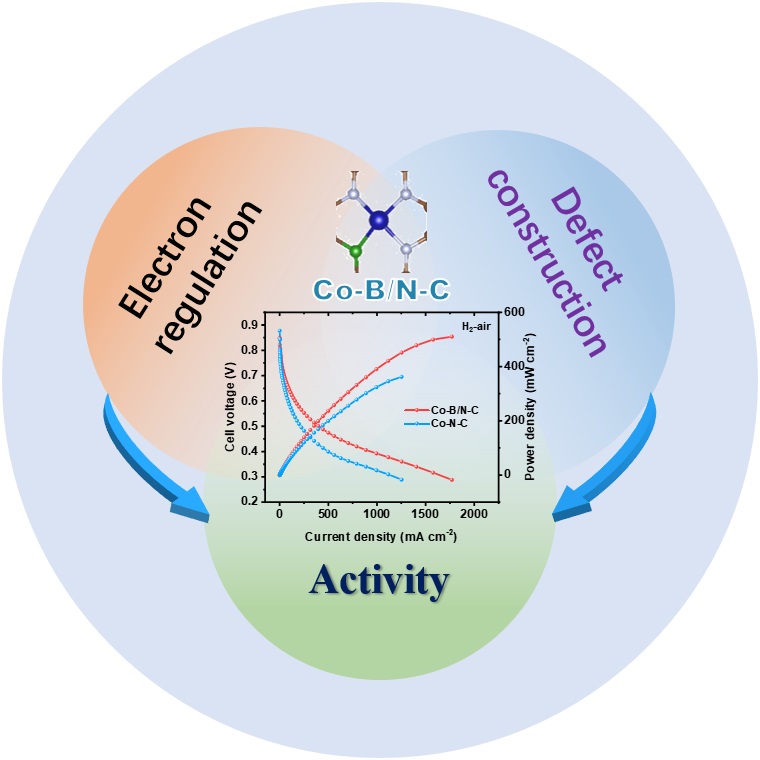
钴(Co)中心对含氧中间体的弱吸附能,是致使Co-N-C催化剂与昂贵的铂基催化剂在催化氧还原反应(ORR)中存在显著性能差异的主要原因。本研究通过硼酸铵共热解策略实现硼取代,从而对Co-N-C活性位点结构进行精准调控。反应中原位生成的氨气(NH3)气体对表面进行刻蚀形成缺陷,为硼原子取代活性中心的氮原子奠定基础。精心构筑的CoB1N3活性中心可以赋予钴位点更高的电荷密度及与氧物种更强的吸附能,进而加速ORR动力学。如预期所示,所制备的Co-B/N-C催化剂展现出优于Co-N-C的ORR性能:半波电位提升40 mV,转换频率提高五倍。该催化剂优异的ORR活性在膜电极性能测试中同样显著,峰值功率密度达824 mW·cm-2,取得了目前同等条件下钴基催化剂的最高水平。本工作不仅提供了先进催化剂的设计方法,更为燃料电池应用开发了一种极具前景的非贵金属ORR电催化剂。
兰畅 , 柏景森 , 关欣 , 王烁 , 张楠淑 , 程雨晴 , 陶金晶 , 楚宇逸 , 肖梅玲 , 刘长鹏 , 邢巍 . 协同硼掺杂显著提升Co-N-C催化剂的氧还原反应活性[J]. 电化学, 2025 , 31(9) : 2506181 . DOI: 10.61558/2993-074X.3577
The weak adsorption energy of oxygen-containing intermediates on Co center leads to a considerable performance disparity between Co-N-C and costly Pt benchmark in catalyzing oxygen reduction reaction (ORR). In this work, we strategically engineer the active site structure of Co-N-C via B substitution, which is accomplished by the pyrolysis of ammonium borate. During this process, the in-situ generated NH3 gas plays a critical role in creating surface defects and boron atoms substituting nitrogen atoms in the carbon structure. The well-designed CoB1N3 active site endows Co with higher charge density and stronger adsorption energy toward oxygen species, potentially accelerating ORR kinetics. As expected, the resulting Co-B/N-C catalyst exhibited superior ORR performance over Co-N-C counterpart, with 40 mV, and fivefold enhancement in half-wave potential and turnover frequency (TOF). More importantly, the excellent ORR performance could be translated into membrane electrode assembly (MEA) in a fuel cell test, delivering an impressive peak power density of 824 mW·cm-2, which is currently the best among Co-based catalysts under the same conditions. This work not only demonstrates an effective method for designing advanced catalysts, but also affords a highly promising non-precious metal ORR electrocatalyst for fuel cell applications.
| [1] | Debe M K. Electrocatalyst approaches and challenges for automotive fuel cells[J]. Nature, 2012, 486: 43-51. https://doi.org/10.1038/nature11115. |
| [2] | Bates J S, Johnson M. R, Khamespanah F, Root T W, Stahl S S. Heterogeneous M-N-C catalysts for aerobic oxidation reactions: lessons from oxygen reduction electrocatalysts[J]. Chem. Rev., 2023, 123(9): 6233-6256. https://doi.org/10.1021/acs.chemrev.2c00424. |
| [3] | Ma M, Shen L X, Zhao Z G, Guo P, Liu J, Xu B, Zhang Z Y, Zhang Y L, Zhao L, Wang Z B. Activation methods and underlying performance boosting mechanisms within fuel cell catalyst layer[J]. eScience, 2024, 4(6): 100254. https://doi.org/10.1016/j.esci.2024.100254. |
| [4] | Wang X, Yu M H, Feng X L. Electronic structure regulation of noble metal-free materials toward alkaline oxygen electrocatalysis[J]. eScience, 2023, 3(4): 100141. https://doi.org/10.1016/j.esci.2023.100141. |
| [5] | Li C Y, Zhang R, Ba X J, Jiang X L, Yang Y Y. Fe nanoparticles encapsulated in N-doped porous carbon for efficient oxygen reduction in alkaline media[J]. J. Electrochem., 2023, 29(5): 2210241. https://doi.org/10.13208/j.electrochem.2210241. |
| [6] | Wang W, Jia Q Y, Mukerjee S, Chen S. Recent insights into the oxygen-reduction electrocatalysis of Fe/N/C materials[J]. ACS Catal., 2019, 9(11): 10126. https://doi.org/10.1021/acscatal.9b02583. |
| [7] | Zhao C X, Li B Q, Liu J N, Zhang Q. Intrinsic electrocatalytic activity regulation of M-N-C single-atom catalysts for the oxygen reduction reaction[J]. Angew. Chem. Int. Ed., 2021, 60(9): 4448. https://doi.org/10.1002/anie.202003917. |
| [8] | He Y H, Liu S W, Priest C, Shi Q R, Wu G. Atomically dispersed metal-nitrogen-carbon catalysts for fuel cells: advances in catalyst design, electrode performance, and durability improvement[J]. Chem. Soc. Rev., 2020, 49(11): 3484-3524. https://doi.org/10.1039/C9CS00903E. |
| [9] | Zheng L W, Niu M, Zeng T T, Ge X H, Wang Y R, Guo C X, Yuan W Y, Cao D P, Zhang L Y, Li C M. Assembling molybdenum-doped platinum clusters into a coral-like nanostructure for highly enhanced oxygen reduction[J]. eScience, 2024, 4(1): 100187. https://doi.org/10.1016/j.esci.2023.100187. |
| [10] | Han C, Zhang S Q, Zhang H M, Dong Y N, Yao P F, Du Y N, Song P, Gong X, Xu W L. Metal-support interaction in single-atom electrocatalysts: A perspective of metal oxide supports[J]. eScience, 2024, 4(5): 100269. https://doi.org/10.1016/j.esci.2024.100269. |
| [11] | Shen L L, Yong C, Xu Y, Wu P, Zhang G R, Mei D. Recent progress in ZIF-derived carbons for enhanced oxygen reduction reaction electrocatalysis[J]. ChemCatChem, 2024, 16(9): e202301379. https://doi.org/10.1002/cctc.202301379. |
| [12] | Zitolo A, Goellner V, Armel V, Sougrati M T, Mineva T, Stievano L, Fonda E, Jaouen F. Identification of catalytic sites for oxygen reduction in iron- and nitrogen-doped graphene materials. Nat. Mater., 2015, 14: 937-942. https://doi.org/10.1038/nmat4367. |
| [13] | Zitolo A, Ranjbar-Sahraie N, Mineva T, Li J, Jia Q, Stamatin S, Harrington G F, Lyth S M, Krtil P, Mukerjee S. Identification of catalytic sites in cobalt-nitrogen-carbon materials for the oxygen reduction reaction[J]. Nat. Commun., 2017, 8: 957. https://doi.org/10.1038/s41467-017-01100-7. |
| [14] | Chung H T, Cullen D A, Higgins D, Sneed B T, Holby E F, More K L, Zelenay P. Direct atomic-level insight into the active sites of a high-performance PGM-free ORR catalyst[J]. Science, 2017, 357(6350): 479-484. https://doi.org/10.1126/science.aan2255. |
| [15] | McClure J P, Borodin O, Olguin M, Chu D, Fedkiw P S. Sensitivity of density functional theory methodology for oxygen reduction reaction predictions on Fe-N4-containing graphitic clusters[J]. J. Phys. Chem. C, 2016, 120(50): 28545-28562. https://doi.org/10.1021/acs.jpcc.6b08498. |
| [16] | Irmawati Y, Mauludi E M, Destyorini F, Hardiansyah A, Oktaviano H S, Nugroho A, Yudianti R. One-pot synthesis of CoFe alloy supported on N-doped carbon as Pt-free oxygen reduction catalysts[J]. A.I.P, 2022, 2652(1): 040002. https://doi.org/10.1063/5.0106430. |
| [17] | Nugroho A, Wahyudhi A, Oktaviano H S, Yudianti R, Hardiansyah A, Destyorini F, Irmawati Y. Effect of iron loading on controlling Fe/N-C electrocatalyst structure for oxygen reduction reaction[J]. Chemistryselect, 2022, 7(45): e202202042. https://doi.org/10.1002/slct.202202042. |
| [18] | Kumar K, Dubau L, Jaouen F, Maillard F. Review on the degradation mechanisms of metal-N-C catalysts for the oxygen reduction reaction in acid electrolyte: Current understanding and mitigation approaches[J]. Chem. Rev., 2023, 123(15): 9265-9326. https://doi.org/10.1021/acs.chemrev.2c00685. |
| [19] | Gubler L, Dockheer S M, Koppenol W H. Radical (HO?, H? and HOO?) formation and ionomer degradation in polymer electrolyte fuel cells[J]. JES, 2011, 158(7): B755-B769. https://doi.org/10.1149/1.3581040. |
| [20] | Iojoiu C, Guilminot E, Maillard F, Chatenet M, Sanchez J Y, Claude E, Rossinot E. Membrane and active layer degradation following PEMFC steady-state operation: II. Influence of on membrane properties[J]. JES, 2007, 154(11): B1115-B1120. https://doi.org/10.1149/1.2775282. |
| [21] | Weiss J, Zhang H, Zelenay P. Recent progress in the durability of Fe-N-C oxygen reduction electrocatalysts for polymer electrolyte fuel cells[J]. J. Electroanal. Chem., 2020, 875(15): 114696. https://doi.org/10.1016/j.jelechem.2020.114696. |
| [22] | Miao Z P, Li S Z, Priest C, Wang T Y, Wu G, Li Q. Effective approaches for designing stable M-Nx/C oxygen-reduction catalysts for proton-exchange-membrane fuel cells[J]. Adv. Mater., 2022, 34(52): 2200595. https://doi.org/10.1002/adma.202200595. |
| [23] | Shah S S A, Najam T, Bashir M S, Javed M S, Rahman A U, Luque R, Bao S J. Identification of catalytic active sites for durable proton exchange membrane fuel cell: catalytic degradation and poisoning perspectives[J]. Small, 2022, 18(18): 2106279. https://doi.org/10.1002/smll.202106279. |
| [24] | Liu S M, Zhou J J, Ji S J, Wen Z S. Preparation and electrocatalytic performance of FeNi-CoP/NC bifunctional catalyst[J]. J. Electrochem., 2023, 29(10): 211118. https://doi.org/10.13208/j.electrochem.211118. |
| [25] | Xie X H, He C, Li B Y, He Y H, Cullen D A, Wegener E C, Kropf A J, Martinez U, Cheng Y, Engelhard M H. Performance enhancement and degradation mechanism identification of a single-atom Co-N-C catalyst for proton exchange membrane fuel cells[J]. Nat. Catal., 2020, 3: 1044-1054. https://doi.org/10.1038/s41929-020-00546-1. |
| [26] | Osmieri L, Monteverde Videla A H A, Ocón P, Specchia S. Kinetics of oxygen electroreduction on Me-N-C (Me = Fe, Co, Cu) Catalysts in acidic medium: Insights on the effect of the transition metal[J]. J. Phys. Chem. C, 2017, 121(33): 17796-17817. https://doi.org/10.1021/acs.jpcc.7b02455. |
| [27] | Degtyarenko I, Nieminen R. M, Rovira C. Structure and dynamics of dioxygen bound to cobalt and iron heme[J]. Biophys. J., 2006, 91(6): 2024-2034. https://doi.org/10.1529/biophysj.106.083048. |
| [28] | Feng X, Bai Y, Liu M Q, Li Y, Yang H, Wang X R, Wu C. Untangling the respective effects of heteroatom-doped carbon materials in batteries, supercapacitors and the ORR to design high performance materials[J]. Energy Environ. Sci., 2021, 14(4): 2036-2089. https://doi.org/10.1039/D1EE00166C. |
| [29] | Guo L, Hwang S, Li B, Yang F, Wang M Y, Chen M J, Yang X X, Karakalos S G, Cullen D A, Feng Z. Promoting atomically dispersed MnN4 sites via sulfur doping for oxygen reduction: unveiling intrinsic activity and degradation in fuel cells[J]. ACS Nano, 2021, 15(4): 6886-6899. https://doi.org/10.1021/acsnano.0c10637. |
| [30] | Wang H, Shao Y, Mei S L, Lu Y, Zhang M, Sun J k, Matyjaszewski K, Antonietti M, Yuan J. Polymer-derived heteroatom-doped porous carbon materials[J]. Chem. Rev., 2020, 120(17): 9363-9419. https://doi.org/10.1021/acs.chemrev.0c00080. |
| [31] | Liu H T, Liu Y Q, Zhu D B. Chemical doping of graphene[J]. J. Mater. Chem., 2011, 21(10): 3335-3345. https://doi.org/10.1039/C0JM02922J. |
| [32] | Zhou Q, Zhao Z B, Chen Y S, Hu H, Qiu J S. Low temperature plasma-mediated synthesis of graphenenanosheets for supercapacitor electrodes[J]. J. Mater. Chem., 2012, 22(13): 6061-6066. https://doi.org/10.1039/C2JM15572A. |
| [33] | Strudwick A J, Weber N E, Schwab M G, Kettner M, Weitz R T, Wünsch J R, Müllen K, Sachdev H. Chemical vapor deposition of high quality graphene films from carbon dioxide atmospheres. ACS Nano, 2015, 9(1): 31-42. https://doi.org/10.1021/nn504822m. |
| [34] | Li S B, Wang Z F, Jiang H N, Zhang L M, Ren J Z, Zheng M T, Dong L C, Sun L Y. Plasma-induced highly efficient synthesis of boron doped reduced graphene oxide for supercapacitors[J]. Chem. Comm., 2016, 52(73): 10988-10991. https://doi.org/10.1039/C6CC04052G. |
| [35] | Xiao M L, Zhang H, Chen Y T, Zhu J B, Gao L Q, Jin Z, Ge J J, Jiang Z, Chen S L, Liu C P, Wei X. Identification of binuclear Co2N5 active sites for oxygen reduction reaction with more than one magnitude higher activity than single atom CoN4 site[J]. Nano Energy, 2018, 46: 396-403. https://doi.org/10.1016/j.nanoen.2018.02.025. |
| [36] | Malko D, Kucernak A, Lopes T. In situ electrochemical quantification of active sites in Fe-N/C non-precious metal catalysts[J]. Nat. Commun., 2016, 7: 13285. https://doi.org/10.1038/ncomms13285. |
| [37] | Bai J S, Zhao T, Xu M J, Mei B B, Yang L T, Shi Z P, Zhu S Y, Wang Y, Jiang Z, Zhao J, Ge J J, Xiao M L, Liu C P, Xing W. Monosymmetric Fe-N4 sites enabling durable proton exchange membrane fuel cell cathode by chemical vapor modification[J]. Nat. Commun., 2024, 15: 4219. https://doi.org/10.1038/s41467-024-47817-0. |
| [38] | Liu S W, Li C Z, Zachman M J, Zeng Y C, Yu H, Li B Y, Wang M Y, Braaten J, Liu J W, Meyer H M, Lucero M, Kropf A J, Alp E E, Gong Q, Shi Q R, Feng Z X, Xu H, Wang G F, Myers D J, Xie J, Cullen D A, Litster S, Wu G. Atomically dispersed iron sites with a nitrogen-carbon coating as highly active and durable oxygen reduction catalysts for fuel cells[J]. Nat. Energy, 2022, 7: 652-663. https://doi.org/10.1038/s41560-022-01062-1. |
| [39] | Guan G J, Liu Y H, Li F H, Shi X W, Liu L Y, Wang T Y, Xu X T, Zhao M, Ding J, Yang H B. Atomic cobalt metal centers with asymmetric N/B-Coordination for promoting oxygen reduction reaction[J]. Adv. Funct. Mater., 2024, 34(48): 2408111. https://doi.org/10.1002/adfm.202408111. |
| [40] | Xue D P, Yuan P F, Jiang S, Wei Y F, Zhou Y, Dong C L, Yan W F, Mu S C, Zhang J N. Altering the spin state of Fe-N-C through ligand field modulation of single-atom sites boosts the oxygen reduction reaction[J]. Nano Energy, 2023, 105: 108020. https://doi.org/10.1016/j.nanoen.2022.108020. |
| [41] | Wang Z, Xu R J, Ye Q T, Jin X Y, Lu Z, Yang Z B, Wang Y, Yan T, Liu Y P, Pan Z J, Hwang S J, Fan H J. Tailoring first coordination sphere of dual-metal atom sites boosts oxygen reduction and evolution activities[J]. Adv. Funct. Mater., 2024, 34(28): 2315376. https://doi.org/10.1002/adfm.202315376. |
| [42] | Wang F Q, Zhang R, Zhang Y Y, Li Y, Zhang J, Yuan W, Liu H, Wang F, Xin H L. Modulating electronic structure of atomically dispersed nickel sites through boron and nitrogen dual coordination boosts oxygen reduction[J]. Adv. Funct. Mater., 2023, 33(17): 2213863. https://doi.org/10.1002/adfm.202213863. |
| [43] | Wan X, Liu X F, Li Y C, Yu R H, Zheng L R, Yan W S, Wang H, Xu M, Shui J. Fe-N-C electrocatalyst with dense active sites and efficient mass transport for high-performance proton exchange membrane fuel cells[J]. Nat. Catal., 2019, 2: 259-268. https://doi.org/10.1038/s41929-019-0237-3. |
| [44] | Han A, Sun W, Wan X, Cai D, Wang X, Li F, Shui J, Wang D. Construction of Co4 atomic clusters to enable Fe-N4 motifs with highly active and durable oxygen reduction performance[J]. Angew. Chem. Int. Ed., 2023, 62(30): e202303185. https://doi.org/10.1002/anie.202303185. |
| [45] | Xu M J, Jin Z, Xiao M L, Liu C P, Xing W. Microwave-assisted synthesis of high-performance Fe-N-C electrocatalyst for proton exchange membrane fuel cells[J]. J. Phys. Chem. C, 2024, 128(25): 10568-10576. https://doi.org/10.1021/acs.jpcc.4c03034. |
| [46] | Yin S H, Yan Y N, Chen L, Cheng N Y, Cheng X Y, Huang R, Huang H, Zhang B W, Jiang Y X, Sun S G. FeN4 active sites electronically coupled with PtFe alloys for ultralow Pt loading hybrid electrocatalysts in proton exchange membrane fuel cells[J]. ACS Nano, 2024, 18(1): 551-559. https://doi.org/10.1021/acsnano.3c08570. |
| [47] | Xiao M L, Chen Y T, Zhu J B, Zhang H, Zhao X, Gao L, Wang X, Zhao J, Ge J J, Jiang Z. Climbing the apex of the ORR volcano plot via binuclear site construction: electronic and geometric engineering[J]. J. Am. Chem. Soc., 2019, 141(44): 17763-17770. https://doi.org/10.1021/jacs.9b08362. |
| [48] | Jiao L, Li J K, Richard L. L, Sun Q, Stracensky T, Liu E S, Sougrati M T, Zhao Z P, Yang F, Zhong S C, Xu H, Mukerjee S, Huang Y, Cullen D A, Park J H, Ferrandon M, Myers D J, Jaouen F, Jia Q Y. Chemical vapour deposition of Fe-N-C oxygen reduction catalysts with full utilization of dense Fe-N4 sites[J]. Nat. Mater., 2021, 20: 1385-1391. https://doi.org/10.1038/s41563-021-01030-2. |
| [49] | Zagal J H, Koper M. T M. Reactivity descriptors for the activity of molecular MN4 catalysts for the oxygen reduction reaction[J]. Angew. Chem. Int. Ed., 2016, 55(47): 14510. https://doi.org/10.1002/anie.201604311. |
/
| 〈 |
|
〉 |