电催化氧还原反应的原位表征
收稿日期: 2021-11-24
修回日期: 2022-02-05
网络出版日期: 2022-03-08
版权
In Situ Characterization of Electrode Structure and Catalytic Processes in the Electrocatalytic Oxygen Reduction Reaction
Received date: 2021-11-24
Revised date: 2022-02-05
Online published: 2022-03-08
Copyright
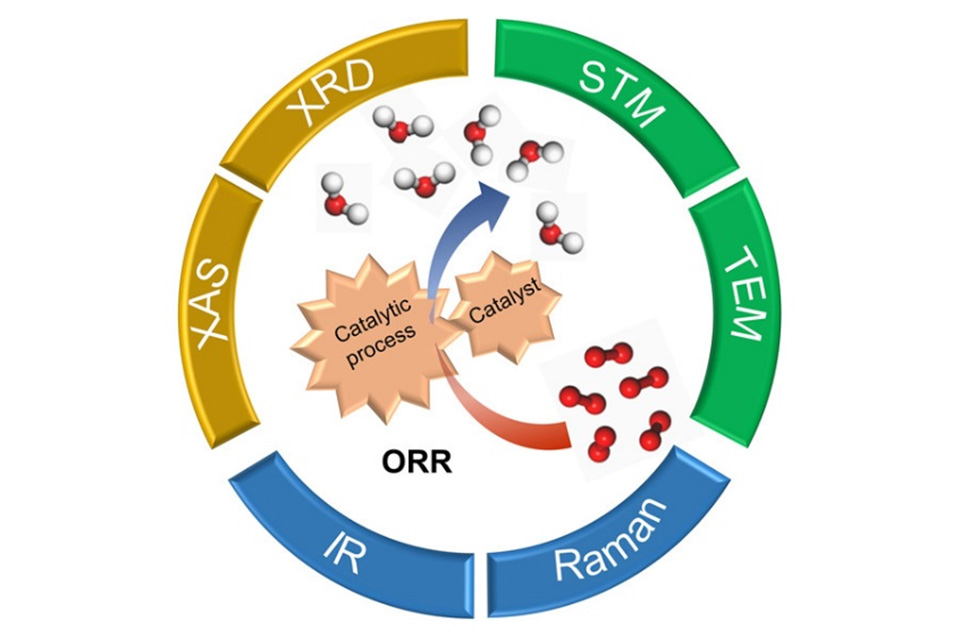
燃料电池作为一种电化学能量转换系统,具有能量转换效率高、清洁度高等优点。氧还原反应(ORR)是燃料电池中重要的阴极反应。目前,电催化剂仍是制约燃料电池进一步商业化的关键材料之一。ORR反应催化机理的研究对于开发具有良好活性和高选择性的电催化剂具有重要价值。近年来人们通过各种先进的原位表征方法深入研究了ORR催化剂的机理和催化过程。本综述旨在总结用于原位表征技术应用于研究 ORR 反应机制的最新研究进展。我们首先简要介绍各种原位技术在ORR研究中的优势,包括电化学扫描隧道技术、 红外光谱、 拉曼光谱、 X射线吸收光谱、 X射线衍和透射电子显微镜等。然后,从催化剂的角度,总结了各种原位表征技术在催化剂形貌和电子结构演变以及催化过程中反应物和中间体的识别中的应用。最后,展望讨论了该领域原位技术的未来发展。
冯雅辰 , 王翔 , 王宇琪 , 严会娟 , 王栋 . 电催化氧还原反应的原位表征[J]. 电化学, 2022 , 28(3) : 2108531 . DOI: 10.13208/j.electrochem.210853
As an electrochemical energy conversion system, fuel cell has the advantages of high energy conversion efficiency and high cleanliness. Oxygen reduction reaction (ORR), as an important cathode reaction in fuel cells, has received extensive attention. At present, the electrocatalysts are still one of the key materials restricting the further commercialization of fuel cells. The fundamental understanding on the catalytic mechanism of ORR is conducive to the development of electrocatalysts with the enhanced activity and high selectivity. This review aims to summarize the in situ characterization techniques used to study ORR. From this perspective, we first briefly introduce the advantages of various in situ techniques in ORR research, including electrochemical scanning tunneling microscopy, infrared spectroscopy, Raman spectroscopy, X-ray absorption spectroscopy, X-ray photoelectron spectroscopy and transmission electron microscopy. Then, the applications of various in situ characterization techniques in characterizing of the catalyst morphological evolution and electronic structure as well as the identification of reactants and intermediates in the catalytic process are summarized. Finally, the future development of in situ technology is outlooked.
/
| 〈 |
|
〉 |