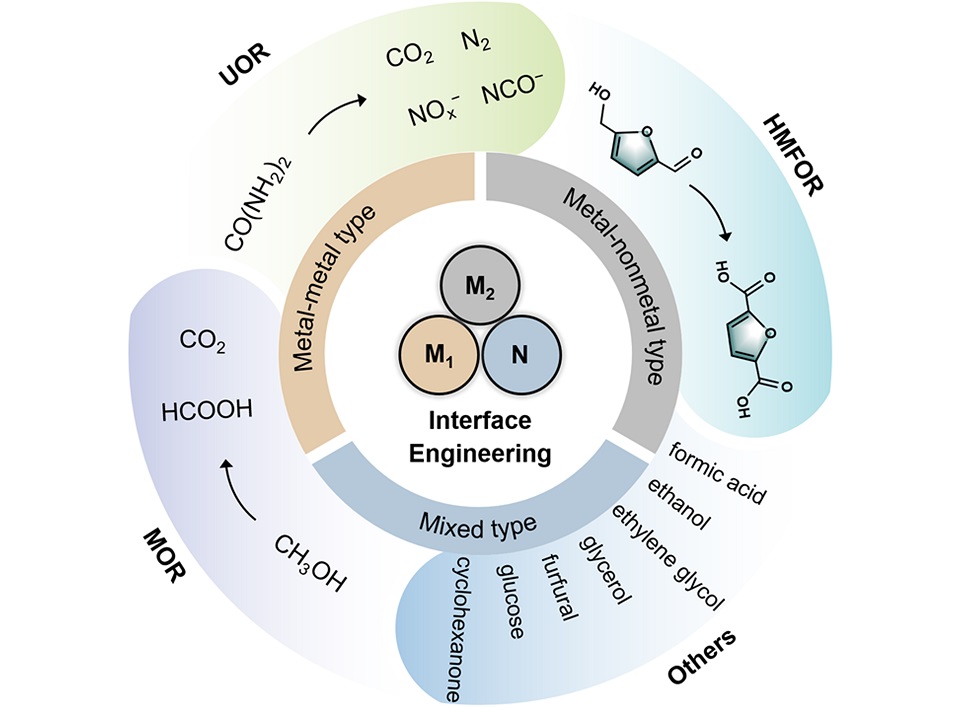
小分子有机物(如甲醇、尿素、5-羟甲基糠醛等)的电氧化可替代电解水中动力学缓慢的析氧反应,从而降低制氢能耗,并同时实现高附加值化学品联产或环境污染物降解,是一种极具应用前景的策略。然而,单组分催化剂通常难以实现有机分子与析氧反应衍生氧物种之间的高效耦合。本文针对该挑战,结合我们的系列研究及相关重要报道,着重阐明催化剂界面工程及重构在有机小分子电氧化领域的关键作用。通过构建异质界面,能够调控电子结构及优化中间体吸附,进而提升小分子有机物电氧化反应的活性、选择性与稳定性。此外,本文展望了该领域的未来研究方向,包括利用原位技术深入揭示反应机理、实现界面结构的原子级精准构筑、研究工况条件下的长期稳定性以及弥合基础研究与实际器件应用之间的差距。本综述有利于研究者进一步理解复合催化剂界面工程及其重构在小分子有机物电氧化技术领域的重要作用。
Electrooxidation of small organic molecules (e.g., methanol, urea, 5-hydroxymethylfurfural) represents a promising strategy to replace the kinetically sluggish oxygen evolution reaction (OER) in water electrolysis, thereby reducing hydrogen production energy consumption and simultaneously achieving co-production of value-added chemicals or degradation of environmental pollutants. However, single-component catalysts often struggle to achieve efficient coupling between organic molecules and OER-derived oxygen species. This review addresses this challenge by highlighting the pivotal role of catalyst interface engineering (including reconstruction), drawing on our series of studies and relevant important reports. By constructing heterointerfaces, electronic structures can be modulated and intermediate adsorption optimized, thereby enhancing the activity, selectivity, and stability of electrooxidation reactions of small organic molecules. Additionally, we outline future directions, including deepening the mechanistic understanding via operando techniques, achieving atomic-level precision in interface synthesis, investigating long-term stability under operational conditions, and bridging the gap between fundamental research and practical device applications. This review enables researchers to gain a deeper understanding of the critical role of composite catalyst interface engineering and its reconstruction in the electrooxidation technology for small-molecule organic compounds.