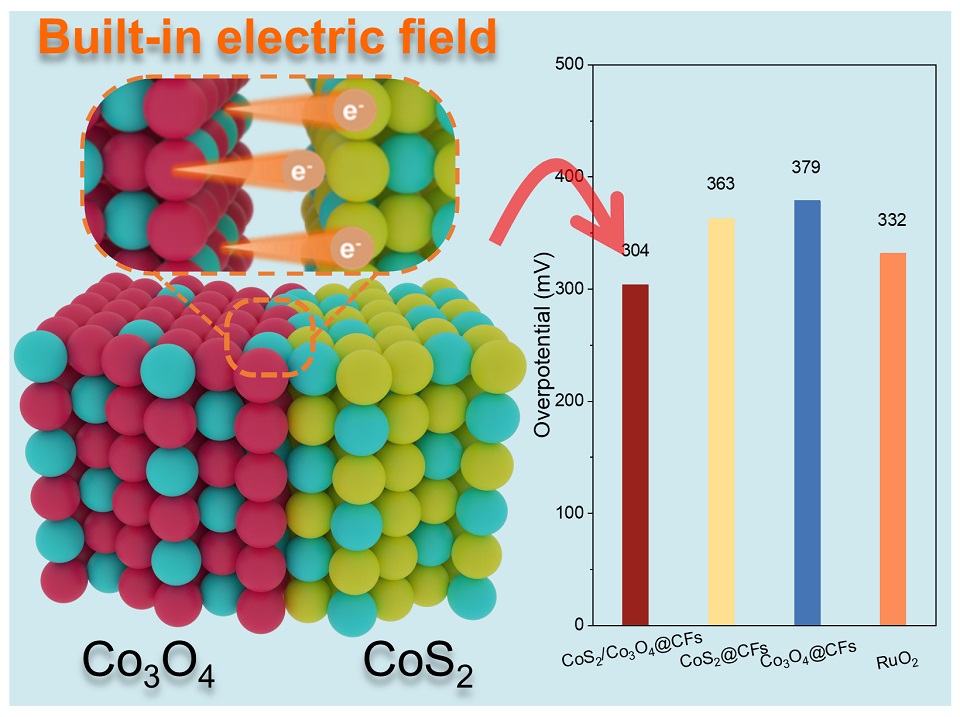
设计高效且耐久的析氧反应(OER)电催化剂,对于推动可充电锌空气电池(ZAB)等可持续电化学能源转换与存储技术的发展至关重要。在此,本文通过阴离子工程策略,在氮掺杂碳纳米纤维上构建了由CoS2与Co3O4纳米片组成的异质结构OER电催化剂(记为CoS2/Co3O4@CFs)。实验结果表明,原位选择性硫化构筑了丰富的CoS2/Co3O4异质界面,从而实现了电子结构与活性位点分布的协同调控。此外,O被S阴离子置换调控了界面电子特征,并形成了显著的功函数差异,即CoS2的功函数高于Co3O4。这种差异驱动了界面电荷重新分布并形成内建电场,该电场可能调控含氧中间体的局域吸附环境,从而有助于提升OER动力学。因此,CoS2/Co3O4@CFs表现出优异的OER活性,在10 mA⋅cm-2下的过电位低至304 mV,并在碱性电解液中具有出色的长期稳定性。此外,当用作ZAB空气阴极时,该催化剂展现出良好的可充电性、倍率性能以及稳定的循环性能。本工作凸显了阴离子诱导的原位拓扑化学转化策略在调控界面电子再分布中的潜力,为合理设计高性能钴基电催化剂提供了新的思路。
任奕源, 张雨桐, 张豪逸, 潘敏睿, 李靖, 陆婷钰, 孙冬梅, 唐亚文
. 阴离子原位转化实现CoS2/Co3O4异质界面电子再分布促进高效析氧[J]. 电化学, 0
: 0
.
DOI: 10.61558/2993-074X.3625
Designing efficient and durable electrocatalysts for the oxygen evolution reaction (OER) is critical for advancing sustainable electrochemical energy conversion and storage technologies such as rechargeable Zinc-Air Battery (ZAB). Herein, we fabricate a heterostructured OER catalyst composed of CoS2 and Co3O4 nanosheets supported on nitrogen-doped carbon nanofibers (hereafter denoted as CoS2/Co3O4@CFs) through the anion engineering. Experimental results demonstrate that the in-situ selective sulfidation constructs abundant CoS2/Co3O4 heterointerfaces, enabling the synergistic regulation of electronic structure and active-site distribution. The O-to-S anion substitution modulates the interfacial electronic properties and establishes a pronounced work-function difference, where CoS2 exhibits a higher work function than Co3O4. This difference drives interfacial charge redistribution and the formation of a built-in electric field, which may modulate the local adsorption environment of oxygenated intermediates and thereby contribute to the enhanced OER kinetics. Therefore, CoS2/Co3O4@CFs delivers superior OER activity with a low overpotential of 304 mV A at 10 mA⋅cm-2, along with remarkable long-term durability in alkaline electrolyte. Furthermore, when employed as the air cathode in a ZAB, the CoS2/Co3O4@CFs demonstrates excellent rechargeability, favorable rate capability, and stable cycling performance. This work highlights anion-induced in-situ topochemical transformation strategy for regulating interfacial electron redistribution, providing insights into the rational design of high-performance cobalt-based electrocatalysts.