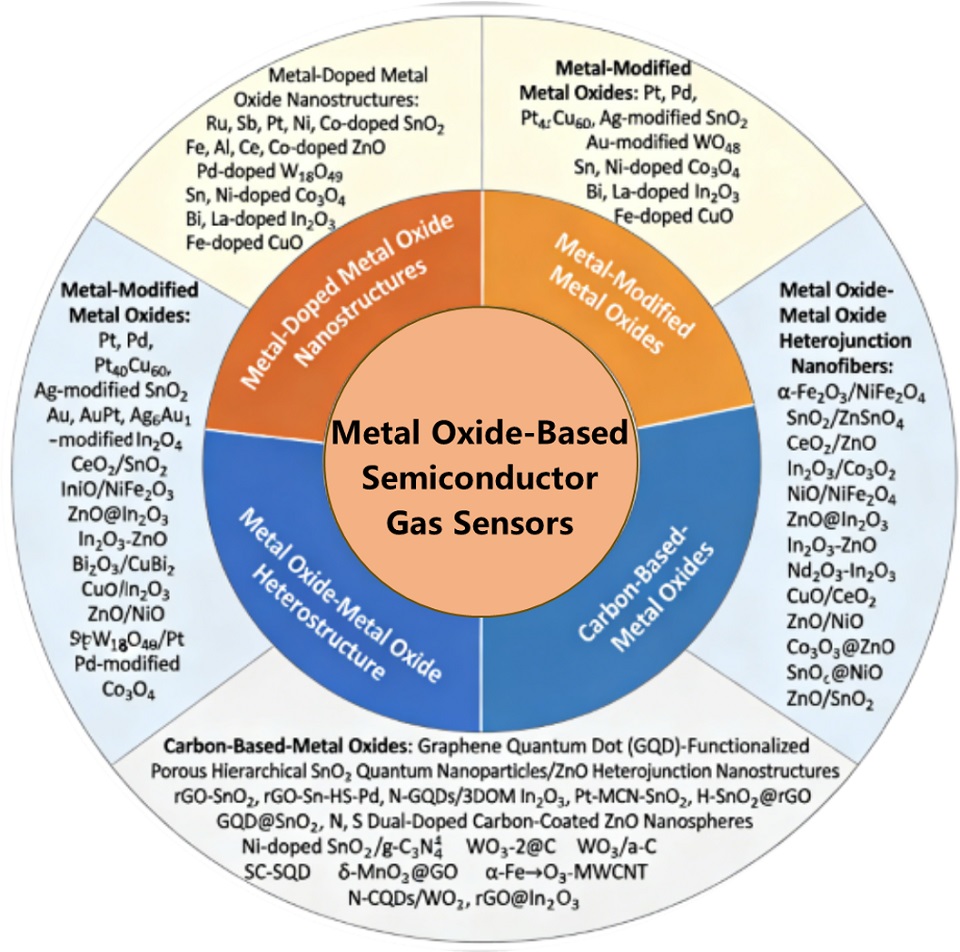
早期癌症筛查可显著改善治疗效果,呼出气中挥发性有机化合物(VOCs)及其他气体作为癌症特异性生物标志物,为非侵入性诊断提供了新路径。金属氧化物半导体(MOS)基气体传感器是呼出气 VOCs 检测的核心技术,具有体积小巧、成本可控、响应快速等优势。本文综述了近五年该类传感器在癌症标志物检测中的研究进展:首先阐明核心工作机制为敏感材料与 VOCs 相互作用引发的电学特性变化,其关键性能考核指标包括灵敏度、选择性、抗湿度干扰能力、响应/恢复时间、稳定性及工作温度。重点介绍了金属掺杂、表面修饰、异质结构构建、金属氧化物 - 载体复合材料制备等性能优化策略,这些策略通过扩大比表面积、引入活性位点、调控界面电荷转移等提升痕量检测能力、选择性与稳定性。最后概述传感阵列结合机器学习在癌症精准识别中的应用。本文为 MOS 传感器的性能优化与临床转化提供理论与实验研究依据。
陈广兰, 罗卉卉, 彭雯雯, 徐诗宇, 李宇婷, 柯慧洁, 钟思慧, 魏佳奥, 陈彤, 李晓坤, 张友林, 陈卫
. 金属氧化物基半导体气体传感器用于呼出气癌症标志物检测[J]. 电化学, 0
: 0
.
DOI: 10.61558/2993-074X.3623
Early cancer screening can significantly improve therapeutic outcomes, volatile organic compounds (VOCs) and other related gases in exhaled breath, as cancer-specific biomarkers, offer a novel approach for non-invasive diagnosis. Metal oxide semiconductor (MOS)-based gas sensors are pivotal for exhaled breath VOCs detection, featuring compact size, cost-effectiveness, and rapid response. This review summarizes the most recent five-year research advances in cancer biomarker detection and clarifies the core mechanisms of electrical property changes from sensing material-VOCs interactions and key performance metrics including sensitivity, selectivity, humidity tolerance, response/recovery time, stability, and operating temperature. This review highlights the optimization strategies of sensing materials such as metal doping, surface modification, heterostructure fabrication, and metal oxide-carrier composite synthesis to enhance trace detection, selectivity, and stability via expanded specific surface area, active sites introduction, and interfacial charge transfer modulation. Finally, this review outlines sensor arrays integrated with machine learning for precise cancer recognition. This review provides theoretical support for the performance optimization and clinical translation of MOS sensors, and facilitates their widespread application in the non-invasive early diagnosis of cancers.