电催化硝酸盐还原合成氨过程中活性氢的原位电化学表征技术
收稿日期: 2026-03-25
修回日期: 2026-05-05
录用日期: 2026-06-11
网络出版日期: 2026-06-11
In situ Electrochemical Characterization Techniques for Active Hydrogen in Electrocatalytic Nitrate Reduction to Ammonia
Hong-Mei Li: Investigation and original draft preparation.
Mei Yi, Zhao-Yu Jin, Ming-Hao Xie, Khalid M. Omer: Investigation, review and editing.
Yong Guo, Pan-Pan Li: Supervision, funding acquisition, writing-review and editing.
All authors read and approved the final manuscript.
Received date: 2026-03-25
Revised date: 2026-05-05
Accepted date: 2026-06-11
Online published: 2026-06-11
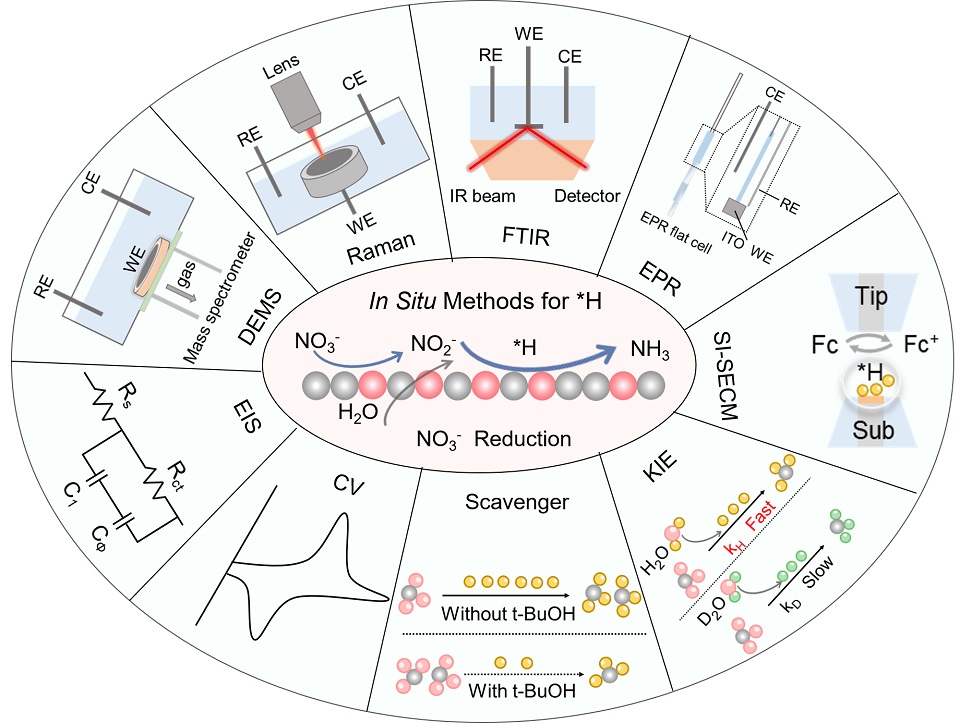
电催化硝酸盐还原合成氨(NitRR)是一条将环境污染治理与高附加值化学品生产相结合的绿色可持续路径。然而,其活性与选择性受限于瞬态中间体——活性氢(*H)的生成、消耗与动态平衡。实现活性氢的精准调控,必须首先依赖于先进的原位电化学表征技术对其行为进行全面解析。尽管已有综述从调控策略、原位表征总览等角度进行论述,但系统评述如何合理选用原位电化学技术对NitRR中的*H进行专门表征,并清晰界定各技术的“检测对象、定量精度与应用边界”的工作仍属空白。本文旨在填补这一方法学空缺,系统梳理了用于解析NitRR中*H行为的原位电化学表征技术,包括原位谱学技术、原位电化学方法和扫描电化学显微镜技术。基于这些先进表征技术,在该综述中,我们重点构建了一个针对NitRR过程中*H表征的“问题导向”的多层次方法学框架。通过阐述这些技术的原理、应用实例与适用范围,旨在为后续活性氢研究中的表征技术选择提供可靠依据,从而深化对NitRR微观机制的理解。此外,还探讨了未来的研究方向和发展趋势,为推动高效、高选择性绿色氨合成技术的发展提供了相关指导。
李红梅 , 易梅 , 晋兆宇 , 解明皓 , 郭勇 , 李盼盼 . 电催化硝酸盐还原合成氨过程中活性氢的原位电化学表征技术[J]. 电化学, 2026 , 32(8) : 2517003 . DOI: 10.61558/2993-074X.3619
Electrocatalytic nitrate reduction to ammonia (NitRR) represents a sustainable pathway that integrates environmental remediation with the production of high-value ammonia. However, the activity and selectivity of this process are limited by the generation, consumption, and dynamic equilibrium of the key transient intermediate—active hydrogen (*H). Precise modulation of *H necessitates a comprehensive understanding of its behavior, which relies fundamentally on advanced in situ electrochemical characterization techniques. However, a systematic review dedicated to the rational selection and application of in situ electrochemical techniques for the specific characterization of *H in NitRR, with clear definitions of each technique’s “detectable targets, quantitative accuracy, and application boundaries” remains absent. This review aims to fill this methodological gap by systematically summarizing in situ electrochemical techniques for probing *H behavior in NitRR, including in situ spectroscopic techniques, in situ electrochemical methods, and scanning electrochemical microscopy. We construct a problem-oriented hierarchical methodological framework tailored for *H characterization in NitRR. By detailing the principles, representative applications, and limitations of these techniques, this review provides a reliable guide for selecting appropriate characterization methods in future *H research, thereby deepening the mechanistic understanding of NitRR. Additionally, future research directions and development trends are discussed, offering insights to advance efficient and selective green ammonia synthesis technologies.
| [1] | Gruber N, Galloway J N. An Earth-system perspective of the global nitrogen cycle[J]. Nature, 2008, 451(7176): 293-296. https://doi.org/10.1038/nature06592. |
| [2] | Chen J G, Crooks R M, Seefeldt L C, Bren K L, Bullock R M, Darensbourg M Y, Holland P L, Hoffman B, Janik M J, Jones A K, Kanatzidis M G, King P, Lancaster K M, Lymar S V, Pfromm P, Schneider W F, Schrock R R. Beyond fossil fuel-driven nitrogen transformations[J]. Science, 2018, 360(6391): eaar6611. https://doi.org/10.1126/science.aar6611. |
| [3] | Shen H D, Choi C, Masa J, Li X, Qiu J S, Jung Y, Sun Z Y. Electrochemical ammonia synthesis: Mechanistic understanding and catalyst design[J]. Chem, 2021, 7(7): 1708-1754. https://doi.org/10.1016/j.chempr.2021.01.009. |
| [4] | Valera-Medina A, Xiao H, Owen-Jones M, David W I F, Bowen P J. Ammonia for power[J]. Prog. Energ. Combust., 2018, 69: 63-102. https://doi.org/10.1016/j.pecs.2018.07.001. |
| [5] | Chen G F, Yuan Y, Jiang H, Ren S Y, Ding L X, Ma L, Wu T, Lu J, Wang H. Electrochemical reduction of nitrate to ammonia via direct eight-electron transfer using a copper-molecular solid catalyst[J]. Nat. Energy, 2020, 5(8): 605-613. https://doi.org/10.1038/s41560-020-0654-1. |
| [6] | Guo W H, Zhang K X, Liang Z B, Zou R Q, Xu Q. Electrochemical nitrogen fixation and utilization: theories, advanced catalyst materials and system design[J]. Chem. Soc. Rev., 2019, 48(24): 5658-5716. https://doi.org/10.1039/c9cs00159j. |
| [7] | Wang L, Xia M K, Wang H, Huang K F, Qian C X, Maravelias C T, Ozin G A. Greening ammonia toward the solar ammonia refinery[J]. Joule, 2018, 2(6): 1055-1074. https://doi.org/10.1016/j.joule.2018.04.017. |
| [8] | Ren Y W, Li S F, Yu C, Zheng Y H, Wang C, Qian B Z, Wang L S, Fang W H, Sun Y, Qiu J S. NH3 electrosynthesis from N2 molecules: Progresses, challenges, and future perspectives[J]. J. Am. Chem. Soc., 2024, 146(10): 6409-6421. https://doi.org/10.1021/jacs.3c11676. |
| [9] | Li S P, Pang Y Y, Li H M, Yang R, Jin Z Y, Yu G H, Li P P. Cross-scale understanding of cascade electrocatalysis for carbon and nitrogen utilization[J]. Chem. Sci., 2026, 17(2): 772-790. https://doi.org/10.1039/d5sc09063f. |
| [10] | Chu K B, Weng B, Lu Z R, Ding Y, Zhang W, Tan R, Zheng Y M, Han N. Exploration of multidimensional structural optimization and regulation mechanisms: Catalysts and reaction environments in electrochemical ammonia synthesis[J]. Adv. Sci., 2025, 12(11): 2416053. https://doi.org/10.1002/advs.202416053. |
| [11] | van Langevelde P H, Katsounaros I, Koper M T M. Electrocatalytic nitrate reduction for sustainable ammonia production[J]. Joule, 2021, 5(2): 290-314. https://doi.org/10.1016/j.joule.2020.12.025. |
| [12] | Li P P, Li R, Liu Y T, Xie M H, Jin Z Y, Yu G H. Pulsed nitrate-to-ammonia electroreduction facilitated by tandem catalysis of nitrite intermediates[J]. J. Am. Chem. Soc., 2023, 145(11): 6471-6479. https://doi.org/10.1021/jacs.3c00334. |
| [13] | Li P P, Liao L, Fang Z W, Su G H, Jin Z Y, Yu G H. A multifunctional copper single-atom electrocatalyst aerogel for smart sensing and producing ammonia from nitrate[J]. Proc. Natl. Acad. Sci. U.S.A., 2023, 120(26): e2305489120. https://doi.org/10.1073/pnas.2305489120. |
| [14] | Li J Y, Chen R M, Wang J L, Zhou Y, Yang G D, Dong F. Subnanometric alkaline-earth oxide clusters for sustainable nitrate to ammonia photosynthesis[J]. Nat. Commun., 2022, 13(1): 1098. https://doi.org/10.1038/s41467-022-28740-8. |
| [15] | Hu Q, Qi S, Huo Q H, Zhao Y X, Sun J J, Chen X B, Lv M Y, Zhou W L, Feng C, Chai X Y, Yang H P, He C X. Designing efficient nitrate reduction electrocatalysts by identifying and optimizing active sites of Co-based spinels[J]. J. Am. Chem. Soc., 2023, 146(5): 2967-2976. https://doi.org/10.1021/jacs.3c06904. |
| [16] | Zheng S S, Yang X Z, Shi Z Z, Ding H W, Pan F, Li J F. The loss of interfacial water-adsorbate hydrogen bond connectivity position surface-active hydrogen as a crucial intermediate to enhance nitrate reduction reaction[J]. J. Am. Chem. Soc., 2024, 146(39): 26965-26975. https://doi.org/10.1021/jacs.4c08256. |
| [17] | Li J, Zhan G M, Yang J H, Quan F J, Mao C L, Liu Y, Wang B, Lei F C, Li L J, Chan A W M, Xu L P, Shi Y B, Du Y, Hao W C, Wong P K, Wang J F, Dou S X, Zhang L Z, Yu J C. Efficient ammonia electrosynthesis from nitrate on strained ruthenium nanoclusters[J]. J. Am. Chem. Soc., 2020, 142(15): 7036-7046. https://doi.org/10.1021/jacs.0c00418. |
| [18] | Zhang H J, Fang K Q, Yang J, Chen H, Ning J Q, Wang H Y, Hu Y. Strategies and applications of electrocatalytic nitrate reduction towards ammonia[J]. Coord. Chem. Rev., 2024, 506: 215723. https://doi.org/10.1016/j.ccr.2024.215723. |
| [19] | Gan G Q, Hong G, Zhang W J. Active hydrogen for electrochemical ammonia synthesis[J]. Adv. Funct. Mater., 2024, 35(21): 2401472. https://doi.org/10.1002/adfm.202401472. |
| [20] | Liu H L, Jia S H, Wu L M, He L, Sun X F, Han B X. Active hydrogen-controlled CO2/N2/NOx electroreduction: From mechanism understanding to catalyst design[J]. Innov. Mater., 2024, 2(1): 100058. https://doi.org/10.59717/j.xinn-mater.2024.100058. |
| [21] | Gu L, Cong Y T, Wu Z Y, Xie F T, Hua Y L, Xu H, Yang J P. Multiscopic microenvironment engineering in nitrate electrocatalytic reduction[J]. Adv. Funct. Mater., 2025, 35(18): 2500316. https://doi.org/10.1002/adfm.202500316. |
| [22] | Kim K H, Lee H B, Huang X P, Choi J H, Chen C P, Kang J K, O’Hare D. Energy-efficient electrochemical ammonia production from dilute nitrate solution[J]. Energy Environ. Sci., 2023, 16(2): 663-681. https://doi.org/10.1039/d2ee03461a. |
| [23] | Chen F Y, Wu Z Y, Gupta S, Rivera D J, Lambeets S, Pecaut S, Kim J Y T, Zhu P, Finfrock Y Z, Meira D M, King G, Gao G H, Xu W Q, Cullen D A, Zhou H, Han Y M, Perea D E, Muhich C L, Wang H T. Efficient conversion of low-concentration nitrate sources into ammonia on a Ru-dispersed Cu nanowire electrocatalyst[J]. Nat. Nanotechnol., 2022, 17(7): 759-767. https://doi.org/10.1038/s41565-022-01121-4. |
| [24] | Wang Y H, Xu A, Wang Z Y, Huang L S, Li J, Li F W, Wicks J, Luo M C, Nam D H, Tan C S, Ding Y, Wu J W, Lum Y W, Dinh C T, Sinton D, Zheng G F, Sargent E H. Enhanced nitrate-to-ammonia activity on copper-nickel alloys via tuning of intermediate adsorption[J]. J. Am. Chem. Soc., 2020, 142(12): 5702-5708. https://doi.org/10.1021/jacs.9b13347. |
| [25] | Wang Z H, Zhang X, Ren Z Y, Chen Z M. A hydrogen-centric perspective on electrocatalytic nitrate reduction: Managing the active hydrogen lifecycle from generation to utilization[J]. J. Energy Chem., 2025, 109: 210-226. https://doi.org/10.1016/j.jechem.2025.05.032. |
| [26] | Wang H M, Huang J J, Cai J M, Wei Y Y, Cao A, Liu B Z, Lu S Y. In situ/operando methods for understanding electrocatalytic nitrate reduction reaction[J]. Small Methods, 2023, 7(7): 2300169. https://doi.org/10.1002/smtd.202300169. |
| [27] | Liu J X, Richards D, Singh N, Goldsmith B R. Activity and selectivity trends in electrocatalytic nitrate reduction on transition metals[J]. ACS Catal., 2019, 9(8): 7052-7064. https://doi.org/10.1021/acscatal.9b02179. |
| [28] | Li Y M, Go Y K, Ooka H, He D P, Jin F M, Kim S H, Nakamura R. Enzyme mimetic active intermediates for nitrate reduction in neutral aqueous media[J]. Angew. Chem. Int. Ed., 2020, 59(24): 9744-9750. https://doi.org/10.1002/anie.202002647. |
| [29] | Jia R R, Wang Y T, Wang C H, Ling Y F, Yu Y F, Zhang B. Boosting selective nitrate electroreduction to ammonium by constructing oxygen vacancies in TiO2[J]. ACS Catal., 2020, 10(6): 3533-3540. https://doi.org/10.1021/acscatal.9b05260. |
| [30] | Liu Y T, Qiu W X, Wang P F, Li R, Liu K, Omer K M, Jin Z Y, Li P P. Pyridine-N-rich Cu single-atom catalyst boosts nitrate electroreduction to ammonia[J]. Appl. Catal. B: Environ., 2024, 340: 123228. https://doi.org/10.1016/j.apcatb.2023.123228. |
| [31] | Lodaya K M, Tang B Y, Bisbey R P, Weng S, Westendorff K S, Toh W L, Ryu J, Román-Leshkov Y, Surendranath Y. An electrochemical approach for designing thermochemical bimetallic nitrate hydrogenation catalysts[J]. Nat. Catal., 2024, 7(3): 262-272. https://doi.org/10.1038/s41929-023-01094-0. |
| [32] | Yu J C, Xi Z C, Su J H, Jing P, Xu X, Liu B C, Wang Y, Zhang J. Influence of active hydrogen on pathway selection in electrochemical nitrate reduction[J]. eScience, 2025, 5(3): 100350. https://doi.org/10.1016/j.esci.2024.100350. |
| [33] | Marx D. Aqueous basic solutions: Hydroxide solvation, structural diffusion, and comparison to the hydrated proton[J]. Chem. Rev., 2010, 110(4): 2174-2216. https://doi.org/10.1021/cr900233f. |
| [34] | Seh Z W, Kibsgaard J, Dickens C F, Chorkendorff I, N?rskov J K, Jaramillo T F. Combining theory and experiment in electrocatalysis: Insights into materials design[J]. Science, 2017, 355(6321): eaad4998. https://doi.org/10.1126/science.aad4998. |
| [35] | N?rskov J K, Bligaard T, Logadottir A, Kitchin J R, Chen J G, Pandelov S, Stimming U. Trends in the exchange current for hydrogen evolution[J]. J. Electrochem. Soc., 2005, 152(3): J23-J26. https://doi.org/10.1149/1.1856988. |
| [36] | Han S H, Li H J, Li T L, Chen F P, Yang R, Yu Y F, Zhang B. Ultralow overpotential nitrate reduction to ammonia via a three-step relay mechanism[J]. Nat. Catal., 2023, 6(5): 402-414. https://doi.org/10.1038/s41929-023-00951-2. |
| [37] | Zhong J, Duan H Y, Cai M Q, Zhu Y, Wang Z L, Li X C, Zhang Z L, Qu W Q, Zhang K, Han D L, Cheng D H, Shen Y J, Xie M, Cortes E, Zhang D S. Cascade electrocatalytic reduction of nitrate to ammonia using bimetallic covalent organic frameworks with tandem active sites[J]. Angew. Chem. Int. Ed., 2025, 64(32): e202507956. https://doi.org/10.1002/anie.202507956. |
| [38] | Su X H, Li M J, Wen Y K, Sun F Q, Shan B. Atomically paired Cu-Co dual sites for near-unity ammonia selectivity in nitrate electroreduction[J]. J. Am. Chem. Soc., 2025, 147(50): 46471-46481. https://doi.org/10.1021/jacs.5c16703. |
| [39] | Ma Y B, Guo L, Chang L, Guo W H, Zhou T, Hao F K, Su W D, Zhou J W, Wang G Z, Shao M Z, Yu J H, Yin J W, Wang Y H, Liu F, Zhang A, Qian K, Wang J, Zhang X Y, Zhou W J, Chu S Q, Ling C Y, Gan L, Guo Z X, Fan Z X. Unconventional phase metal heteronanostructures with tunable exposed interface for efficient tandem nitrate electroreduction to ammonia[J]. Nat. Commun., 2025, 16(1): 7632. https://doi.org/10.1038/s41467-025-63013-0. |
| [40] | Xu J W, Liu H J, Zhang S B, Peng Q, Liu S, Chen J H, Wang X Y, Wang W P, Liu H X, Xie Z H, Song L, Li K, Chen W. Integrated cascade catalysts for electrochemical nitrate reduction to ammonia[J]. J. Am. Chem. Soc., 2025, 148(1): 148-156. https://doi.org/10.1021/jacs.5c03265. |
| [41] | Majhi K C, Chen H, Batool A, Zhu Q, Jin Y, Liu S, Sit P H L, Lam J C H. In-tandem electrochemical reduction of nitrate to ammonia on ultrathin-sheet-assembled iron-nickel alloy nanoflowers[J]. Angew. Chem. Int. Ed., 2025, 64(14): e202500167. https://doi.org/10.1002/anie.202500167. |
| [42] | He W H, Zhang J, Dieckh?fer S, Varhade S, Brix A C, Lielpetere A, Seisel S, Junqueira J R C, Schuhmann W. Splicing the active phases of copper/cobalt-based catalysts achieves high-rate tandem electroreduction of nitrate to ammonia[J]. Nat. Commun., 2022, 13(1): 1129. https://doi.org/10.1038/s41467-022-28728-4. |
| [43] | Fang J Y, Zheng Q Z, Lou Y Y, Zhao K M, Hu S N, Li G, Akdim O, Huang X Y, Sun S G. Ampere-level current density ammonia electrochemical synthesis using CuCo nanosheets simulating nitrite reductase bifunctional nature[J]. Nat. Commun., 2022, 13(1): 7899. https://doi.org/10.1038/s41467-022-35533-6. |
| [44] | Liu K, Li H M, Xie M H, Wang P F, Jin Z Y, Liu Y T, Zhou M, Li P P, Yu G H. Thermally enhanced relay electrocatalysis of nitrate-to-ammonia reduction over single-atom-alloy oxides[J]. J. Am. Chem. Soc., 2024, 146(11): 7779-7789. https://doi.org/10.1021/jacs.4c00429. |
| [45] | Zheng M Y, Wan Y C, Huang Z H, Kang F Y, Lv R T. Interfacial synergistic hydrogen spillover and electron transfer for boosting electrocatalytic nitrate reduction to ammonia[J]. Adv. Mater., 2025, 38(4): 2414834. https://doi.org/10.1002/adma.202514834. |
| [46] | Zheng Q, Xu H Y, Yao Y C, Dai J, Zhan G M, Wang J X, Zhou B, Wang R Z, Wang K Y, Zhao R, Yang B, Zhang L Z. Regulation of Rh single-atom coordination for enhanced reverse hydrogen spillover and efficient electrochemical dechlorination[J]. J. Am. Chem. Soc., 2025, 147(47): 44032-44041. https://doi.org/10.1021/jacs.5c18184. |
| [47] | Ouyang X, Qiao W, Yang Y T, Xi B J, Yu Y, Wu Y L, Fang J Y, Li P, Xiong S L. Intensifying interfacial reverse hydrogen spillover for boosted electrocatalytic nitrate reduction to ammonia[J]. Angew. Chem. Int. Ed., 2025, 64(13): e202422585. https://doi.org/10.1002/anie.202422585. |
| [48] | Chen Y G, Bai H Y, Lan J, Kao C W, Xie F, Meng L H, Li J H, Lu Y R, Peng M, Pan H, Tan Y W. Ru single atoms anchored in metal borides enable hydrogen spillover for superior electrochemical ammonia production[J]. Angew. Chem. Int. Ed., 2025, 64(35): e202504568. https://doi.org/10.1002/anie.202504568. |
| [49] | Wang P F, Li P P, Pan Z C, Liu K, Xie M H, Zhou L W, Zhou M, Yu G H, Jin Z Y. Photothermal-electrocatalysis interface for fuel-cell grade ammonia harvesting from the environment[J]. Nat. Commun., 2025, 16(1): 5581. https://doi.org/10.1038/s41467-025-60636-1. |
| [50] | Zheng S J, Dong X Y, Chen H, Huang R W, Cai J, Zang S Q. Unveiling ionized interfacial water-induced localized H* enrichment for electrocatalytic nitrate reduction[J]. Angew. Chem. Int. Ed., 2024, 64(1): e202413033. https://doi.org/10.1002/anie.202413033. |
| [51] | Muthukumar P, Ullah Z, Zhang X, Ullah H, Liu Y X, Li L F, Tian S J, Zhou X L, Anthony S P, Zuo Y P, Lv C D, Wang X, and Wang C D. Unlocking a water coordination environment in Co-based metal-organic frameworks for advanced nitrate-to-ammonia electroreduction[J]. J. Am. Chem. Soc., 2025, 147(33): 29949-29960. https://doi.org/10.1021/jacs.5c07066. |
| [52] | Jin X D, Sun L B, Wang X Y, Wang R T, Yan L T, Fisher A C, Lee J M, Wang X. Localized active H* enrichment by cobalt molecular catalysts for enhanced electrocatalytic nitrate reduction[J]. Angew. Chem. Int. Ed., 2026, 65(4): e24566. https://doi.org/10.1002/anie.202524566. |
| [53] | Hu Q K, Yang K, Peng O W, Li M Z, Ma L, Huang S P, Du Y H, Xu Z X, Wang Q, Chen Z X, Yang M, Loh K P. Ammonia electrosynthesis from nitrate using a ruthenium-copper cocatalyst system: A full concentration range study[J]. J. Am. Chem. Soc., 2023, 146(1): 668-677. https://doi.org/10.1021/jacs.3c10516. |
| [54] | Zhou R Y, Zheng S, Liu X, Wang Y H, Li S, Yang X, Pan F, Li J F. Elevating nitrate reduction through the mastery of hierarchical hydrogen-bond networks[J]. J. Am. Chem. Soc., 2025, 147(24): 20504-20511. https://doi.org/10.1021/jacs.5c02540. |
| [55] | Yang M X, Wang W Z, Zhao Z Y, Yue S, Zhi T Y, Fu T, Liu K W, Wang P F, Zhan S H. Boosting nitrate reduction through Ru-CO32- microenvironment modulated hydrogen-bond networks[J]. Angew. Chem. Int. Ed., 2025, 65(2): e21249. https://doi.org/10.1002/anie.202521249. |
| [56] | Wen W D, Fang S D, Zhou Y T, Zhao Y, Li P, Yu X Y. Modulating the electrolyte microenvironment in electrical double layer for boosting electrocatalytic nitrate reduction to ammonia[J]. Angew. Chem. Int. Ed., 2024, 63(32): e202408382. https://doi.org/10.1002/anie.202408382. |
| [57] | Zhang M, Cheng X T, Duan Y, Chen J X, Wang L, Wang Y Q. Hydration-effect boosted active hydrogen facilitates neutral ammonia electrosynthesis from nitrate reduction[J]. Adv. Funct. Mater., 2025, 35(2): 2413070. https://doi.org/10.1002/adfm.202413070. |
| [58] | Zhu A Q, Liu H, Qiao L L, Liu B, Liu K L, Luan C H, Liu K, Zhou Y, Lin D W, Gan G Q, Li J P, Hong G, Zhang W J. Tuning active hydrogen on reconstructed RuO2/Co(OH)2 catalysts for selective ammonia synthesis[J]. Adv. Mater., 2025, 38(3): 2515346. https://doi.org/10.1002/adma.202515346. |
| [59] | Li Z Y, Shi Z C, Ou Y G, Zhong L X, Yan C S, Zhang C, Song K, Liu H J, Liu D B, Song P, Yin C H, Qi Z M, Song L, Lv C D. Pulsed electrocatalysis driven efficient ammonia synthesis by facilitating *NOOH formation and balancing *H supply[J]. Angew. Chem. Int. Ed., 2025, 64(37): e202510287. https://doi.org/10.1002/anie.202510287. |
| [60] | Li J W, Yu W Q, Yuan H F, Wang Y J, Chen Y K, Jiang D, Wu T, Song K P, Jiang X C, Liu H, Hu R M, Huang M, Zhou W J. Lattice hydrogen transfer in titanium hydride enhances electrocatalytic nitrate to ammonia conversion[J]. Nat. Commun., 2024, 15(1): 9499. https://doi.org/10.1038/s41467-024-53833-x. |
| [61] | Zheng W R. Beginner's guide to Raman spectroelectrochemistry for electrocatalysis study[J]. Chem. Methods, 2023, 3(2): e202200042. https://doi.org/10.1002/cmtd.202200042. |
| [62] | Zhang H J, Ran J, Ding Y, Ding Y X, Zhou L, Wang H Y, Wang Y H, Cao Y Y, Wang Y. In situ manipulation of interfacial water in Ni-Co3O4 for efficient neutral nitrate electroreduction to ammonia[J]. Appl. Catal. B: Environ., 2026, 381: 125830. https://doi.org/10.1016/j.apcatb.2025.125830. |
| [63] | Chen X, Wang X T, Le J B, Li S M, Wang X, Zhang Y J, Radjenovic P, Zhao Y, Wang Y H, Lin X M, Dong J C, Li J F. Revealing the role of interfacial water and key intermediates at ruthenium surfaces in the alkaline hydrogen evolution reaction[J]. Nat. Commun., 2023, 14(1): 5289. https://doi.org/10.1038/s41467-023-41030-1. |
| [64] | Zhang L C, Liu Y, Li L, Wu T Z, Wu Q, Seow J Z Y, Lin X, Sun S R, Tannesia L, Tang K, Shao D S, Xi S B, Guo X D, Xu Z C J. High-efficiency ammonia electrosynthesis from nitrate on ruthenium-induced trivalent cobalt sites[J]. Energy Environ. Sci., 2025, 18(11): 5622-5632. https://doi.org/10.1039/d5ee01585e. |
| [65] | Li D P, Wang T D, Gao G H, Wang H, Ni L F, Wang Y Y. Multisite (Cu0/Cu+/Cu2+-Fe) interfaces enhance nitrate adsorption and active hydrogen utilization for ammonia electrosynthesis from neutral nitrate[J]. Environ. Sci. Technol., 2026, 60(2): 2219-2228. https://doi.org/10.1021/acs.est.5c13909. |
| [66] | Wang Y H, Zheng S, Yang W M, Zhou R Y, He Q F, Radjenovic P, Dong J C, Li S, Zheng J, Yang Z L, Attard G, Pan F, Tian Z Q, Li J F. In situ Raman spectroscopy reveals the structure and dissociation of interfacial water[J]. Nature, 2021, 600(7887): 81-85. https://doi.org/10.1038/s41586-021-04068-z. |
| [67] | Li H M, Li S P, Guan R J, Jin Z Y, Xiao D, Guo Y, Li P P. Modulating the surface concentration and lifetime of active hydrogen in cu-based layered double hydroxides for electrocatalytic nitrate reduction to ammonia[J]. ACS Catal., 2024, 14(16): 12042-12053. https://doi.org/10.1021/acscatal.4c03245. |
| [68] | Chen X H, Cheng Y M, Zhang B, Zhou J, He S S. Gradient-concentration RuCo electrocatalyst for efficient and stable electroreduction of nitrate into ammonia[J]. Nat. Commun., 2024, 15(1): 6278. https://doi.org/10.1038/s41467-024-50670-w. |
| [69] | Wan Y C, Tang Y X, Zuo Y Z, Sun K A, Zhuang Z W, Zheng Y, Yan W, Zhang J J, Lv R T. Interfacial hydrogen-bond modulation of dynamic catalysts for nitrate electroreduction to ammonia[J]. Energy Environ. Sci., 2025, 18(15): 7460-7472. https://doi.org/10.1039/d5ee00597c. |
| [70] | Zhou X, Xu W C, Xiao J W, Guo L F, Liang Y Q, Jiang H, Gao Z H, Li Z Y, Cui Z D, Sun M H, Yang Y, Huang J L, Zhang W, Yu H, Xu A N, Zhu S L, Li F W. Tuning active hydrogen via spillover enables the wide-potential electrochemical reduction of nitrate to ammonia[J]. Adv. Mater., 2026, 38(9): 2518272. https://doi.org/10.1002/adma.202518272. |
| [71] | Shi X X, Wang C B, Jiang S Y, Fan K C, Zhao Z P, Zong L B, Wang L. Active Interfacial Perimeter in NbN-Supported CoCu Alloys for Electrocatalytic Nitrate Reduction to Ammonia[J]. ACS Catal., 2026, 16(3): 2497-2508. https://doi.org/10.1021/acscatal.5c07666. |
| [72] | Xu J W, Zhang S B, Liu H J, Liu S, Yuan Y, Meng Y H, Wang M M, Shen C Y, Peng Q, Chen J H, Wang X Y, Song L, Li K, Chen W. Breaking local charge symmetry of iron single atoms for efficient electrocatalytic nitrate reduction to ammonia[J]. Angew. Chem. Int. Ed., 2023, 62(52): e202308044. https://doi.org/10.1002/anie.202308044. |
| [73] | Katayama Y, Okanishi T, Muroyama H, Matsui T, Eguchi K. Enhanced supply of hydroxyl species in CeO2-modified platinum catalyst studied by in situ ATR-FTIR spectroscopy[J]. ACS Catal., 2016, 6(3): 2026-2034. https://doi.org/10.1021/acscatal.6b00108. |
| [74] | Fan K, Xie W F, Li J Z, Sun Y N, Xu P C, Tang Y, Li Z H, Shao M F. Active hydrogen boosts electrochemical nitrate reduction to ammonia[J]. Nat. Commun., 2022, 13(1): 7958. https://doi.org/10.1038/s41467-022-35664-w. |
| [75] | Neukermans S, Samanipour M, Ching H Y V, Hereijgers J, Van Doorslaer S, Hubin A, Breugelmans T. A Versatile in-situ electron paramagnetic resonance spectro-electrochemical approach for electrocatalyst research[J]. ChemElectroChem, 2020, 7(22): 4578-4587. https://doi.org/10.1002/celc.202001193. |
| [76] | Alwast D, Schnaidt J, Law Y T, and Behm R J. A Novel approach for differential electrochemical mass spectrometry studies on the decomposition of ionic liquids[J]. Electrochim. Acta, 2016, 197: 290-301. https://doi.org/10.1016/j.electacta.2015.12.226. |
| [77] | Tian Q, Ye X S, Jing L Y, Wang W Y, Zheng Z H, Li A K, Xie K L, Huang X J, Hu Q, Yang H P, Zhang X, He C X. Nanocellular organelle engineering for optimizing reaction microenvironments in nitrate-to-ammonia electrocatalysis[J]. Angew. Chem. Int. Ed., 2025, 64(46): e202516919. https://doi.org/10.1002/anie.202516919. |
| [78] | Han F Z, Xing C S, Chen M Y, Liu X, Jiang K, Wang Y J, Su H S, Du Y Q, Gao W Q, Liu H, Zhou W J. Self-tandem catalysis of unsaturated Cu with dual active sites for efficient ammonia electrosynthesis[J]. Adv. Energy Mater., 2026, 16(11): 2406098. https://doi.org/10.1002/aenm.202506098. |
| [79] | Liu Y B, Zheng Y Q, Ren Y F, Wang Y, You S J, Liu M. Selective nitrate electroreduction to ammonia on CNT electrodes with controllable interfacial wettability[J]. Environ. Sci. Technol., 2024, 58(16): 7228-7237. https://doi.org/10.1021/acs.est.4c01464. |
| [80] | Lv Y X, Ren J, Jiang M, Wang R, Guo H R, Sun X P, Guo X D, Li T S. A-site deficiency-mediated creation of oxygen vacancies in LaMnO3-δ nanofibers for efficient nitrate reduction[J]. ACS Catal., 2025, 15(10): 8094-8103. https://doi.org/10.1021/acscatal.4c08074. |
| [81] | Wu Y M, Liu C B, Wang C H, Lu S Y, Zhang B. Selective transfer semihydrogenation of alkynes with H2O (D2O) as the H (D) source over a Pd-P cathode[J]. Angew. Chem. Int. Ed., 2020, 59(47): 21170-21175. https://doi.org/10.1002/anie.202009757. |
| [82] | Wang K F, Mao R, Liu R, Zhang J J, Zhao H C, Ran W, Zhao X. Intentional corrosion-induced reconstruction of defective NiFe layered double hydroxide boosts electrocatalytic nitrate reduction to ammonia[J]. Nat. Water, 2023, 1(12): 1068-1079. https://doi.org/10.1038/s44221-023-00169-3. |
| [83] | Li J Y, Hu J, Zhang M K, Gou W Y, Zhang S, Chen Z, Qu Y Q, Ma Y Y. A fundamental viewpoint on the hydrogen spillover phenomenon of electrocatalytic hydrogen evolution[J]. Nat. Commun., 2021, 12(1): 3502. https://doi.org/10.1038/s41467-021-23750-4. |
| [84] | Wei Z W, Wang H J, Zhang C, Xu K, Lu X L, Lu T B. Reversed charge transfer and enhanced hydrogen spillover in platinum nanoclusters anchored on titanium oxide with rich oxygen vacancies boost hydrogen evolution reaction[J]. Angew. Chem. Int. Ed., 2021, 60(30): 16622-16628. https://doi.org/10.1002/anie.202104856. |
| [85] | Chen Z P, Liu G, Zhao Y S, Yan Y, Ke Q P, Wan C, Zhang Z R, Yuan J X, Li H L, Liu M K, Zeng J. Co1Zn single-atom alloy boosts active hydrogen spillover for highly efficient electrosynthesis of ammonia over 2 A cm-2 current density[J]. Angew. Chem. Int. Ed., 2025, 65(4): e23740. https://doi.org/10.1002/anie.202523740. |
| [86] | Pasquini C, Zaharieva I, González-Flores D, Chernev P, Mohammadi M R, Guidoni L, Smith R D L, Dau H. H/D isotope effects reveal factors controlling catalytic activity in Co-based oxides for water oxidation[J]. J. Am. Chem. Soc., 2019, 141(7): 2938-2948. https://doi.org/10.1021/jacs.8b10002. |
| [87] | Kong Y, Li Y, Sang X H, Yang B, Li Z J, Zheng S X, Zhang Q H, Yao S Y, Yang X X, Lei L C, Zhou S D, Wu G, Hou Y. Atomically dispersed zinc(I) active sites to accelerate nitrogen reduction kinetics for ammonia electrosynthesis[J]. Adv. Mater., 2022, 34(2): 2103548. https://doi.org/10.1002/adma.202103548. |
| [88] | Yu Z H, Zheng X N, Lin C, Cheng H, Chen K, Tong Y, Chen P Z, Wu C Z. Atomic Ru-mediated spontaneous heterointerface phase transition enables ampere-level catalytic performance in paired electrolysis[J]. Angew. Chem. Int. Ed., 2026, 65(2): e20214. https://doi.org/10.1002/anie.202520214. |
| [89] | Jin Z Y, Bard A J. Atom-by-atom electrodeposition of single isolated cobalt oxide molecules and clusters for studying the oxygen evolution reaction[J]. Proc. Natl. Acad. Sci. USA, 2020, 117(23): 12651-12656. https://doi.org/10.1073/pnas.2002168117. |
| [90] | Jin Z Y, Li P P, Fang Z W, Yu G H. Emerging electrochemical techniques for probing site behavior in single-atom electrocatalysts[J]. Acc. Chem. Res., 2022, 55(5): 759-769. https://doi.org/10.1021/acs.accounts.1c00785. |
| [91] | Jin Z Y, Bard A J. Surface interrogation of electrodeposited MnOx and CaMnO3 perovskites by scanning electrochemical microscopy: probing active sites and kinetics for the oxygen evolution reaction[J]. Angew. Chem. Int. Ed., 2021, 60(2): 794-799. https://doi.org/10.1002/anie.202008052. |
| [92] | Yu Y, Sun T, Mirkin M V. Scanning electrochemical microscopy of single spherical nanoparticles: Theory and particle size evaluation[J]. Anal. Chem., 2015, 87(14): 7446-7454. https://doi.org/10.1021/acs.analchem.5b01690. |
| [93] | Bhat M A, Nioradze N, Kim J, Amemiya S, Bard A J. In situ detection of the adsorbed Fe(II) intermediate and the mechanism of magnetite electrodeposition by scanning electrochemical microscopy[J]. J. Am. Chem. Soc., 2017, 139(44): 15891-15897. https://doi.org/10.1021/jacs.7b08835. |
| [94] | Jin Z Y. High-spatiotemporal-resolution electrochemical measurements of electrocatalytic reactivity[J]. Anal. Chem., 2023, 95(16): 6477-6493. https://doi.org/10.1021/acs.analchem.2c05755. |
| [95] | Li H M, Guo Y, Jin Z Y. Advanced electrochemical techniques for characterizing electrocatalysis at the single-particle level[J]. Carbon Neutrality, 2023, 2(1): 22. https://doi.org/10.1007/s43979-023-00062-8. |
| [96] | Liang Z X, Ahn H S, Bard A J. A study of the mechanism of the hydrogen evolution reaction on nickel by surface interrogation scanning electrochemical microscopy[J]. J. Am. Chem. Soc., 2017, 139(13): 4854-4858. https://doi.org/10.1021/jacs.7b00279. |
| [97] | Ahn H S, Bard A J. Surface interrogation of CoPi water oxidation catalyst by scanning electrochemical microscopy[J]. J. Am. Chem. Soc., 2015, 137(2): 612-615. https://doi.org/10.1021/ja511740h. |
| [98] | Li P P, Jin Z Y, Fang Z W, Yu G H. A single-site iron catalyst with preoccupied active centers that achieves selective ammonia electrosynthesis from nitrate[J]. Energy Environ. Sci., 2021, 14(6): 3522-3531. https://doi.org/10.1039/d1ee00545f. |
| [99] | Zigah D, Rodríguez-López J, Bard A J. Quantification of photoelectrogenerated hydroxyl radical on TiO2 by surface interrogation scanning electrochemical microscopy[J]. Phys. Chem. Chem. Phys., 2012, 14(37): 12764-12772. https://doi.org/10.1039/c2cp40907k. |
| [100] | Yang R, Yang L, Yong W H, Li P P, Zhou M, Jin Z Y. Surface interrogation of advanced electrocatalysts by scanning electrochemical microscopy: fundamentals, progress and perspectives[J]. Chem. Sci., 2025, 16(40): 18482-18499. https://doi.org/10.1039/d5sc04951b. |
| [101] | Kim Y, Kim J, Choi S I, Lee H, Ahn H S. Structure dependent accessibility of active sites governs catalytic activity and stability of iridium oxides in the acidic oxygen evolution reaction[J]. J. Am. Chem. Soc., 2025, 148(1): 957-968. https://doi.org/10.1021/jacs.5c16721. |
| [102] | Jin Z Y, Liu K, Pan Z C, Shan X Y, Cai F R, Yang D Q, Li P P, Yu G H, Zhou M. Thermally stabilized hydrogenation dynamics in single-atom alloys enables selective CO2 electroreduction[J]. J. Am. Chem. Soc., 2025, 148(1): 622-631. https://doi.org/10.1021/jacs.5c15278. |
| [103] | Ren Y F, Wang J C, Yang L, Gao Q F, Li P P, Zhang Y C, Xiong Y C, Fan Z X, Quan X, Liu Y B. Single-atom Cu and Zn vacancy synergy in NiFe-LDH boosts metal-support interaction for high-efficiency nitrate-to-ammonia electroreduction[J]. Environ. Sci. Technol., 2025, 59(22): 11414-11424. https://doi.org/10.1021/acs.est.5c04310. |
| [104] | Yi M, Wang P F, Shi R G, Guo W J, Yang D Q, Li P P, Yu G H, Jin Z Y. Pulse-electrodeposited single-atom alloys with steered surface hydrogenation dynamics for air-to-fertilizer synthesis[J]. Angew. Chem. Int. Ed., 2026, 65(8): e202521345. https://doi.org/10.1002/anie.202521345. |
| [105] | Fu Q M, Xu T, Wang D M, Liu C. Rare earth modified carbon-based catalysts for oxygen electrode reactions: A machine learning assisted density functional theory investigation[J]. Carbon, 2024, 223: 119045. https://doi.org/10.1016/j.carbon.2024.119045. |
| [106] | Liu M L, Fu Q M, Zhong W, Peera S G, Liu C. Machine learning high-throughput screening of rare earth SACs with different coordination environments for the HER[J]. Chem. Commun., 2026, 62(4): 506-509. https://doi.org/10.1039/d5cc05978j. |
| [107] | Fu Q M, Xu T, He C G, Wang D M, Liu M L, Liu C. Machine learning-assisted study of RENxC6-x-doped graphene as potential electrocatalysts for oxygen electrode reactions[J]. Langmuir, 2024, 40(16): 10726-10736. https://doi.org/10.1021/acs.langmuir.4c00803. |
/
| 〈 |
|
〉 |