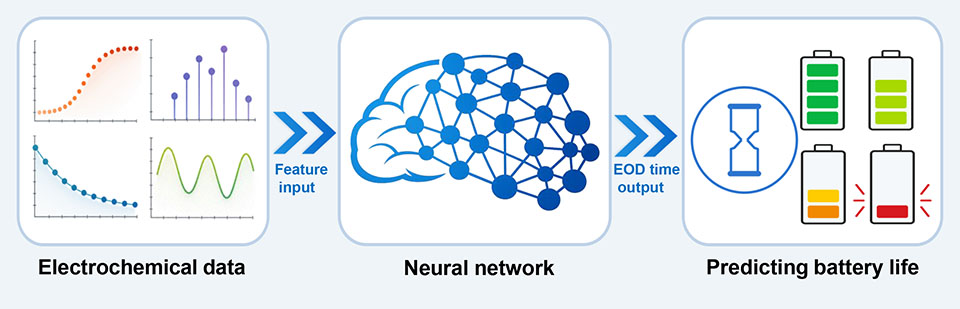
海水电解液基金属空气电池在海洋能源供给系统中展现出巨大应用潜力。然而,传统的统计分析手段虽可应用于海水金属空气电池的寿命预测,却存在预测精度不足、误差偏大的固有局限。本文提出一种基于InceptionTime并融合先验偏置注意力池化的深度时序回归框架,用以构建电化学性能序列与催化剂放电终止时间之间的非线性映射关系。具体而言,采用计时电流曲线提取长期稳定性特征,同时引入源自线性扫描伏安法的先验知识,以强化模型对关键电位区间的注意力权重。在嵌套留一催化剂交叉验证框架下,结合单标准误差准则进行迭代轮次选取,该模型在小样本测试集上,经多种聚合策略验证均表现出高度一致性,决定系数(R2)可达0.90以上。研究结果表明,通过注意力驱动的回归框架将多尺度时序特征与电化学先验知识相结合,可显著提升放电终止时间预测的准确性,从而为海水金属空气电池的催化剂评价及未来工程应用提供一种数据驱动范式。
申鹏鹏, 潘奕池, 刘育荣, 张露丹, 牛宁, 王冠军, 杨德坤, 田新龙, 饶鹏
. 基于电化学性能数据驱动的神经网络预测海水电解液金属空气电池放电终止时间[J]. 电化学, 0
: 0
.
DOI: 10.61558/2993-074X.3616
Seawater electrolyte-based metal-air batteries exhibit great promise for marine energy supply systems. However, conventional statistical analysis methods, though applicable to seawater metal-air battery lifetime prediction, have inherent limitations of insufficient prediction accuracy and large error. Herein, a deep time-series regression framework based on InceptionTime and incorporating prior-biased attention pooling is proposed to construct a nonlinear mapping between electrochemical performance sequences and the discharge termination time of catalysts. Specifically, chronoamperometry profiles are employed to extract long-term stability features, while prior knowledge derived from linear sweep voltammetry is introduced to strengthen the attention weighting over critical potential regions. Under a nested leave-one-catalyst-out cross-validation framework with the one-standard-error rule for epoch selection, the model demonstrates high consistency across various aggregation strategies on a small-sample test set containing different air cathode catalysts, yielding a coefficient of determination (R2) of over 0.90. These findings suggest that integrating multiscale temporal features with electrochemical prior knowledge through an attention-driven regression framework can improve the prediction accuracy and reduce the prediction error of discharge termination time in the current dataset, thereby providing a preliminary data-driven approach for catalyst evaluation in seawater metal-air batteries.