原位自组装SmMn2O5-NiMn2O4双相复合阴极的制备及性能研究
收稿日期: 2026-03-31
修回日期: 2026-04-26
录用日期: 2026-05-14
网络出版日期: 2026-05-14
Preparation and Performance Study of In-Situ Self-Assembled Biphasic SmMn2O5-NiMn2O4 Composite Cathode
Neng-Chu Xia: Conceptualization, data curation, formal analysis, investigation, and writing-original draft. Yu Zhou: Conceptualization, investigation, and project administration. Qin Wang: Project administration. Jia-You Zhang: Software and supervision. Chun Yu: Supervision and validation. Yang Zhang: Writing-review & editing. Wan-Bing Guan: Funding acquisition, resources, validation, and writing-review & editing. Jian-Xin Wang: Methodology, supervision, project administration, and writing-review & editing. All authors discussed the results, reviewed the manuscript, and approved the final version.
Received date: 2026-03-31
Revised date: 2026-04-26
Accepted date: 2026-05-14
Online published: 2026-05-14
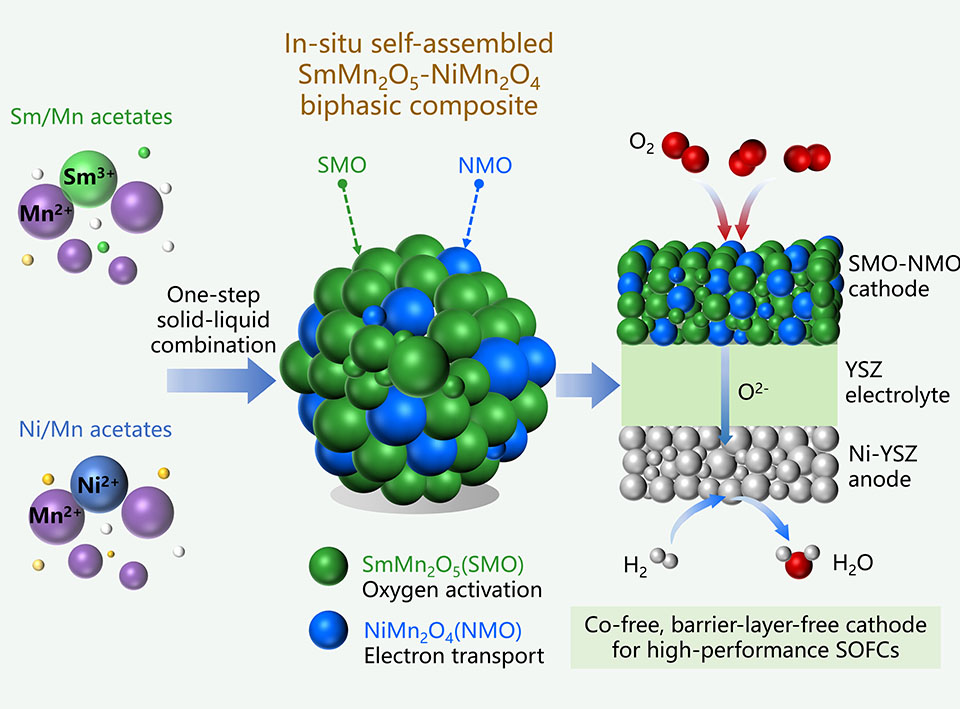
莫来石结构氧化物具有优异的氧还原反应活性,得益于其独特的晶体结构而表现出较低的热膨胀系数(TEC),且由于不含碱土元素,可避免使用阻挡层并简化制备工艺。因此,它们作为新型固体氧化物燃料电池阴极材料具有广阔的应用前景。本工作通过固-液复合路线一步法合成了莫来石-尖晶石结构的SmMn2O5-NiMn2O4(SMO-NMO)复合阴极,其原位自组装特性使其在无需阻挡层的情况下即可与电解质实现良好的界面匹配。表征结果表明,当SMO:NMO=5:5(SN55)时,复合阴极通过两相之间的协同作用,克服了单相材料的性能瓶颈-即纯SMO导电性低(800 °C时仅为0.035 S·cm-1)以及纯NMO氧还原反应活性不足的问题。在800 °C下,全电池的峰值功率密度达到1069.82 mW·cm-2,分别为纯SMO(329.92 mW·cm-2)和纯NMO(890.20 mW·cm-2)的3.24倍和1.20倍。以SN55为阴极的全电池在750 °C、540 mA·cm-2条件下恒流放电150 h后,电压衰减约为1.6%,平均衰减率为5.62%/kh,且阴极-电解质界面未出现任何缺陷与元素偏析。本研究为设计无阻挡层固体氧化物燃料电池阴极材料提供了一条新的思路。
夏能楚 , 周宇 , 王琴 , 张家友 , 余春 , 张旸 , 官万兵 , 王建新 . 原位自组装SmMn2O5-NiMn2O4双相复合阴极的制备及性能研究[J]. 电化学, 2026 , 32(7) : 2603211 . DOI: 10.61558/2993-074X.3615
Mullite-structured oxides exhibit excellent oxygen reduction reaction activity, possess a low thermal expansion coefficient due to their unique crystal structure, and can eliminate the need for a barrier layer and simplify the preparation process as they contain no alkaline earth elements. Thus, they hold great promise as novel cathode materials for solid oxide fuel cells. In this work, a mullite-spinel-structured SmMn2O5-NiMn2O4 (SMO-NMO) composite cathode was one-step synthesized via a solid-liquid composite route, and its in-situ self-assembly enabled good compatibility with the electrolyte without any barrier layer. Characterization results showed that the SMO:NMO = 5:5 (SN55)composite cathode overcame the bottlenecks of single-phase materials-namely, the low conductivity of pure SMO (only 0.035 S·cm-1 at 800 °C) and the insufficient oxygen reduction reaction activity of pure NMO-through a synergistic effect between the two phases. At 800 °C, the single cell delivered a peak power density of 1069.82 mW·cm-2, which was 3.24-fold and 1.20-fold higher than that of pure SMO (329.92 mW·cm-2) and NMO (890.20 mW·cm-2), respectively. Under galvanostatic operation at 750 °C (current density corresponding to 540 mA·cm-2), the SN55-based cell runs for ~150 h with only 1.6% voltage loss, corresponding to a degradation rate of 5.62%/kh, and no defects appeared at the cathode-electrolyte interface. This study provided a new route for designing barrier-layer-free cathodes for solid oxide fuel cells.
Key words: Solid Oxide Fuel Cell; Cathode; Mullite; Barrier-free; In-situ Composite
| [1] | Singh M, Zappa D, Comini E. Solid oxide fuel cell: Decade of progress, future perspectives and challenges[J]. Int. J. Hydrogen Energy, 2021, 46(54): 27643-27674. https://doi.org/10.1016/j.ijhydene.2021.06.020. |
| [2] | Feng P, Yang K, Liu X Y, Zhang J J. A review of advanced SOFCs and SOECs: materials, innovative synthesis, functional mechanisms, and system integration[J]. eScience, 2025, 6(2): 100460. https://doi.org/10.1016/j.esci.2025.100460. |
| [3] | Zheng Z H, Luo X L, Hou B X, Liu B, Jia L C, Xie X P, Luo D W, Wang C C. Novel high entropy double pervoskite cathode for solid oxide fuel cells[J]. J. Alloys Compd., 2023, 968: 172102. https://doi.org/10.1016/j.jallcom.2023.172102. |
| [4] | Gu X K, Nikolla E. Design of Ruddlesden-Popper oxides with optimal surface oxygen exchange properties for oxygen reduction and evolution[J]. ACS Catal., 2017, 7 (9): 5912-5920. https://doi.org/10.1021/acscatal.7b01483. |
| [5] | Ghosh A, Sahu A K, Gulnar A K, Suri A K. Synthesis and characterization of lanthanum strontium manganite[J]. Scr. Mater., 2005, 52(12): 1305-1309. https://doi.org/10.1016/j.scriptamat.2005.02.020. |
| [6] | Cai W Q, Zheng Q R, Yuan J L, Yu W N, Yin Z B, Wu Y, Zhang Z G. Thermo-electro-chemo-mechanical coupled modeling of solid oxide fuel cell with LSCF-GDC composite cathode[J]. Int. J. Mol. Sci., 2023, 24(4): 4137. https://doi.org/10.3390/ijms24044137. |
| [7] | Li M S, Lu F, Cui R W, Shi L, Wang J F, He H, Su J R, Cai B. High performance thermal expansion offset LSCF-SZM cathodes of IT-SOFCs[J]. Solid State Ionics, 2024, 414: 116639. https://doi.org/10.1016/j.ssi.2024.116639. |
| [8] | Hanif M B. Tailoring thermal expansion for next-generation energy systems: Integrating the potential of NTE materials in SOFCs and beyond[J]. J. Power Sources, 2025, 633: 236460. https://doi.org/10.1016/j.jpowsour.2025.236460. |
| [9] | Zhou Y, Ye T K, Xia N C, Guan W B, Yang J, Zhu L Z, Gao Y F, Wu A Q, Wang J X. The application of cobalt-free spinel Ni1.4Mn1.6O4 as a cathode in intermediate temperature solid oxide fuel cells[J]. J. Alloys Compd., 2025, 1024: 180288. https://doi.org/10.1016/j.jallcom.2025.180288. |
| [10] | Shu G J, Wu P C, Chou F C. The spin-orbit-phonon coupling and crystalline elasticity of LaCoO3 perovskite[J]. RSC Adv., 2020, 10(70): 43117-43128. https://doi.org/10.1039/D0RA09675J. |
| [11] | Hardy V, Guillou F, Bréard Y. Jumps in entropy and magnetic susceptibility at the valence and spin-state transition in a cobalt oxide[J]. J. Phys.: Condens. Matter, 2013, 25(24): 246003. https://doi.org/10.1088/0953-8984/25/24/246003. |
| [12] | Wang W C, McCool G, Kapur N, Yuan G, Shan B, Nguyen M, Graham U M, Davis B, Jacobs G, Cho K, Hao X. Mixed-phase oxide catalyst based on Mn-mullite (Sm, Gd) Mn2O5 for NO oxidation in diesel exhaust[J]. Science, 2012, 337(6096): 832-835. https://doi.org/10.1126/science.1225091. |
| [13] | Wen X R, Wang X W, Ma K, Chen Y L, Yu C, Yuan Z H. Optimized oxygen reduction reaction of Sm0.7La0.3Mn2O5 nanorods by a lanthanum dopant for zinc-air batteries[J]. ACS Appl. Energy Mater., 2022, 5(6): 7356-7363. https://doi.org/10.1021/acsaem.2c00863. |
| [14] | Liu J, Yu M, Wang X W, Wu J, Wang C H, Zheng L J, Yang D C, Liu H, Yao Y, Lu F, Wang W C. Investigation of high oxygen reduction reaction catalytic performance on Mn-based mullite SmMn2O5[J]. J. Mater. Chem. A, 2017, 5(39): 20922-20931. https://doi.org/10.1039/C7TA02905E. |
| [15] | Duan Y C, Li H, Li S Q, Zhou Y, Liu R X, Gao Z C, Guan W B, Yang J, Wang J X, Wan X, Zhao C, Wang W C. Thermal expansion matching as a key criterion for developing high‐performance Mn‐based mullite cathodes in SOFCs[J]. Adv. Mater., 2026, 38(4): e13615. https://doi.org/10.1002/adma.202513615. |
| [16] | Yao Y C, Feng J Y, Xu L F, Zhang W F, Wang F H, Yan P, Zhang J, Hu Q, Zhou Y C, Wang S R, Li J Q. In situ construction of a high‐entropy perovskite based tri‐phase composite electrode toward efficient reversible solid oxide cells[J]. Adv. Mater., 2025, 37(45): e12257. https://doi.org/10.1002/adma.202512257. |
| [17] | Zhuang W B, Li J H, Cao Q, Qin L J, Jia J, Liu J F. Microstructure, mechanical properties and strengthening mechanism of in-situ synthesized TiC/6061 nanocomposites[J]. Heliyon, 2024, 10(17): e37122. https://doi.org/10.1016/j.heliyon.2024.e24676. |
| [18] | Cai T T, Xia J, Feng Z C, Wang X, Jiang Y L, Su X Y. A-site doped mullite-type oxides A0.5Sm0.5Mn2O5 (A=Y, Pr) with boosted Hg0 removal performance under high GHSV[J]. Fuel, 2025, 398: 135570. https://doi.org/10.1016/j.fuel.2025.135570. |
| [19] | Dong C, Liu Z W, Liu J Y, Wang W C, Cui L, Luo R C, Guo H L, Zheng X L, Qiao S Z, Du X W, Yang J. Modest oxygen‐defective amorphous manganese‐based nanoparticle mullite with superior overall electrocatalytic performance for oxygen reduction reaction[J]. Small, 2017, 13(16): 1603903. https://doi.org/10.1002/smll.201603903. |
| [20] | Stoerzinger K A, Risch M, Han B, Horn Y. Recent insights into manganese oxides in catalyzing oxygen reduction kinetics[J]. ACS Catal., 2015, 5(10): 6021-6031. https://doi.org/10.1021/acscatal.5b01444. |
| [21] | Aoki Y, Takase K, Kiuchi H, Kowalski D, Sato Y, Toriumi H, Kitano S, Habazaki H. In situ activation of a manganese perovskite oxygen reduction catalyst in concentrated alkaline media[J]. J. Am. Chem. Soc., 2021, 143(17): 6505-6515. https://doi.org/10.1021/jacs.1c00449. |
| [22] | Yadav P L, Shelke A R, Wang H T, Chen K H, Lin W X, Li C W, Chen M Y, Yeh P H, Dong C L, Qorbani M, Huang Y C, Chiou J W, Tsai H M, Kadam P M, Chen K H, Chen L C, Pong W F, Wang H T. Mn3+eg configuration and electron transfer in Na-Incorporating α-MnO2 to improve electrochemical supercapacitor: An in situ and ex situ X-ray absorption spectroscopic investigation[J]. ACS Appl. Energy Mater., 2023, 6(12): 6443-6455. https://doi.org/10.1021/acsaem.3c00263. |
| [23] | Li X, Wang X W, Zhang K, Zhang X, Li S Q, Wang X. Interfacial synergy of SmMn2O5/Mn2O3: Electronic structure modulation for enhanced oxygen reduction reaction in zinc-air batteries[J]. Surf. Interfaces, 2025, 73: 107582. https://doi.org/10.1016/j.surfin.2025.107582. |
| [24] | Subramaniam T, Krishnaveni B S, Devaraj S. Tuning the surface oxygen vacancies of α-MnO2 to enhance the kinetics of ORR and OER[J]. J. Mater. Sci.: Mater. Electron., 2024, 35(17): 1184. https://doi.org/10.1007/s10854-024-12971-0. |
| [25] | Takasu Y, Matsui M, Tamura H, Kawamura S, Matsuda Y, Toyoshima I. Temperature-programmed desorption on the unstable lattice oxygen of praseodymium oxide[J]. J. Catal., 1981, 69(1): 51-57. https://doi.org/10.1016/0021-9517(81)90127-5. |
| [26] | Zhu Y N, Du C, Feng Z J, Chen Y J, Li H, Chen R, Shen M Q, Shan B. Highly dispersed Pd on macroporous SmMn2O5 mullite for low temperature oxidation of CO and C3H8[J]. RSC Adv., 2018, 8(10): 5459-5467. https://doi.org/10.1039/C7RA11551B. |
| [27] | Jin Q, Han L, Li N, Zhang T T, Gao E H, Yao M, Yao S L, Wu Z L, Li J, Zhu J L, Wang W. Exploring the influence of chemical state of Cu species on CO-SCR performance in spinel-type CuM2O4 (M= Co, Mn, Fe, Ni, and Cr): The synergy between Cu2+ and surface oxygen vacancy[J]. Fuel, 2024, 360: 130553. https://doi.org/10.1016/j.fuel.2023.130553. |
| [28] | Xu K, Zhang Y, Shan W, He H. Promotional effects of Sm/Ce/La doping on soot oxidation over MnCo2O4 spinel catalysts[J]. J. Phys. Chem. C, 2021, 125(48): 26484-26491. https://doi.org/10.1021/acs.jpcc.1c07736. |
| [29] | Dojcinovic M P, Vasiljevic Z Z, Krstic J B, Vujancevic J D, Markovic S, Tadic N B, Nikolic M V. Electrospun nickel manganite (NiMn2O4) nanocrystalline fibers for humidity and temperature sensing[J]. Sensors, 2021, 21(13): 4357. https://doi.org/10.3390/s21134357. |
| [30] | Lee S, Lee D, Kim K, Park M. Cation distribution in Ni-Mn-O spinel system for the application of IR sensors[J]. Procedia Eng., 2016, 168: 1279-1282. https://doi.org/10.1016/j.proeng.2016.11.447. |
| [31] | Schmidt R, Basu A, Brinkman A W, Klusek Z, Datta P K. Electron-hopping modes in NiMn2O4+δ materials[J]. Appl. Phys. Lett., 2005, 86(7): 073501. https://doi.org/10.1063/1.1866643. |
| [32] | Kong H F, Li X, Xuan L, Zhang T L, Wang Z Q, Zhang S W, Hou Y. Effects of substitutional doping on structural, electrical, and optical properties of nickel manganite NiMn2O4 films[J]. Appl. Phys. A, 2019, 125(2): 93. https://doi.org/10.1007/s00339-019-2394-2. |
| [33] | Fan H, Zheng L Z, Jia Y Z, Li W H, Yan Z L. Effect of Ni doping on Pr0.5Sr0.5FeO3-δ perovskite cathodes for solid oxide fuel cells[J]. Ceram. Int., 2025, 52(6): 7011-7019. https://doi.org/10.1016/j.ceramint.2025.12.448. |
| [34] | Ma Y Y, Li S B, Yan Z, An S L, Qiao H L, Liu Y P, Zhang J, Zhang X, Zhang G R, Zhao J. Regulation of electronic and ionic transport in Ni-doped La0.6Sr0.4 FeO3-δ for enhanced oxygen reduction in intermediate-temperature solid oxide fuel cells[J]. Phys. Chem. Chem. Phys., 2025, 27(35): 18309-18316. https://doi.org/10.1039/D5CP02679B. |
| [35] | Hou B X, Xiang J L, Liu L H, Tang R, Wang X T, Tan Z X, Gholizadeh M, Wang C C. Synergistic preparation of nano-sized PrBa0.5Sr0.5Co1.5Fe0.5O5+δ-LaCo0.6Ni0.4O3-δ cathodes of solid oxide fuel cells[J]. J. Solid State Electrochem., 2025, 29(7): 2791-2800. https://doi.org/10.1007/s10008-024-06187-9. |
| [36] | Nadeem M, Hu B, Xia C. Effect of NiO addition on oxygen reduction reaction at lanthanum strontium cobalt ferrite cathode for solid oxide fuel cell[J]. Int. J. Hydrogen Energy, 2018, 43(16): 8079-8087. https://doi.org/10.1016/j.ijhydene.2018.03.053. |
| [37] | Osinkin D A. Detailed analysis of electrochemical behavior of high-performance solid oxide fuel cell using DRT technique[J]. J. Power Sources, 2022, 527: 231120. https://doi.org/10.1016/j.jpowsour.2022.231120. |
| [38] | Chen T, Zhang H L, Zheng G Z, Xue Q, Huang Z Z, Zhou Y C, Wang S. A high-strength solid oxide fuel cell supported by an ordered porous cathode membrane[J]. Membranes, 2024, 14(2): 44. https://doi.org/10.3390/membranes14020044. |
/
| 〈 |
|
〉 |