碱性海水电解镍基阳极的动态表面重构工程实现抗腐蚀
收稿日期: 2026-03-10
修回日期: 2026-04-15
录用日期: 2026-05-09
网络出版日期: 2026-05-09
Dynamic Reconstruction Engineering of Anti-Corrosion Ni-Based Anodes for Alkaline Seawater Electrolysis
Zhi-Yi Lu and Tian-Yu Zhang conceptualized the work, supervised the project and revised the manuscript. Yi-Gang Zhang and Wen-Wen Xu wrote the original draft and prepared the figures. All authors discussed the content and approved the final version.
Received date: 2026-03-10
Revised date: 2026-04-15
Accepted date: 2026-05-09
Online published: 2026-05-09
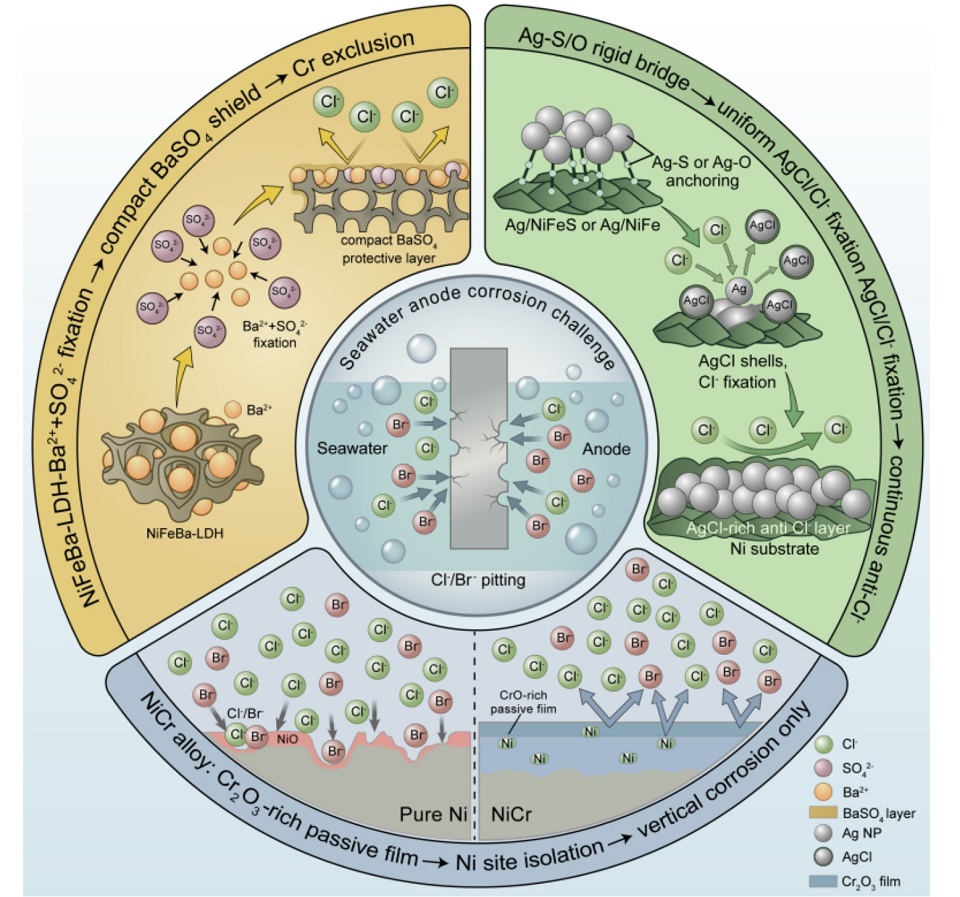
碱性海水电解制备绿氢为缓解能源危机和气候挑战提供了一条环境友好、可持续且极具成本效益的绿色路线。然而,其复杂的离子环境和工业级大电流密度使阳极的稳定性成为亟待解决的瓶颈问题。镍基阳极不仅面临海水复杂卤素离子的腐蚀,同时会在析氧反应过程中发生表面重构,因此需发展动态防腐策略兼顾此特点。本微综述系统总结了从模拟海水的单一离子环境到真实海水的复杂离子环境,开发用于碱性海水电解抗腐蚀镍基阳极的重构工程策略。本文聚焦本课题组在动态重构策略中的进展,为提供全面视角,本文也涉及基于动态重构引发的化学吸附及固定的防腐蚀策略。具体涵盖以下电解液环境:(i)氯离子主导环境;(ii) 氯离子与含氧阴离子共存环境;以及(iii) 氯离子与溴离子共存环境。在氯离子主导的腐蚀性环境中,在催化剂中引入银组分可使其在工作电位下原位重构生成氯化银。该过程以氯化银的形式固定氯离子,利用同离子排斥效应抑制了界面处氯离子的富集与渗透。在氯离子与含氧阴离子共存的环境中,镍基表面重构产生的羟基氧化物物种优先吸附含氧阴离子,从而形成稳定的阴离子屏蔽层。该屏蔽层降低了氯离子靠近和吸附的概率,有效缓解了由氯离子引发的腐蚀。此外,本文还总结了在氯离子与溴离子共存环境中溴化物引发阳极腐蚀的潜在机制,以及相应的抑制重构策略。最后,本文提出了具有普适性的阳极设计原则,旨在推动海水电解技术从材料级演示向器件级可靠运行迈进。
张益钢 , 徐雯雯 , 张天宇 , 陆之毅 . 碱性海水电解镍基阳极的动态表面重构工程实现抗腐蚀[J]. 电化学, 2026 , 32(7) : 2615001 . DOI: 10.61558/2993-074X.3613
Green hydrogen production via alkaline seawater electrolysis offers an environmentally sustainable and potentially cost-effective route to address both energy and climate challenges. Achieving long-term anode stability under complex ionic environments and industrial current densities remains a central bottleneck. Specifically, Ni-based anodes exhibit intense surface reconstruction during the oxygen evolution reaction, necessitating dynamic anti-corrosion strategies. This mini review systematically summarizes reconstruction engineering approaches to develop anti-corrosion Ni-based anodes of alkaline seawater electrolysis across increasingly complex ionic environments from simulated seawater to real seawater: (i) Cl- dominated; (ii) Cl- with co-existing oxyanions, and (iii) Cl- with co-existing Br-. Notably, the progress achieved by our group in dynamic reconstruction engineering is highlighted, as well as reported advances on reconstruction-induced chemical adsorption/fixation strategies to provide a broader mechanistic understanding. In a Cl- dominated corrosive environment, the introduction of Ag component enables in situ reconstruction into AgCl under the operating potential. This process immobilizes Cl- via AgCl formation and simultaneously suppresses interfacial Cl- enrichment and penetration through a co-ion exclusion effect. For Cl- with co-existing oxyanions, the oxyhydroxide species generated by Ni-based surface reconstruction preferentially adsorb oxygen-containing anions, thereby forming a stable anionic shielding layer. This layer lowers the probability of Cl- approach and adsorption, leading to effective mitigation of Cl--induced corrosion. Additionally, the mechanisms underlying bromide-induced anodic corrosion in Cl- with co-existing Br- are summarized, together with relevant reconstruction inhibition strategies. Finally, transferable anode design principles are proposed to push seawater electrolysis from materials demonstrations to device-level reliable operation.
| [1] | Chu S, Majumdar A. Opportunities and challenges for a sustainable energy future[J]. Nature, 2012, 488(7411): 294-303. https://doi.org/10.1038/nature11475. |
| [2] | Turner J A. Sustainable hydrogen production[J]. Science, 2004, 305(5686): 972-974. https://doi.org/10.1126/science.1103197. |
| [3] | Dong W J, Xiao Y X, Yang K R, Ye Z W, Zhou P, Navid I A, Batista V S, Mi Z T. Pt nanoclusters on GaN nanowires for solar-assisted seawater hydrogen evolution[J]. Nat. Commun., 2023, 14(1): 179. https://doi.org/10.1038/s41467-023-35782-z. |
| [4] | Frisch M L, Thanh T N, Arinchtein A, Hager L, Schmidt J, Brückner S, Kerres J, Strasser P. Seawater electrolysis using all-PGM-free catalysts and cell components in an asymmetric feed[J]. ACS Energy Lett., 2023, 8(5): 2387-2394. https://doi.org/10.1021/acsenergylett.3c00492. |
| [5] | Sha Q H, Wang S Y, Yan L, Feng Y S, Zhang Z, Li S H, Guo X L, Li T S, Li H, Zhuang Z B, Zhou D J, Liu B, Sun X M. 10,000-h-stable intermittent alkaline seawater electrolysis[J]. Nature, 2025, 639(8054): 360-367. https://doi.org/10.1038/s41586-025-08610-1. |
| [6] | Zhang X, Tong L, Huang Q B, Liang X, Shi X H, Bai X Y, Wang C Z, Liu Y P, Lin S W, Zou X X. Substrate-adaptive sacrificial corrosion strategy enables 700 mV oxygen evolution window for enhanced seawater electrolysis[J]. Nat. Commun., 2025, 17(1): 757. https://doi.org/10.1038/s41467-025-67439-4. |
| [7] | Liu T, Zhao Z Y, Tang W B, Chen Y, Lan C, Zhu L Y, Jiang W C, Wu Y F, Wang Y P, Yang Z Z, Yang D S, Wang Q J, Luo L B, Liu T S, Xie H P. In-situ direct seawater electrolysis using floating platform in ocean with uncontrollable wave motion[J]. Nat. Commun., 2024, 15(1): 5305. https://doi.org/10.1038/s41467-024-49639-6. |
| [8] | He X, Yao Y C, Zhang L M, Wang H F, Tang H, Jiang W L, Ren Y C, Nan J, Luo Y S, Wu T W, Luo F M, Tang B, Sun X P. Hexafluorophosphate additive enables durable seawater oxidation at ampere-level current density[J]. Nat. Commun., 2025, 16(1): 5349. https://doi.org/10.1038/s41467-025-60413-0. |
| [9] | Xie H P, Zhao Z Y, Liu T, Wu Y F, Lan C, Jiang W C A, Zhu L Y, Wang Y P, Yang D S, Shao Z P. A membrane-based seawater electrolyser for hydrogen generation[J]. Nature, 2022, 612(7941): 673-678. https://doi.org/10.1038/s41586-022-05379-5. |
| [10] | Tong W, Forster M, Dionigi F, Dresp S, Sadeghi Erami R, Strasser P, Cowan A J, Farràs P. Electrolysis of low-grade and saline surface water[J]. Nat. Energy, 2020, 5(5): 367-377. https://doi.org/10.1038/s41560-020-0550-8. |
| [11] | Li Z X, Liang J, Hong S H, Ren Y C, Zhang M, Sun S J, Cai Z W, Yang C X, Wang H F, Luo Y S, Liu S H, Yao Y C, Gong F, Sun X P, Tang B. A triple-defense electrocatalyst for robust seawater oxidation[J]. Nat. Commun., 2025, 16(1): 10327. https://doi.org/10.1038/s41467-025-65272-3. |
| [12] | Yu L, Zhu Q, Song S W, McElhenny B, Wang D Z, Wu C Z, Qin Z J, Bao J M, Yu Y, Chen S, Ren Z F. Non-noble metal-nitride based electrocatalysts for high-performance alkaline seawater electrolysis[J]. Nat. Commun., 2019, 10(1): 5106. https://doi.org/10.1038/s41467-019-13092-7. |
| [13] | He X, Yao Y C, Zhang M, Zhou Y L, Zhang L M, Ren Y C, Dong K, Tang H, Nan J, Zhou X L, Luo H, Ying B W, Yu Q, Luo F M, Tang B, Sun X P. Engineered PW12-polyoxometalate docked Fe sites on CoFe hydroxide anode for durable seawater electrolysis[J]. Nat. Commun., 2025, 16(1): 5541. https://doi.org/10.1038/s41467-025-60620-9. |
| [14] | Sun F, Qin J S, Wang Z Y, Yu M Z, Wu X H, Sun X M, Qiu J S. Energy-saving hydrogen production by chlorine-free hybrid seawater splitting coupling hydrazine degradation[J]. Nat. Commun., 2021, 12(1): 4182. https://doi.org/10.1038/s41467-021-24529-3. |
| [15] | Wang J Q, Liu Y, Yang G C, Jiao Y Q, Dong Y M, Tian C G, Yan H J, Fu H G. MXene-assisted NiFe sulfides for high-performance anion exchange membrane seawater electrolysis[J]. Nat. Commun., 2025, 16(1): 1319. https://doi.org/10.1038/s41467-025-56639-7. |
| [16] | Guo J, Zheng Y, Hu Z, Zheng C, Mao J, Du K, Jaroniec M, Qiao S Z, Ling T. Direct seawater electrolysis by adjusting the local reaction environment of a catalyst[J]. Nat. Energy, 2023, 8(3): 264-272. https://doi.org/10.1038/s41560-023-01195-x. |
| [17] | Yi L, Chen C H, Wen Y J, Zhang S X, Chen H C, Zhu J C, Weng J B, Zhang W Y, Xu W W, Guan W B, Chen X, Qiu T Y, Tian X L, Lu Z Y. Supersolidophobic Pt catalyst for long-term natural seawater electrolysis with hydrogen production and magnesium extraction[J]. Nat. Commun., 2025, 16(1): 11493. https://doi.org/10.1038/s41467-025-66473-6. |
| [18] | Marin D H, Perryman J T, Hubert M A, Lindquist G A, Chen L H K, Aleman A M, Kamat G A, Niemann V A, Stevens M B, Regmi Y N, Boettcher S W, Nielander A C, Jaramillo T F. Hydrogen production with seawater-resilient bipolar membrane electrolyzers[J]. Joule, 2023, 7(4): 765-781. https://doi.org/10.1016/j.joule.2023.03.005. |
| [19] | Cai Z, Liang J, Li Z, Yan T, Yang C, Sun S, Yue M, Liu X, Xie T, Wang T, Li T, Luo Y, Zheng D, Liu Q, Zhao J, Sun X, Tang B. Stabilizing NiFe sites by high-dispersity of nanosized and anionic Cr species toward durable seawater oxidation[J]. Nat. Commun., 2024, 15(1): 6624. https://doi.org/10.1038/s41467-024-51130-1. |
| [20] | Zhou L, Guo D, Wu L, Guan Z, Zou C, Jin H, Fang G, Chen X A, Wang S. A restricted dynamic surface self-reconstruction toward high-performance of direct seawater oxidation[J]. Nat. Commun., 2024, 15(1): 2481. https://doi.org/10.1038/s41467-024-46708-8. |
| [21] | Liang J, Cai Z W, Li Z X, Yao Y C, Luo Y S, Sun S J, Zheng D D, Liu Q, Sun X P, Tang B. Efficient bubble/precipitate traffic enables stable seawater reduction electrocatalysis at industrial-level current densities[J]. Nat. Commun., 2024, 15(1): 2950. https://doi.org/10.1038/s41467-024-47121-x. |
| [22] | Wu L B, Lu W H, Ong W L, Wong A S W, Zhang Y M, Zhang T X, Zeng K Y, Ren Z F, Ho G W. Photothermal-promoted anion exchange membrane seawater electrolysis on a nickel-molybdenum-based catalyst[J]. Nat. Commun., 2025, 16(1): 3098. https://doi.org/10.1038/s41467-025-58320-5. |
| [23] | Tang W B, Zhao Z Y, Yang D S, Liu Y H, Zhu L Y, Wu Y, Lan C, Jiang W C, Wu Y F, Liu T, Xie H P. A gel electrolyte-based direct seawater electrolysis[J]. Energy Environ. Sci., 2025, 18(14): 7048. https://doi.org/10.1039/d5ee00453e. |
| [24] | Dresp S, Thanh T N, Klingenhof M, Brückner S, Hauke P, Strasser P. Efficient direct seawater electrolysers using selective alkaline NiFe-LDH as OER catalyst in asymmetric electrolyte feeds[J]. Energy Environ. Sci., 2020, 13(6): 1725-1729. https://doi.org/10.1039/d0ee01125h. |
| [25] | Niu Q, Gao F Y, Sun X G, Zheng Y, Qiao S Z. Chloride-mediated electron buffering on Ni-Fe anodes for ampere-level alkaline seawater electrolysis[J]. Adv. Funct. Mater., 2025, 35(36): 2504872. https://doi.org/10.1002/adfm.202504872. |
| [26] | Han Y J, Shao L, Liu Y H, Li G D, Wang T Z, Zheng X R, Li J H, Han X P, Hu W B, Deng Y D. Sulfate-assisted Ni/Fe-based electrodes for anion exchange membrane saline splitting[J]. Nano Res., 2024, 17(7): 5985-5995. https://doi.org/10.1007/s12274-024-6646-x. |
| [27] | Li J K, Wu Q L, He B Q, Guan Z Y, Hong H M, Zhang G Q, Lei L F, Zhu M H, Zhuang L Z, Chen J, Xu Z. An integrated stainless steel-based electrode for durable direct natural seawater electrolysis[J]. Adv. Mater., 2026, 38(13): 2518307. https://doi.org/10.1002/adma.202518307. |
| [28] | Enkhtuvshin E, Yeo S H, Choi H, Kim K M, An B S, Biswas S, Lee Y J, Nayak A K, Jang J U, Na K H, Choi W Y, Ali G, Chae K H, Akbar M, Chung K Y, Yoo K, Chung Y C, Shin T H, Kim H, Chung C Y, Han H Y K. Surface reconstruction of Ni-Fe layered double hydroxide inducing chloride ion blocking materials for outstanding overall seawater splitting[J]. Adv. Funct. Mater., 2023, 33(22): 2214069. https://doi.org/10.1002/adfm.202214069. |
| [29] | Xiao L Y, Bai X, Han J Y, Tang T M, Chen S Y, Qi H, Hou C M, Bai F Q, Wang Z L, Guan J Q. Surface reconstruction and structural transformation of two-dimensional Ni-Fe MOFs for oxygen evolution in seawater media[J]. Nano Res., 2024, 17(4): 2429-2437. https://doi.org/10.1007/s12274-023-6088-x. |
| [30] | Zhang R W, Ji X W, Fan Y W, Yang F, Lin S W, Lu X H. Local coordination engineering of NiFe-LDH catalyst with carboxylate and sodium for durable seawater oxygen evolution[J]. Appl. Catal. B Environ. Energy, 2026, 381: 125850. https://doi.org/10.1016/j.apcatb.2025.125850. |
| [31] | Ding P, Song H Q, Chang J W, Lu S Y. N-doped carbon dots coupled NiFe-LDH hybrids for robust electrocatalytic alkaline water and seawater oxidation[J]. Nano Res., 2022, 15(8): 7063-7070. https://doi.org/10.1007/s12274-022-4377-4. |
| [32] | Ren Y W, Fan F Y, Zhang Y J, Chen L, Wang Z, Li J D, Zhao J W, Tang B, Cui G L. A dual-cation exchange membrane electrolyzer for continuous H2 production from seawater[J]. Adv. Sci., 2024, 11(25): 2401702. https://doi.org/10.1002/advs.202401702. |
| [33] | Li Z H, Lin G X, Wang L Q, Lee H, Du J, Tang G, Ding G H, Ren R, Li W L, Cao X, Ding S W, Ye W T, Yang W X, Sun L C. Seed-assisted formation of NiFe anode catalysts for anion exchange membrane water electrolysis at industrial-scale current density[J]. Nat. Catal., 2024, 7(8): 944-952. https://doi.org/10.1038/s41929-024-01209-1. |
| [34] | He D T, Yang P J, Yang K Z, Qiu J S, Wang Z Y. Durable seawater electrolysis enabled by chloride rejection on hydroxide trapping anode[J]. J. Energy Chem., 2025, 107: 407-415. https://doi.org/10.1016/j.jechem.2025.03.063. |
| [35] | Kang X, Yang F N, Zhang Z Y, Liu H M, Ge S Y, Hu S Q, Li S H, Luo Y T, Yu Q M, Liu Z B, Wang Q, Ren W C, Sun C H, Cheng H M, Liu B L. A corrosion-resistant RuMoNi catalyst for efficient and long-lasting seawater oxidation and anion exchange membrane electrolyzer[J]. Nat. Commun., 2023, 14(1): 3607. https://doi.org/10.1038/s41467-023-39386-5. |
| [36] | Hu H S, Zhang Z R, Liu L J, Che X L, Wang J C, Zhu Y, Attfield J P, Yang M H. Efficient and durable seawater electrolysis with a V2O3-protected catalyst[J]. Sci. Adv., 2024, 10(20): eadn7012. https://doi.org/10.1126/sciadv.adn7012. |
| [37] | Li J H, Chen H, You S H, Yang G X, Liu P, Gao M Q, Chen S G, Zhang F F. Highly anti-corrosive NiFe LDHs-NiFe alloy hybrid enables long-term stable alkaline seawater electrolysis[J]. Rare Metals, 2024, 43(9): 4321-4332. https://doi.org/10.1007/s12598-024-02780-z. |
| [38] | Xing Z H, Zhao Y, Wang Y H, Liu X H, Guo Z Q, Chen Q Y. Boosting charge transfer via interface charge reconstruction between amorphous NiFe-LDH and crystalline NiCo2O4 for efficient alkaline water/seawater oxidation[J]. Nano Res., 2024, 17(6): 4856-4863. https://doi.org/10.1007/s12274-024-6469-9. |
| [39] | Yao Y C, Sun S J, Zhang H, Li Z X, Yang C X, Cai Z W, He X, Dong K, Luo Y L, Wang Y, Ren Y C, Liu Q, Zheng D D, Zhuang W H, Tang B, Sun X P, Hu W C. Enhancing the stability of NiFe-layered double hydroxide nanosheet array for alkaline seawater oxidation by Ce doping[J]. J. Energy Chem., 2024, 91: 306-312. https://doi.org/10.1016/j.jechem.2024.01.011. |
| [40] | Dao H T, Sidra S, Hoa V, Nguyen Q H, Mai M, Tran P K L, Kim D. In situ growth and interfacial reconstruction of Mo-doped Ni3S2/VO2 as anti-corrosion electrocatalyst for long-term durable seawater splitting[J]. Appl. Catal. B Environ. Energy, 2025, 365: 124925. https://doi.org/10.1016/j.apcatb.2024.124925. |
| [41] | Li Z X, Yao Y C, Sun S J, Liang J, Hong S H, Zhang H, Yang C X, Zhang X F, Cai Z W, Li J, Ren Y C, Luo Y S, Zheng D D, He X, Liu Q, Wang Y, Gong F, Sun X P, Tang B. Carbon oxyanion self-transformation on NiFe oxalates enables long-term ampere-level current density seawater oxidation[J]. Angew. Chem. Int. Ed., 2024, 63(1): e202316522. https://doi.org/10.1002/anie.202316522. |
| [42] | Guo D X, Zong M Y, Zhao Z, Fan C Z, Wang D H. A dual-strategy of interface and reconstruction engineering to boost efficient alkaline water and seawater oxidation[J]. Sustain. Energ. Fuels, 2022, 6(24): 5521-5530. https://doi.org/10.1039/d2se01200f. |
| [43] | Tang X L, Yang N, Li Z X, Cai Z W, Dai Q Y, Wang H F, He X, Yao Y C, Li T S, Guo J, Niu X B, Sun X P. NiFe-based arrays with manganese dioxide enhance chloride blocking for durable alkaline seawater oxidation[J]. J. Colloid Interface Sci., 2025, 684: 64-72. https://doi.org/10.1016/j.jcis.2025.01.106. |
| [44] | Li T, Yang C X, Cai Z W, Li Z X, Sun S J, Wang X Y, Zhang M, Yue M, Wang H F, Zhang X X, Zheng D D, Yao Y C, Luo Y S, Hamdy M S, Ibrahim F A, Sun X P, Tang B. Surface borate layer dramatically enhances the stability of NiFe-layered double hydroxide for alkaline seawater oxidation[J]. Mater. Today Phys., 2025, 50: 101612. https://doi.org/10.1016/j.mtphys.2024.101612. |
| [45] | Jadhav A R, Kumar A, Lee J, Yang T, Na S, Lee J, Luo Y, Liu Y, Hwang Y, Liu Y, Lee H. Stable complete seawater electrolysis by using interfacial chloride ion blocking layer on catalyst surface[J]. J. Mater. Chem. A, 2020, 8(46): 24501-24514. https://doi.org/10.1039/d0ta08543j. |
| [46] | Zhang M, Sun Y Z, Meng C C, Xu Q J, Zhang Y, Li X H, Fan L Z, Li T F, Li Y C. Electrodeposition of oxyanion films as universal chloride ion-repelling layers for efficient and stable seawater oxidation at ampere-level current density[J]. J. Mater. Chem. A, 2025, 13(14): 9886-9898. https://doi.org/10.1039/d4ta09017a. |
| [47] | Huang W Z, Liu S L, Li J T, Wang G Y, Lu R H, Zhao Y, Wang Y T, Wang Z Y, Qu L B, Zhou L, Mai L Q. Selective anion-gating interlayer enables chloride-resistant and long-life alkaline seawater electrolysis[J]. Interdiscip. Mater., 2026, 5(1): 180-191. https://doi.org/10.1002/idm2.70031. |
| [48] | Dong F, Duan H, Lin Z D, Yuan H F, Ju M, Du X J, Gao J Q, Yu J, Yang S H. Unravelling the effect of Cl- on alkaline saline water electrooxidation on NiFe (oxy)hydroxides[J]. Appl. Catal. B Environ. Energy, 2024, 340: 123242. https://doi.org/10.1016/j.apcatb.2023.123242. |
| [49] | Shen P L, Zhu J W, Deng C, Zhu S Q, He X M, Ouyang W G, Tu X, Zhang H Y, Lin R C. Dynamic stability in intermittent seawater electrolysis via frustrated lewis pair engineering[J]. Adv. Sci., 2026, 13(7): e2518514. https://doi.org/10.1002/advs.202518514. |
| [50] | Ren Y C, Guo Y X, Li Z X, Hong S H, Sun S J, Yang C X, Ibrahim F A, Hamdy M S, Gong F, Lv Y Q, Sun X P, Tang B. Palladium-chloride ion coordination stabilizes NiFe layered double hydroxides for alkaline seawater oxidation at industrial current densities[J]. J. Colloid Interface Sci., 2025, 700: 138388. https://doi.org/10.1016/j.jcis.2025.138388. |
| [51] | Liu H, Shen W, Jin H Y, Xu J, Xi P X, Dong J C, Zheng Y, Qiao S Z. High-performance alkaline seawater electrolysis with anomalous chloride promoted oxygen evolution reaction[J]. Angew. Chem. Int. Ed., 2023, 62(46): e202311674. https://doi.org/10.1002/anie.202311674. |
| [52] | Duan X X, Sha Q H, Li P S, Li T S, Yang G T, Liu W, Yu E D, Zhou D J, Fang J J, Chen W X, Chen Y Z, Zheng L R, Liao J W, Wang Z Y, Li Y P, Yang H B, Zhang G X, Zhuang Z B, Hung S F, Jing C F, Luo J, Bai L, Dong J C, Xiao H, Liu W, Kuang Y, Liu B, Sun X M. Dynamic chloride ion adsorption on single iridium atom boosts seawater oxidation catalysis[J]. Nat. Commun., 2024, 15(1): 1973. https://doi.org/10.1038/s41467-024-46140-y. |
| [53] | Liu K, Cai Y H, Wei X T, Qu L H, Lu J X, Qi Y W, Wang Z B, Liu D. Dual chloride confinement in noble metal-doped NiV LDH catalysts enables stable industrial-level seawater electrolysis[J]. Nano-Micro Lett., 2026, 18(1): 210. https://doi.org/10.1007/s40820-026-02067-1. |
| [54] | Xu W, Wang Z, Liu P Y, Tang X, Zhang S X, Chen H C, Yang Q H, Chen X, Tian Z Q, Dai S, Chen L, Lu Z Y. Ag nanoparticle-induced surface chloride immobilization strategy enables stable seawater electrolysis[J]. Adv. Mater., 2024, 36(2): 2306062. https://doi.org/10.1002/adma.202306062. |
| [55] | Mu J W, Liu S, Yu C, Yang W X, Song X D, Liu Y B, Dong J T, Zhao J R, Chen L, Qiu J S. Intensified accumulation of OH- and improved electron transfer by reactive chlorine-resistant layer achieve high-durability seawater electrolysis[J]. Adv. Mater., 2026, 38(14): 2520960. https://doi.org/10.1002/adma.202520960. |
| [56] | Chen H C, Zhang S X, Wen Y J, Yi L, Wang D G, Zhu J C, Chen X, Zhang W Y, Xu W W, Nai J W, Lu Z Y. Sulfurization-induced uniform Ag nanoparticles anchoring for long-lasting anode protection in alkaline seawater electrolysis[J]. J. Energy Chem., 2026, 115: 447-455. https://doi.org/10.1016/j.jechem.2025.11.048. |
| [57] | Yu M, Li J H, Liu F M, Liu J D, Xu W C, Hu H L, Chen X J, Wang W C, Cheng F Y. Anionic formulation of electrolyte additive towards stable electrocatalytic oxygen evolution in seawater splitting[J]. J. Energy Chem., 2022, 72: 361-369. https://doi.org/10.1016/j.jechem.2022.04.004. |
| [58] | Mahadik S, Surendran S, Choi J, Jeong G H, Lim H, Janani G, An T Y, Moon D J, Lu X Y, Kwon G, Choi H, Choi C H, Bae K, Kim T H, Sim U. Oxyanion-regulated Fe-NiMoN electrocatalyst for efficient and durable alkaline seawater electrolysis: Advancing energy chemistry through interface engineering[J]. Int. J. Hydrog. Energy, 2026, 203: 153017. https://doi.org/10.1016/j.ijhydene.2025.153017. |
| [59] | Ma T F, Xu W W, Li B R, Chen X, Zhao J J, Wan S S, Jiang K, Zhang S X, Wang Z F, Tian Z Q, Lu Z Y, Chen L. The critical role of additive sulfate for stable alkaline seawater oxidation on nickel-based electrodes[J]. Angew. Chem. Int. Ed., 2021, 60(42): 22740-22744. https://doi.org/10.1002/anie.202110355. |
| [60] | Tan L, Yu J T, Wang C, Wang H F, Liu X E, Gao H T, Xin L T, Liu D Z, Hou W G, Zhan T R. Partial sulfidation strategy to NiFe-LDH@FeNi2S4 heterostructure enable high-performance water/seawater oxidation[J]. Adv. Funct. Mater., 2022, 32(29): 2200951. https://doi.org/10.1002/adfm.202200951. |
| [61] | Chen H C, Liu P P, Li W B, Xu W W, Wen Y J, Zhang S X, Yi L, Dai Y Q, Chen X, Dai S, Tian Z Q, Chen L, Lu Z Y. Stable seawater electrolysis over 10000 h via chemical fixation of sulfate on NiFeBa-LDH[J]. Adv. Mater., 2024, 36(45): 2411302. https://doi.org/10.1002/adma.202411302. |
| [62] | Sun X G, Shen W, Liu H, Xi P X, Jaroniec M, Zheng Y, Qiao S Z. Corrosion-resistant NiFe anode towards kilowatt-scale alkaline seawater electrolysis[J]. Nat. Commun., 2024, 15(1): 10351. https://doi.org/10.1038/s41467-024-54754-5. |
| [63] | Wang P, Zheng J, Li Y Y, Shi Q F, Zhang J, Wan Y, Niu M, Yamauchi Y, Long Y Z. Catalyst for industrial-scale seawater electrolysis: inhibit active metal dissolution and chlorine corrosion[J]. Adv. Sci., 2025, 12(45): e2514301. https://doi.org/10.1002/advs.202514301. |
| [64] | Tian P F, Zong W, Xiong J, Liu W, Liu J Q, Dai Y H, Zhu J X, Huang S T, Song S W, Chu K B, He G J, Han N. Dynamic reconstruction of crystal/amorphous hetero-phosphate janus interfaces for highly stable seawater splitting[J]. Adv. Funct. Mater., 2025, 35(42): 2504862. https://doi.org/10.1002/adfm.202504862. |
| [65] | Liu X, Chen W M, Li G, Xue M Y, Li Z, Liu Q, Zhuo H Y, Chen Y L. Phosphate-Induced oxygen vacancies and surface reconstruction of CoFe2O4 for industrial-grade seawater oxidation[J]. Appl. Catal. A Gen., 2026, 711: 120721. https://doi.org/10.1016/j.apcata.2025.120721. |
| [66] | Fan R L, Liu C H, Li Z H, Huang H T, Feng J Y, Li Z S, Zou Z G. Ultrastable electrocatalytic seawater splitting at ampere-level current density[J]. Nat. Sustain., 2024, 7(2): 158-167. https://doi.org/10.1038/s41893-023-01263-w. |
| [67] | Sun C Y, Zhang Z Y, Jang H, Li Z J, Kim M G, Cho J, Liu S G, Liu X, Hou L Q. Rational design of nitrate-intercalated NiFe LDH with dual chloride-blocking mechanisms for stable alkaline seawater oxidation[J]. Sci. China Chem., 2026, 69(3): 1240-1249. https://doi.org/10.1007/s11426-025-2983-5. |
| [68] | Luo F T, Yu P, Xiang J T, Jiang J J, Chen S J. In situ generation of oxyanions-decorated cobalt(nickel) oxyhydroxide catalyst with high corrosion resistance for stable and efficient seawater oxidation[J]. J. Energy Chem., 2024, 94: 508-516. https://doi.org/10.1016/j.jechem.2024.03.006. |
| [69] | Zhao Z, Qin S Y, Li X, Sun J P, Li Z Z, Meng X C. Sulfur-facilitated in situ deep reconstruction of transition metal molybdates toward superior electrocatalytic oxidation of alkaline seawater[J]. Chem. Catalysis, 2024, 4(11): 101144. https://doi.org/10.1016/j.checat.2024.101144. |
| [70] | Sun Z, Yin Y T, Liu S Y, Liao B, He B, Wang Z J, Lu X Q, Zhang X H. The internal-external synergy of self-reconstructed C/NiFeOOH/SeO42- for efficient and stable seawater electrolysis[J]. Adv. Sci., 2026, 13(19): e23396. https://doi.org/10.1002/advs.202523396. |
| [71] | Zhu J, Mao B G, Wang B, Cao M H. The dynamic anti-corrosion of self-derived space charge layer enabling long-term stable seawater oxidation[J]. Appl. Catal. B Environ. Energy, 2024, 344: 123658. https://doi.org/10.1016/j.apcatb.2023.123658. |
| [72] | Wang J Y, He C, Kang R Y, Liu B W, Zhang Z, Kong Y X, Huang Z C, Ma T, Wang M, Cheng C, Wu H, Wang Y, Li S. Janus-architected HEA-Mo2C heterophase catalysts with self-optimizing interfaces for efficient alkaline seawater electrooxidation[J]. Adv. Funct. Mater., 2026, 36(16): 2517862. https://doi.org/10.1002/adfm.202517862. |
| [73] | Wang T T, Wei X Y, Cheng Z H, Li X C, Liu K J, Ming L, Zhang L Y, Lyu J, Pan K M, Li Z H, Li R Q, Wang S X, Chen C, Kou Z K. In situ constructed chromate cover stabilizes seawater oxidation via competitively repelling chloride ions[J]. Nano Res., 2025, 18(12): 94907952. https://doi.org/10.26599/NR.2025.94907952. |
| [74] | Kadowaki M, Moronaga T, Nakamura A, Murase Y, Hashimoto T, Katayama H, Takanabe K, Tsutsumi Y. Corrosion inhibition of nickel achieved by phosphate addition into chloride-rich media toward seawater electrolysis[J]. J. Phys. Chem. C, 2025, 129(35): 15939-15948. https://doi.org/10.1021/acs.jpcc.5c04712. |
| [75] | Yu Y, Zhou W, Yuan J S, Zhou X H, Zhang X W, Li X H, Xia X, Zhang L Q, Chen Y J, Meng X X, Wang X X, Sun F, Gao J H, Zhao G B. Redefining catalyst reconstruction and Cl--repulsion correlation to delineate a dynamic protective skeleton for seawater splitting[J]. Nat. Commun., 2026, 17(1): 3014. https://doi.org/10.1038/s41467-026-69755-9. |
| [76] | Zhang S X, Wang Y A, Li S Y, Wang Z F, Chen H C, Yi L, Chen X, Yang Q H, Xu W W, Wang A Y, Lu Z Y. Concerning the stability of seawater electrolysis: a corrosion mechanism study of halide on Ni-based anode[J]. Nat. Commun., 2023, 14(1): 4822. https://doi.org/10.1038/s41467-023-40563-9. |
| [77] | Zhang X H, Zhang H L, Chen Z X, Chen X D, Wang J Y, Wei S X, Liu S Y, Wang Z J, Dai F N, Wang M H, Lu X Q. Self-adapting oxyanion armor achieves highly stable and efficient seawater electrolysis at ampere-level current densities[J]. Adv. Funct. Mater., 2025, 35(16): 2418940. https://doi.org/10.1002/adfm.202418940. |
| [78] | Liu W, Yu J G, Li T, Li T S, Ding B Y, Guo X L, Cao A Q, Sha Q H, Zhou D J, Kuang Y, Sun X M. Self-protecting CoFeAl-layered double hydroxides enable stable and efficient brine oxidation at 2 A cm-2[J]. Nat. Commun., 2024, 15(1): 4712. https://doi.org/10.1038/s41467-024-49195-z. |
| [79] | Zhang S X, Xu W W, Zhu J C, Wen Y J, Wang Y X, Dai Y Q, Chen H C, Yi L, Tian Z Q, Lu Z Y. Ni-X (X = Cl, Br) reaction energy barrier regulation in passive film for stable oxygen evolution reaction in alkaline seawater[J]. Adv. Mater., 2026, 38(2): 2512787. https://doi.org/10.1002/adma.202512787. |
| [80] | Yin M M, Jia X J, Sun Y K, Zhan Z P, Zhao T S, Jiang H R. Self-protecting interlocked electrodes for highly efficient and stable alkaline seawater electrolyzers[J]. J. Mater. Chem. A, 2025, 13(30): 24753-24763. https://doi.org/10.1039/d5ta03666f. |
| [81] | Li P S, Wang S Y, Samo I A, Zhang X H, Wang Z L, Wang C, Li Y, Du Y Y, Zhong Y, Cheng C T, Xu W W, Liu X J, Kuang Y, Lu Z Y, Sun X M. Common-ion effect triggered highly sustained seawater electrolysis with additional NaCl production[J]. Research, 2020, 2020: 2872141. https://doi.org/10.34133/2020/2872141. |
| [82] | Yang C X, Cai Z W, Liang J, Dong K, Li Z X, Sun H, Sun S J, Zheng D D, Zhang H, Luo Y S, Yao Y C, Wang Y, Ren Y C, Liu Q, Li L M, Chu W, Sun X P, Tang B. Surface-derived phosphate layer on NiFe-layered double hydroxide realizes stable seawater oxidation at the current density of 1 A cm-2[J]. Nano Res., 2024, 17(7): 5786-5794. https://doi.org/10.1007/s12274-024-6562-z. |
| [83] | Zeng M Y, Ji L Y, Xu W C, Wei T Q, Zhong M, Li Z S, Xu N, Zhang X, Zou Z G, Zhu J. Interfacial solar vapor electrolyzer for efficient and durable hydrogen production directly from seawater[J]. Natl. Sci. Rev., 2025, 12(11): nwaf397. https://doi.org/10.1093/nsr/nwaf397. |
| [84] | Li T T, Wang B R, Cao Y, Liu Z X, Wang S G, Zhang Q, Sun J, Zhou G M. Energy-saving hydrogen production by seawater electrolysis coupling tip-enhanced electric field promoted electrocatalytic sulfion oxidation[J]. Nat. Commun., 2024, 15(1): 6173. https://doi.org/10.1038/s41467-024-49931-5. |
| [85] | Sun J P, Zhou S, Zhao Z, Qin S Y, Meng X C, Tung C H, Wu L Z. Deep reconstruction of a Mo-based electrocatalyst for high-performance water/seawater oxidation at ampere-level current density[J]. Energy Environ. Sci., 2025, 18(4): 1952-1962. https://doi.org/10.1039/d4ee04941a. |
| [86] | Guo J X, Wang R G, Wang Q L, Ma R Z, Li J S, Zhao E R, Shan J Q, Ling T. Constructing an OH--enriched microenvironment on the electrode surface for natural seawater electrolysis[J]. Nano Res., 2024, 17(11): 9483-9489. https://doi.org/10.1007/s12274-024-6873-1. |
| [87] | Zhang L C, Liang J, Yue L C, Dong K, Li J, Zhao D L, Li Z R, Sun S J, Luo Y S, Liu Q, Cui G W, Alshehri A A, Guo X D, Sun X P. Benzoate anions-intercalated NiFe-layered double hydroxide nanosheet array with enhanced stability for electrochemical seawater oxidation[J]. Nano Res. Energy, 2022, 1(3): e9120028. https://doi.org/10.26599/nre.2022.9120028. |
| [88] | Ren Y C, Song J Y, Sun S J, Li Z X, Yang C X, Cai Z W, Zhang M, Yue M, Wang H F, Zheng D D, Lv Y Q, Sun X P, Tang B. A hierarchical NiPOx@NiFe LDH nanoarray for durable seawater oxidation[J]. J. Colloid Interface Sci., 2025, 687: 708-714. https://doi.org/10.1016/j.jcis.2025.02.114. |
| [89] | Yu Y, Zhou W, Yuan J S, Zhou X H, Meng X X, Zhang X W, Li X H, Xue N Y, Chen Y J, Xia X, Gu M Y, Chen J, Wang X X, Sun F, Gao J H, Zhao G B. A hydrogen-bond network sieve enables selective OH-/Cl- discrimination for stable seawater splitting at 2.0 A cm-2[J]. Energy Environ. Sci., 2025, 18(22): 9949. https://doi.org/10.1039/d5ee04595a. |
/
| 〈 |
|
〉 |