平面与非平面型钴基分子催化剂的二氧化碳电还原行为特征
收稿日期: 2026-01-22
修回日期: 2026-03-05
录用日期: 2026-04-09
网络出版日期: 2026-04-09
Distinct CO2 Electroreduction Behaviors over Planar and Non-Planar Cobalt Molecular Catalysts
Ru Jia was responsible for the experimental design, implementation, data analysis, and writing of the original draft. Cheng-Biao Zhu and Zi-Mo Zhang conducted the in-situ HRMS measurements. Tuo Wang, Kai-Cong Yang, Guang-Zhe Wang, Yang Hu, Ting-Ting Zhang, Zhen-Wei Wei, and Li Xiao assisted in experimental implementation and data analysis. Gong-Wei Wang and Lin Zhuang supervised the research and revised the manuscript.
Received date: 2026-01-22
Revised date: 2026-03-05
Accepted date: 2026-04-09
Online published: 2026-04-09
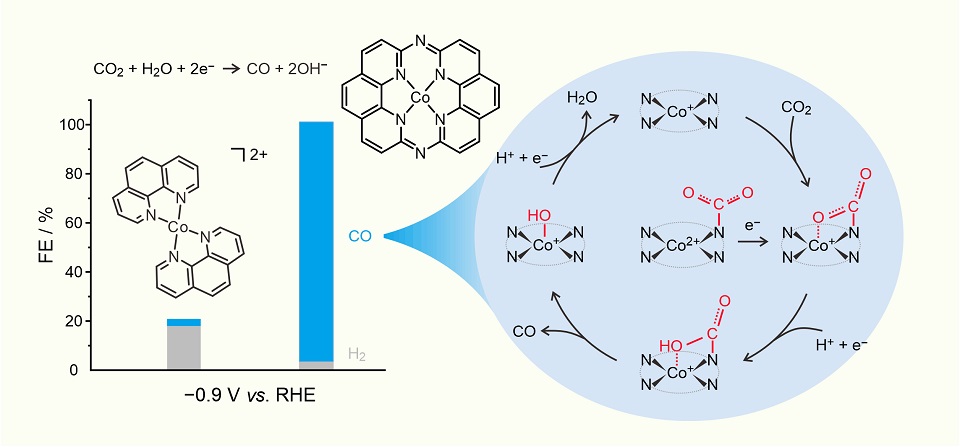
分子催化剂凭借其结构明确、易于调控的优势,为电催化反应机理研究提供了理想平台。然而,当前研究主要集中于中心金属或外围配体的调控作用,空间构型对分子催化剂性能的影响仍缺乏系统探索。基于此,本文合成了两种具有相似配位环境但空间构型不同的钴基配合物——平面型六氮杂大环钴配合物(CoHAM)与非平面型不成环钴配合物Co(phen)2Cl2,并系统考察了二者在电催化二氧化碳还原反应中的特征行为。结果发现,平面型CoHAM的二氧化碳还原性能显著优于非平面型Co(phen)2Cl2。为了理解性能差异的根源,进一步结合原位紫外可见光谱、高分辨质谱以及拉曼光谱技术,揭示出二者催化二氧化碳还原中不同的关键中间体与反应路径。这些发现指明分子催化剂空间构型对电催化性能的关键影响,亦为高效二氧化碳还原催化剂的理性设计提供了新思路。
贾茹 , 朱成标 , 张子墨 , 王托 , 杨铠聪 , 王光喆 , 胡杨 , 张婷婷 , 魏振威 , 肖丽 , 王功伟 , 庄林 . 平面与非平面型钴基分子催化剂的二氧化碳电还原行为特征[J]. 电化学, 2026 , 32(6) : 2601221 . DOI: 10.61558/2993-074X.3610
Molecular catalysts serve as ideal platforms for studying electrocatalytic reaction mechanisms. While current research mainly focuses on modulating central metals or surrounding ligands, the influence of molecular spatial configuration remains largely unexplored. Herein, we synthesized two cobalt complexes with similar ligand environments but distinct spatial geometries, a planar cobalt hexaazamacrocyclic complex (CoHAM) and a non-planar acyclic Co(phen)2Cl2, and evaluated their performance in CO2 reduction reaction (CO2RR). The planar CoHAM exhibited dramatically superior CO2RR performance compared to the non-planar Co(phen)2Cl2. Through a series of combined analyses using in-situ UV-vis spectroscopy, high-resolution mass spectrometry (HRMS), and Raman spectroscopy, we elucidated the origins of this performance gap by identifying key intermediates and reaction pathways. These findings underscore the critical role of the spatial configuration of molecular catalysts in governing electrocatalytic performance and provide a strategic direction for the rational design of efficient CO2RR catalysts.
| [1] | Zeng Y Q, Zhao J, Wang S F, Wang W J, Lu Y R, Xi S B, Xu W, Yoda Y, Masuda R, Li X N, Huang Y Q, Liu B, Zhang T. Unraveling the dynamic low-spin state evolution of single-Fe-atom sites for efficient CO2 electroreduction[J]. J. Am. Chem. Soc., 2025, 147(46): 42539-42548. https://doi.org/10.1021/jacs.5c13466. |
| [2] | Francke R, Schille B, Roemelt M. Homogeneously catalyzed electroreduction of carbon dioxide—methods, mechanisms, and catalysts[J]. Chem. Rev., 2018, 118(9): 4631-4701. https://doi.org/10.1021/acs.chemrev.7b00459. |
| [3] | Jin S, Hao Z M, Zhang K, Yan Z H, Chen J. Advances and challenges for the electrochemical reduction of CO2 to CO: from fundamentals to industrialization[J]. Angew. Chem. Int. Ed., 2021, 60(38): 20627-20648. https://doi.org/10.1002/anie.202101818. |
| [4] | Boutin E, Merakeb L, Ma B, Boudy B, Wang M, Bonin J, Anxolabéhère-Mallart E, Robert M. Molecular catalysis of CO2 reduction: recent advances and perspectives in electrochemical and light-driven processes with selected Fe, Ni and Co aza macrocyclic and polypyridine complexes[J]. Chem. Soc. Rev., 2020, 49(16): 5772-5809. https://doi.org/10.1039/D0CS00218F. |
| [5] | Kortlever R, Shen J, Schouten K J P, Calle-Vallejo F, Koper M T M. Catalysts and reaction pathways for the electrochemical reduction of carbon dioxide[J]. J. Phys. Chem. Lett., 2015, 6(20): 4073-4082. https://doi.org/10.1021/acs.jpclett.5b01559. |
| [6] | Su D J, Xiang S Q, Gao S T, Jiang Y M, Liu X H, Zhang W, Zhao L B, Tian Z Q. Kinetic understanding of catalytic selectivity and product distribution of electrochemical carbon dioxide reduction reaction[J]. JACS Au, 2023, 3(3): 905-918. https://doi.org/10.1021/jacsau.3c00002. |
| [7] | Saha P, Amanullah S, Dey A. Selectivity in electrochemical CO2 reduction[J]. Acc. Chem. Res., 2022, 55(2): 134-144. https://doi.org/10.1021/acs.accounts.1c00678. |
| [8] | Xue Y Y, Zhang L J, Kuang M, Zheng G F. Tuning the CO2 and CO electroreduction by rate-determining and selectivity-determining steps[J]. ACS Appl. Mater. Interfaces, 2025, 17(8): 11375-11388. https://doi.org/10.1021/acsami.4c21239. |
| [9] | Lin Y X, Wang S C, Liu H J, Liu X, Yang L, Su X Z, Shan L, Li X Y, Song L. Regulating the electrocatalytic active centers for accelerated proton transfer towards efficient CO2 reduction[J]. Natl. Sci. Rev., 2025, 12(3): nwaf010. https://doi.org/10.1093/nsr/nwaf010. |
| [10] | Wang H, Ma C Q, Lu Q P, Gu M Z, Jiang L, Hao Y X, Hu F, Li L L, Wang G F, Peng S J, Zhang X J. Precise tuning of functional group spatial distribution on porphyrin rings for enhanced CO2 electroreduction selectivity[J]. Angew. Chem. Int. Ed., 2025, 64(19): e202501091. https://doi.org/10.1002/anie.202501091. |
| [11] | Wang Y, Ma F Y, Zhang P F, Zhang G Q, Zhao Z H, Zheng X B, Zhao H, Zhang J W, Dong Y M, Zhu Y F. Tuning *CO-*CHO dimerization via twisted electron localization of asymmetrically coordinated Cu-Cu dual sites by P and N scatterings boosts CO2 electroreduction[J]. ACS Catal., 2025, 15(21): 17703-17714. https://doi.org/10.1021/acscatal.5c04995. |
| [12] | Xiong L, Zhan S Q, Di Ciano L, Li S S, Liu R M, Lu S J, Yao P, Fu X B, Yue Q. Elucidating the donor/acceptor regulatory mechanism for CO2 electroreduction[J]. Adv. Mater., 2025, e12478. https://doi.org/10.1002/adma.202512478. |
| [13] | Liu N, Pham T M, Han Y N, Yang L F, Bokareva O S, Bartling S, Springer A, Spannenberg A, Kubis C, Weiss J, Doronkin D E, Ju W, Francke R. Heterogenized copper(II) phenanthroline catalysts for electroreduction of CO2 to C2 compounds: substitution on the ligand causes structural changes to the molecular framework and stability enhancement[J]. Adv. Mater., 2025, 38(3): e13702. https://doi.org/10.1002/adma.202513702. |
| [14] | Yang Z W, Chen J M, Qiu L Q, Xie W J, He L N. Molecular engineering of metal complexes for electrocatalytic carbon dioxide reduction: from adjustment of intrinsic activity to molecular immobilization[J]. Angew. Chem. Int. Ed., 2022, 61(44): e202205301. https://doi.org/10.1002/anie.202205301. |
| [15] | Kong X D, Zhu J C, Xu Z F, Geng Z G. Fundamentals and challenges of ligand modification in heterogeneous electrocatalysis[J]. Angew. Chem. Int. Ed., 2025, 64(1): e202417562. https://doi.org/10.1002/anie.202417562. |
| [16] | Zhang D A, Liu X, Zhao Y, Zhang H, Rudnev A V, Li J F. In situ Raman spectroscopic studies of CO2 reduction reactions: from catalyst surface structures to reaction mechanisms[J]. Chem. Sci., 2025, 16(12): 4916-4936. https://doi.org/10.1039/D5SC00569H. |
| [17] | Li X D, Wang S M, Li L, Sun Y F, Xie Y. Progress and perspective for in situ studies of CO2 reduction[J]. J. Am. Chem. Soc., 2020, 142(21): 9567-9581. https://doi.org/10.1021/jacs.0c02973. |
| [18] | Ren X Y, Zhao J, Li X N, Shao J M, Pan B B, Salamé A, Boutin E, Groizard T, Wang S F, Ding J, Zhang X, Huang W Y, Zeng W J, Liu C Y, Li Y G, Hung S F, Huang Y Q, Robert M, Liu B. In-situ spectroscopic probe of the intrinsic structure feature of single-atom center in electrochemical CO/CO2 reduction to methanol[J]. Nat. Commun., 2023, 14(1): 3401. https://doi.org/10.1038/s41467-023-39153-6. |
| [19] | Sakamoto N, Sekizawa K, Shirai S, Nonaka T, Arai T, Sato S, Morikawa T. Dinuclear Cu(I) molecular electrocatalyst for CO2-to-C3 product conversion[J]. Nat. Catal., 2024, 7(5): 574-584. https://doi.org/10.1038/s41929-024-01147-y. |
| [20] | Wu M J, Yang S Y, Gao Y, Chen Z S, Dong F, Lei H Y, Yang Y K, Chen N, Omanovic S, Regier T, Cui X, Xia B Y, Zhang G X, Sun S H. Steering CO2 electroreduction pathway via tuning microenvironment of cobalt center in molecular catalysts[J]. ACS Nano, 2025, 19(36): 32507-32517. https://doi.org/10.1021/acsnano.5c09554. |
| [21] | Yang H Z, Guo N, Xi S B, Wu Y, Yao B Q, He Q, Zhang C, Wang L. Potential-driven structural distortion in cobalt phthalocyanine for electrocatalytic CO2/CO reduction towards methanol[J]. Nat. Commun., 2024, 15(1): 7703. https://doi.org/10.1038/s41467-024-52168-x. |
| [22] | Ogawa S, Yamaguchi T, Gotoh N. Preparation of a conjugated tautomer of 1,14:7,8-diethenotetrapyrido-[2,1,6-de:2',1',6'-gh:2'',1'',6''-kl:2''',1''',6'''-na][1,3,5,8,10,12]hexa-azacyclotetradecine and its metal derivatives[J]. J. Chem. Soc., Perkin Trans. 1, 1974: 976-978. https://doi.org/10.1039/P19740000976. |
| [23] | Jiang Y, Jung H, Joo S H, Sun Q K, Li C Q, Noh H J, Oh I, Kim Y J, Kwak S K, Yoo J W, Baek J B. Catalyst- and solvent-free synthesis of a chemically stable aza-bridged bis(phenanthroline) macrocycle-linked covalent organic framework[J]. Angew. Chem. Int. Ed., 2021, 60(31): 17191-17197. https://doi.org/10.1002/anie.202106389. |
| [24] | Hennig H, Benedix R, Hempel K, Reinhold J. Zur Konstitution von Bis-(phenanthrolin)-kobalt(II)-Komplexen[J]. Z. Anorg. Allg. Chem., 1975, 412(2): 141-147. https://doi.org/10.1002/zaac.19754120206. |
| [25] | Isaacs M, Canales J C, Riquelme A, Lucero M, Aguirre M J, Costamagna J. Contribution of the ligand to the electroreduction of CO2 catalyzed by a cobalt(II) macrocyclic complex[J]. J. Coord. Chem., 2003, 56(14): 1193-1201. https://doi.org/10.1080/00958970310001624447. |
| [26] | Chen X J, Ren H, Peng W, Zhang H M, Lu J T, Zhuang L. Highly efficient molecular cobalt electrode for (photo)electrochemical hydrogen evolution[J]. J. Phys. Chem. C, 2014, 118(36): 20791-20798. https://doi.org/10.1021/jp5061792. |
| [27] | Zhang X, Wu Z S, Zhang X, Li L W, Li Y Y, Xu H M, Li X X, Yu X L, Zhang Z S, Liang Y Y, Wang H L. Highly selective and active CO2 reduction electrocatalysts based on cobalt phthalocyanine/carbon nanotube hybrid structures[J]. Nat. Commun., 2017, 8(1): 14675. https://doi.org/10.1038/ncomms14675. |
| [28] | Zhu Q S, Rooney C L, Shema H, Zeng C, Panetier J A, Gross E, Wang H L, Baker L R. The solvation environment of molecularly dispersed cobalt phthalocyanine determines methanol selectivity during electrocatalytic CO2 reduction[J]. Nat. Catal., 2024, 7(9): 987-999. https://doi.org/10.1038/s41929-024-01190-9. |
| [29] | Rohrbach D F, Heineman W R, Deutsch E. Thin-layer spectroelectrochemical studies of cobalt and copper Schiff base complexes[J]. Inorg. Chem., 1979, 18(9): 2536-2542. https://doi.org/10.1021/ic50199a041. |
| [30] | Chen J X, Wang X Y, Cui X, Li Y Y, Feng Y Q, Wei Z W. In situ probing and identification of electrochemical reaction intermediates by floating electrolytic electrospray mass spectrometry[J]. Angew. Chem. Int. Ed., 2023, 62(12): e202219302. https://doi.org/10.1002/anie.202219302. |
| [31] | Zhao K, Pang W Y, Jiang S Y, Hu C Y, Liu P R, Cui D D, An X F, Tian B J, Gao C, Zhang P, Tian M, Fu D, Zhao H J. Operando reconstruction-induced CO2 reduction activity and selectivity for cobalt-based photocatalysis[J]. Nano Res., 2023, 16(4): 4812-4820. https://doi.org/10.1007/s12274-023-5432-5. |
| [32] | Wu F, Jiang F S, Yang J H, Dai W Y, Lan D H, Shen J, Fang Z J. Investigation of molecular mechanism of cobalt porphyrin catalyzed CO2 electrochemical reduction in ionic liquid by in-situ SERS[J]. Molecules, 2023, 28(6): 2747. https://doi.org/10.3390/molecules28062747. |
| [33] | Jia J Z, Zhao X H, Hu W H, Wang Y T, Huang J F, Huang J, Li H, Peng Y, Ma H Y, Xu C L. Role of cobalt phthalocyanine on the formation of high-valent cobalt species revealed by in situ Raman spectroscopy[J]. J. Mater. Chem. A, 2023, 11(15): 8141-8149. https://doi.org/10.1039/D2TA10063K. |
/
| 〈 |
|
〉 |