石墨-羧甲基纤维素界面锂离子的分布与传输机制
收稿日期: 2026-02-10
修回日期: 2026-03-22
录用日期: 2026-04-09
网络出版日期: 2026-04-09
Distribution and Transport of Lithium Ions at Interfaces between Graphite and Carboxymethyl Celluloses
Sheng-Li Chen and Zi-Jun Huang conceived and designed the research. Jian Wang raised the topic. Zi-Jun Huang performed all simulations. Zhen-Ying Zheng provided guidance on theoretical modeling and simulations. Hua-Wei Cao and Jian Wang provided guidance on experimental and engineering aspects. Qing-Feng Zhang provided supervision and contributed to the revision of the manuscript. Zi-Jun Huang and Sheng-Li Chen wrote the paper. All authors discussed the results and commented on the manuscript.
Received date: 2026-02-10
Revised date: 2026-03-22
Accepted date: 2026-04-09
Online published: 2026-04-09
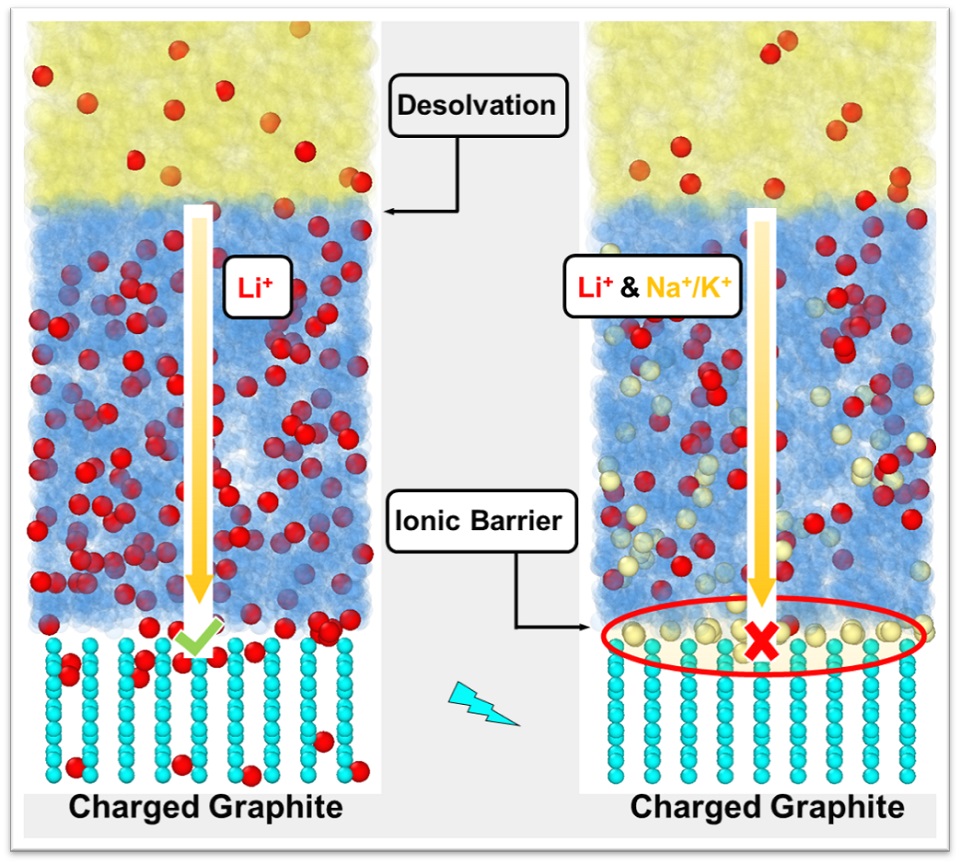
羧甲基纤维素(CMC)是一种广泛应用于石墨负极的水系粘结剂。然而,CMC反离子(Li+/Na+/K+)的种类与组成如何在分子尺度上调控界面离子传输并影响电极性能仍缺乏清晰认识。本文采用分子动力学模拟构建电解液/CMC/石墨三相界面模型,以CMC-Li、CMC-Na、CMC-K及混合反离子CMC作为粘结剂,系统探究充电过程中Li+穿越粘结剂相并进入石墨的微观迁移路径。结果表明,在CMC-Li体系中,Li+能够持续由电解液穿过粘结剂相并嵌入石墨层间,在模拟时间尺度内形成稳定的传输通路。相比之下,在CMC-Na与CMC-K体系中,Na+/K+难以进入石墨内部而倾向于在石墨表面富集,形成阳离子富集界面屏障,从而抑制Li+向石墨迁移。进一步地,随着在CMC中逐步以Li+替代Na+/K+,该界面阻塞效应减弱,Li+对石墨的可及性随之提高。本研究为CMC-Li相较CMC-Na/K在实验中性能表现更优提供了微观机制解释,并为粘结剂离子传输性能的优化提供了理论依据与设计思路。
黄子郡 , 郑臻颖 , 曹华伟 , 王键 , 张庆丰 , 陈胜利 . 石墨-羧甲基纤维素界面锂离子的分布与传输机制[J]. 电化学, 2026 , 32(6) : 2614001 . DOI: 10.61558/2993-074X.3611
Carboxymethyl cellulose (CMC) is a water-processable binder widely used for graphite anodes. However, a microscopic understanding of why the identity of CMC counterions (Li+/Na+/K+) strongly affects electrode performance remains limited. Here, molecular dynamics (MD) simulations are used to track Li+ transport accessibility across electrolyte/CMC/graphite three-phase interfaces, comparing pure CMC-Li, CMC-Na, CMC-K, and mixed-counterion CMC binders. We find that CMC-Li sustains a continuous Li+ transport pathway from the electrolyte through the binder phase toward graphite. In contrast, in CMC-Na and CMC-K, Na+/K+ ions preferentially enrich at the graphite/binder interface, forming a cation-enriched interfacial layer which reduces Li+ accessibility to graphite. Partial replacement of Na+/K+ in CMC-Na and CMC-K with Li+ weakens this interfacial blocking effect and increases Li+ accessibility. Furthermore, a stage-resolved kinetic analysis visualizes the progressive suppression of Li+ crossing the binder phase upon the barrier layer formation. These results provide a microscopic rationale for the experimentally observed performance advantage of CMC-Li over CMC-Na and CMC-K binders.
| [1] | Goodenough J B, Park K S. The Li-ion rechargeable battery: A perspective[J]. J. Am. Chem. Soc., 2013, 135(4): 1167-1176. http://dx.doi.org/10.1021/ja3091438. |
| [2] | Li H D, Shen Q W, Zhang Z Y, Zhao X Y, Wei Y, Li S A. Research progress on thermal management of lithium-ion batteries[J]. J. Electrochem., 2025, 31(7): 2411161. http://dx.doi.org/10.61558/2993-074X.3526. |
| [3] | Bresser D, Buchholz D, Moretti A, Varzi A, Passerini S. Alternative binders for sustainable electrochemical energy storage - the transition to aqueous electrode processing and bio-derived polymers[J]. Energy Environ. Sci., 2018, 11(11): 3096-3127. http://dx.doi.org/10.1039/c8ee00640g. |
| [4] | Buqa H, Holzapfel M, Krumeich F, Veit C, Novák P. Study of styrene butadiene rubber and sodium methyl cellulose as binder for negative electrodes in lithium-ion batteries[J]. J. Power Sources, 2006, 161(1): 617-622. http://dx.doi.org/10.1016/j.jpowsour.2006.03.073. |
| [5] | Chen J C, Liu J Y, Qi Y, Sun T, Li X D. Unveiling the roles of binder in the mechanical integrity of electrodes for lithium-ion batteries[J]. J. Electrochem. Soc., 2013, 160(9): A1502-A1509. http://dx.doi.org/10.1149/2.088309jes. |
| [6] | Nirmale T C, Kale B B, Varma A J. A review on cellulose and lignin based binders and electrodes: Small steps towards a sustainable lithium ion battery[J]. Int. J. Biol. Macromol., 2017, 103: 1032-1043. http://dx.doi.org/10.1016/j.ijbiomac.2017.05.155. |
| [7] | Zou F, Manthiram A. A review of the design of advanced binders for high-performance batteries[J]. Adv. Energy Mater., 2020, 10(45): 2002508. http://dx.doi.org/10.1002/aenm.202002508. |
| [8] | Dong Q Y, Hong B, Fan H H, Gao C, Huang X J, Bai M, Zhou Y, Lai Y Q. A self-adapting artificial sei layer enables superdense lithium deposition for high performance lithium anode[J]. Energy Storage Mater., 2022, 45: 1220-1228. http://dx.doi.org/10.1016/j.ensm.2021.11.022. |
| [9] | Liu D, Zhao Y, Tan R, Tian L L, Liu Y D, Chen H B, Pan F. Novel conductive binder for high-performance silicon anodes in lithium ion batteries[J]. Nano Energy, 2017, 36: 206-212. http://dx.doi.org/10.1016/j.nanoen.2017.04.043. |
| [10] | Qian S S, Chen H, Zheng M, Zhu Y, Xing C, Tian Y, Yang P, Wu Z, Zhang S. Complementary combination of lithium protection strategies for robust and longevous lithium metal batteries[J]. Energy Storage Mater., 2023, 57: 229-248. http://dx.doi.org/10.1016/j.ensm.2023.02.019. |
| [11] | Saal A, Hagemann T, Schubert U S. Polymers for battery applications—active materials, membranes, and binders[J]. Adv. Energy Mater., 2020, 11(43): 2001984. http://dx.doi.org/10.1002/aenm.202001984. |
| [12] | Ibing L, Gallasch T, Schneider P, Niehoff P, Hintennach A, Winter M, Schappacher F M. Towards water based ultra-thick li ion battery electrodes - a binder approach[J]. J. Power Sources, 2019, 423: 183-191. http://dx.doi.org/10.1016/j.jpowsour.2019.03.020. |
| [13] | Qiu L, Yang W, Hu X B, Li W S. High performance study of lithium carboxymethylcellulose as water-soluble binder for lithium supplementation in lithium batteries[J]. Starch - St?rke, 2022, 74(7-8): 2200049. http://dx.doi.org/10.1002/star.202200049. |
| [14] | Yoon J, Lee J, Kim H, Kim J, Jin H J. Polymeric binder design for sustainable lithium-ion battery chemistry[J]. Polymers (Basel), 2024, 16(2): 254. http://dx.doi.org/10.3390/polym16020254. |
| [15] | Pham T A, Kweon K E, Samanta A, Lordi V, Pask J E. Solvation and dynamics of sodium and potassium in ethylene carbonate from ab initio molecular dynamics simulations[J]. J. Phys. Chem. C, 2017, 121(40): 21913-21920. http://dx.doi.org/10.1021/acs.jpcc.7b06457. |
| [16] | Qiu L, Shao Z Q, Wang D X, Wang F J, Wang W J, Wang J Q. Carboxymethyl cellulose lithium (cmc-li) as a novel binder and its electrochemical performance in lithium-ion batteries[J]. Cellulose, 2014, 21(4): 2789-2796. http://dx.doi.org/10.1007/s10570-014-0274-7. |
| [17] | Wynn T A, Lee J Z, Banerjee A, Meng Y S. In situ and operando probing of solid-solid interfaces in electrochemical devices[J]. MRS Bull., 2018, 43(10): 768-774. http://dx.doi.org/10.1557/mrs.2018.235. |
| [18] | Mayer S F, Mercier-Guyon B, Doublet C, Fauchier-Magnan A, Mangani L R, Renais C, Reuter M, Thompson O, Trassart L, Villevieille C. Understanding interphases and interfaces of battery materials at the nanoscale[J]. Small, 2025, 21(34): e2504379. http://dx.doi.org/10.1002/smll.202504379. |
| [19] | Li L, Pascal T A, Connell J G, Fan F Y, Meckler S M, Ma L, Chiang Y M, Prendergast D, Helms B A. Molecular understanding of polyelectrolyte binders that actively regulate ion transport in sulfur cathodes[J]. Nat. Commun., 2017, 8(1): 2277. http://dx.doi.org/10.1038/s41467-017-02410-6. |
| [20] | Wang P Y, Chiu T H, Chiu C C. Molecular effects of Li+-coordinating binders and negatively charged binders on the Li+ local mobility near the electrolyte/lifepo(4) cathode interface within lithium-ion batteries[J]. Polymers, 2024, 16(3): 319. http://dx.doi.org/10.3390/polym16030319. |
| [21] | Trivedi H C, Patel R D. Studies on carboxymethylcellulose: Conductivity measurements of solutions, 2[J]. Die Makromol. Chem., 1986, 187(1): 199-210. https://doi.org/10.1002/macp.1986.021870119. |
| [22] | Wang Y, Ma Z, Cao Z, Cai T, Liu G, Cheng H M, Zhao F F, Cavallo L, Li Q, Ming J. Unraveling new role of binder functional group as a probe to detect dynamic lithium-ion de-solvation process toward high electrode performances[J]. Adv. Funct. Mater., 2023, 33(45): 2305974. http://dx.doi.org/10.1002/adfm.202305974. |
| [23] | Byun S, Liu Z X, Shin D O, Kim K, Choi J, Roh Y, Jin D H, Jung S, Kim K G, Lee Y G, Ringe S, Lee Y M. Alkali metal ion substituted carboxymethyl cellulose as anode polymeric binders for rapidly chargeable lithium-ion batteries[J]. Energy Environ. Mater., 2023, 7(1): 12509. http://dx.doi.org/10.1002/eem2.12509. |
| [24] | Chen B W, Zhang Z, Xiao M Y, Wang S K, Huang S K, Han D Y, Meng Y. Polymeric binders used in lithium ion batteries: Actualities, strategies and trends[J]. ChemElectroChem, 2024, 11(14): 202300651. http://dx.doi.org/10.1002/celc.202300651. |
| [25] | Laurenti B, Gonzalez-Rosillo J C, Chiabrera F, Fiocco A, Monteiro Freitas F, Chaigneau M, Morata A, Tarancón A. Unraveling nanoscale interfacial kinetics in battery cathodes through operando tip-enhanced raman spectroscopy[J]. EES Batteries, 2025, 1(5): 1147-1157. http://dx.doi.org/10.1039/d5eb00094g. |
| [26] | Martinez L, Andrade R, Birgin E G, Martinez J M. Packmol: A package for building initial configurations for molecular dynamics simulations[J]. J. Comput. Chem., 2009, 30(13): 2157-2164. http://dx.doi.org/10.1002/jcc.21224. |
| [27] | Jorgensen W L, Tirado-Rives J. Potential energy functions for atomic-level simulations of water and organic and biomolecular systems[J]. Proc. Natl. Acad. Sci. U.S.A., 2005, 102(19): 6665-6670. http://dx.doi.org/10.1073/pnas.0408037102. |
| [28] | Dodda L S, Cabeza de Vaca I, Tirado-Rives J, Jorgensen W L. Ligpargen web server: An automatic opls-aa parameter generator for organic ligands[J]. Nucleic Acids Res., 2017, 45(W1): W331-W336. http://dx.doi.org/10.1093/nar/gkx312. |
| [29] | Neese F. The orca program system[J]. WIREs Comput. Mol. Sci., 2012, 2(1): 73-78. http://dx.doi.org/10.1002/wcms.81. |
| [30] | Lu T. A comprehensive electron wavefunction analysis toolbox for chemists, multiwfn[J]. J. Chem. Phys., 2024, 161(8): 082501. http://dx.doi.org/10.1063/5.0216272. |
| [31] | Lu T, Chen F. Multiwfn: A multifunctional wavefunction analyzer[J]. J. Comput. Chem., 2012, 33(5): 580-592. http://dx.doi.org/10.1002/jcc.22885. |
| [32] | Dodda L S, Vilseck J Z, Tirado-Rives J, Jorgensen W L. 1.14*CM1A-LBCC: Localized bond-charge corrected cm1a charges for condensed-phase simulations[J]. J. Phys. Chem. B, 2017, 121(15): 3864-3870. http://dx.doi.org/10.1021/acs.jpcb.7b00272. |
| [33] | Thompson A P, Aktulga H M, Berger R, Bolintineanu D S, Brown W M, Crozier P S, in 't Veld P J, Kohlmeyer A, Moore S G, Nguyen T D, Shan R, Stevens M J, Tranchida J, Trott C, Plimpton S J. Lammps - a flexible simulation tool for particle-based materials modeling at the atomic, meso, and continuum scales[J]. Comput. Phys. Commun., 2022, 271: 108171. http://dx.doi.org/10.1016/j.cpc.2021.108171. |
| [34] | Li J X, Wang A L, Wei H X, Liu S W, Li L, Wu Q, Liu Y, Liu Y X, Nie G K, Nie S X, Yao S Q, Yu H L. Direct synthesis of a lithium carboxymethyl cellulose binder using wood dissolving pulp for high-performance LiFePO4 cathodes in lithium-ion batteries[J]. Bioresour. Technol., 2024, 401: 130711. http://dx.doi.org/10.1016/j.biortech.2024.130711. |
/
| 〈 |
|
〉 |