利用线性稠合的吡嗪单元调控电子结构用于高压稳定的锌-有机电池正极
收稿日期: 2025-12-28
修回日期: 2026-03-11
录用日期: 2026-03-31
网络出版日期: 2026-03-31
Modulating Electronic Structure with Linearly Fused Pyrazine Units for High-Voltage and Stable Zinc-Organic Batteries Cathode
Min-Jian Zhao: Writing - original draft, Methodology, Investigation. Li-Bin Zhang: Writing - original draft, Investigation, Data curation. Jin-Tao Wang: Software, Resources, Formal analysis. Kun Ding: Vali dation, Project administration. Hai-Mei Liu: Writing - review & editing, Supervision, Project administration. Yong-Gang Wang: Validation, Supervision.
#Min-Jian Zhao and Li-Bin Zhang contributed equally to this work.
Received date: 2025-12-28
Revised date: 2026-03-11
Accepted date: 2026-03-31
Online published: 2026-03-31
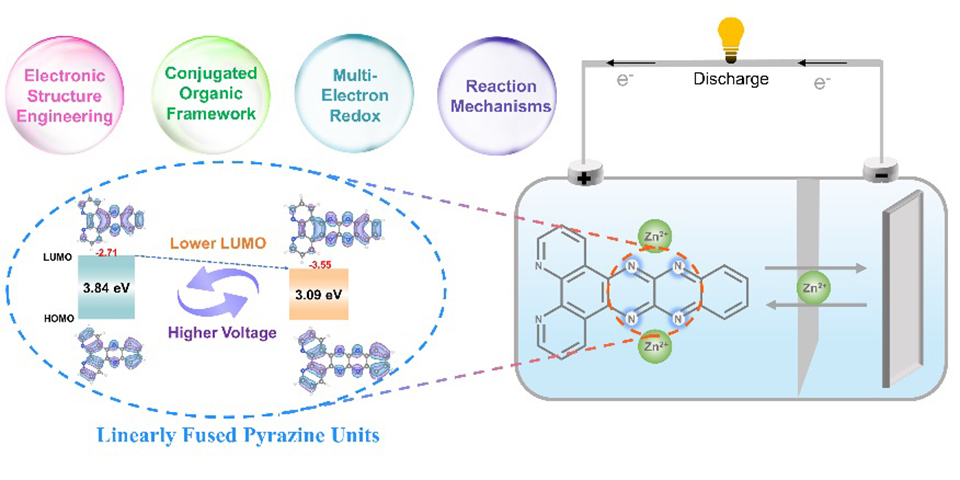
高电压n型有机正极材料是构建高比能、长寿命锌-有机电池(ZOBs)的关键。然而,大多数n型材料的电子结构和较高的电子能级使得n型材料的表现出缓慢的动力学,高溶解性和低放电电压(小于0.8 V)。本文通过在芳香族化合物的共轭骨架中引入局部缺电子结构,设计了一种小分子,quinoxalino[2',3':5,6]pyrazino[2,3-f][1,10]phenanthroline (DPQP),用于ZOBs正极。由线性稠合的缺电子的吡嗪单元扩展的吡嗪并苯结构优化了材料的电子结构,从而显著提高了材料的放电电压,扩展的共轭平面进一步抑制了活性材料的溶解并促进了快速的电荷转移动力学。得益于这些结果,DPQP电极在0.1 A·g-1下的平均工作电压从0.61 V提高到1.07 V(vs. Zn2+/Zn),过电位仅为140 mV,且随着电流密度的增加,未见明显电压降,反应了快速可逆的氧化还原动力学。此外,DPQP正极表现出令人满意的循环性能,在0.1 A·g-1下保持稳定循环超过2000小时并且在10 A·g-1循环超过10000圈且具有82.5%的高容量保持率。值得注意的是,DPQP电极具有出色的极端温度适应性,能够在-20 ℃ - 60 ℃的宽温域中表现出令人满意的电化学性能。同时,通过一系列物理表征证明了DPQP正极高度的电化学可逆性和锌离子存储机制。
赵敏健 , 张立斌 , 王金涛 , 丁昆 , 刘海梅 , 王永刚 . 利用线性稠合的吡嗪单元调控电子结构用于高压稳定的锌-有机电池正极[J]. 电化学, 2026 , 32(5) : 2512291 . DOI: 10.61558/2993-074X.3609
High-voltage n-type organic cathode materials are critical for constructing zinc-organic batteries (ZOBs) with high energy density and long cycle life. However, the intrinsically unfavorable electronic structures and relatively high LUMO energy levels of most n-type materials often lead to sluggish kinetics, high solubility, and suboptimal discharge voltages (< 0.8 V). Here, we design a small molecule, quinoxalino[2',3':5,6]pyrazino[2,3-f][1,10]phenanthroline (DPQP), as a ZOB cathode by introducing locally electron-deficient motifs into the conjugated backbone of aromatic compounds. The linearly fused pyrazine units extending the pyrazine-benzene framework effectively optimize the electronic structure, thereby significantly enhancing the discharge voltage. Meanwhile, the expanded π-conjugated plane suppresses dissolution and accelerates charge-transfer kinetics. Benefiting from these features, the DPQP electrode exhibits an exceptional increase in average operating voltage from 0.61 V to 1.07 V (vs. Zn2+/Zn) at 0.1 A·g-1, with an overpotential of only 140 mV. Notably, no discernible voltage decay occurs as the current density increases, indicating rapid and highly reversible redox kinetics. Furthermore, the DPQP cathode delivers outstanding cycling stability, maintaining over 2000 h of continuous operation at 0.1 A·g-1 and retaining 82.5% of its capacity after more than 10,000 cycles at 10 A·g-1. Remarkably, the DPQP electrode also demonstrates excellent tolerance to extreme temperatures, achieving stable electrochemical performance across a wide temperature range from -20 °C to 60 °C. In addition, a series of spectroscopic and microscopic characterizations confirm the highly reversible redox behavior and Zn2+ storage mechanism of the DPQP cathode.
| [1] | Wang H G, Wu Q, Cheng L Q, Zhu G S. The emerging aqueous zinc-organic battery[J]. Coord. Chem. Rev., 2022, 472: 214772. https://doi.org/10.1016/j.ccr.2022.214772. |
| [2] | Song Z Y, Liu W B, Huang Q, Lv Y K, Gan L H, Liu M X. Unlocking the potential of a multi-electron p-type polyheterocycle cathode: when it meets a small-size and high-charge anion[J]. Chem. Sci., 2025, 36: 16542-16551. https://doi.org/10.1039/d5sc05022g. |
| [3] | Nam K W, Kim H, Beldjoudi Y, Kwon T W, Kim D J, Stoddart J F. Redox-active phenanthrenequinone triangles in aqueous rechargeable zinc batteries[J]. J. Am. Chem. Soc., 2020, 142(5): 2541-2548. https://doi.org/10.1021/jacs.9b12436. |
| [4] | Guo J H, Zhang Z, Zhu F L, Yang Q L, Fu Y Z, Guo W. Aqueous zinc-organoiodine battery with high kinetics and dense cathodes[J]. J. Am. Chem. Soc., 2025, 147(43): 39652-39661. https://doi.org/10.1021/jacs.5c13131. |
| [5] | Hua K, Ma Q W, Liu Y Y, Xiong P, Wang R, Yuan L B, Hao J N, Zhang L H, Zhang C F. High-performance bipolar small-molecule organic cathode for wide-temperature-range aqueous zinc-ion batteries[J]. ACS Nano, 2025, 19(14): 14249-4261. https://doi.org/10.1021/acsnano.5c00833. |
| [6] | Zhang Y, Li M, Li Z Y, Lu Y Y, Li H M, Liang J X, Hu X Y, Zhang L B, Ding K, Xu Q J, Liu H M, Wang Y G. A high capacity p‐type organic cathode material for aqueous zinc batteries[J]. Angew. Chem. Int. Ed., 2024, 63(48): e202410342. https://doi.org/10.1002/anie.202410342. |
| [7] | Li W D, Xu H Y, Zhang H Y, Wei F C, Huang L Y, Ke S Z, Fu J W, Jing C B, Cheng J G, Liu S H. Tuning electron delocalization of hydrogen-bonded organic framework cathode for high-performance zinc-organic batteries[J]. Nat. Commun., 2023, 14: 5235. https://doi.org/10.1038/s41467-023-40969-5. |
| [8] | Wang R M, Zhang Y, Ma C B, Wang X B, Cai M, Du H P, Yang Z, Chao D L, Wang Y Q. A high-voltage organic cathode enabled by a continuous electronegativity zone in aqueous zinc‐organic batteries[J]. Adv. Funct. Mater., 2025, 35(38): 2505318. https://doi.org/10.1002/adfm.202505318. |
| [9] | Shi H T, Wang M Y, Lv A J, Tu J G, Jiao S Q. Molecule engineering of dual-electron-withdrawing groups for rechargeable aluminum batteries[J]. ACS Sustainable Chem. Eng., 2022, 10(49): 16271-16279. https://doi.org/10.1021/acssuschemeng.2c04972. |
| [10] | Du D W, Chen Y Q, Zhang H, Zhao J P, Jin L Y, Ji W X, Huang H, Pang S P. High‐performance azo cathodes enabled by N‐heteroatomic substitution for zinc batteries with a self‐charging capability[J]. Angew. Chem. Int. Ed., 2024, 63(33): e202408292. https://doi.org/10.1002/anie.202408292. |
| [11] | Chen X J, Su H Q, Yang B Z, Liu X C, Song X T, Su L X, Yin G, Liu Q. Constructing high-capacity and flexible aqueous zinc-ion batteries with air-recharging capability using organic cathodes[J]. Chin. Chem. Lett., 2024, 35(3): 108487. https://doi.org/10.1016/j.cclet.2023.108487. |
| [12] | Chen X J, Su H A, Yang B Z, Yin G, Liu Q. Realizing high-rate aqueous zinc-ion batteries using organic cathode materials containing electron-withdrawing groups[J]. Sustainable Energy Fuels, 2022, 6(11): 2523-2531. https://doi.org/10.1039/d2se00310d. |
| [13] | Ye Z L, Xie S J, Cao Z Y, Wang L P, Xu D X, Zhang H, Matz J, Dong P, Fang H Y, Shen J F, Ye M X. High-rate aqueous zinc-organic battery achieved by lowering homo/lumo of organic cathode[J]. Energy Storage Mater., 2021, 37: 378-386. https://doi.org/10.1016/j.ensm.2021.02.022. |
| [14] | Zhang L B, Wang X Y, Wang X, Wang Q M, Li J J, Zhao M J, Ding K, Liu H M, Wang Y G. Electron-withdrawing group functionalization for improved zinc-ion storage in organic electrode materials[J]. Chem. Eng. J., 2025, 521: 166985. https://doi.org/10.1016/j.cej.2025.166985. |
| [15] | Peng H L, Xiao J, Wu Z H, Zhang L, Geng Y C, Xin W L, Li J W, Yan Z C, Zhang K, Zhu Z Q. N-heterocycles extended π-conjugation enables ultrahigh capacity, long-lived, and fast-charging organic cathodes for aqueous zinc batteries[J]. CCS Chem., 2023, 5(8): 1789-1801. https://doi.org/10.31635/ccschem.022.202202276. |
| [16] | Kresse G, Joubert D J. From ultrasoft pseudopotentials to the projector augmented-wave method[J]. Phys. Rev. B, 1999, 59(3): 1758-1775. https://doi.org/10.1103/PhysRevB.59.1758 |
| [17] | Lu T. Visualization analysis of covalent and noncovalent interactions in real space[J]. Angew. Chem. Int. Ed., 2025, 64(29): e202504895. https://doi.org/https://doi.org/10.1002/anie.202504895. |
| [18] | Sun T J, Yi Z H, Zhang W J, Nian Q S, Fan H J, Tao Z L. Dynamic balance of partial charge for small organic compound in aqueous zinc‐organic battery[J]. Adv. Funct. Mater., 2023, 33(47): 2306675. https://doi.org/10.1002/adfm.202306675. |
| [19] | Li H B, Cao M G, Wang R, Xiong P, Liu Y Y, Zhang L, Zhang L T, Zhang L H, Chao D L, Zhang C F. Design strategy for small-molecule organic cathodes: regulated active groups enable high capacity and voltage in aqueous and seawater aluminum ion batteries[J]. Angew. Chem. Int. Ed., 2025, 64(35): e202508057. https://doi.org/10.1002/anie.202508057. |
| [20] | Wang R M, Zhang Y, Wang X B, Ma C B, Zhao Y, Wang Y Q, Yang Z. Varying voltage performance of Zn2+/H+ co-storage caused by active site restriction in aqueous zinc-organic batteries[J]. Small, 2025, 21(39): e07069. https://doi.org/https://doi.org/10.1002/smll.202507069. |
| [21] | Gan X T, Zhang H D, Hu Z J, Li M L, Wang J X, Cai T T, Chen Z G, Gong H S, Wang Y G, Song Z P. Trinaphthylenehexone: toward high‐energy and high-stability small-molecule quinone cathode materials[J]. Adv. Funct. Mater., 2025, 35(36): 2504093. https://doi.org/10.1002/adfm.202504093. |
| [22] | Liu X, Tang J L, Bin D, Wang Y K, Li C C, Su L Y, Shen Y, Hu W X, Hu Z H, Zhuang W, Yang B B, Lu H B, Wang Y G. Quinone-pyrazine organic cathode with intramolecular hydrogen bonds enabling high-charging and wide-temperature aqueous zinc batteries[J]. Energy Storage Mater., 2025, 81: 104517. https://doi.org/10.1016/j.ensm.2025.104517. |
| [23] | Zhang L B, Zhang Y, Zhao M J, Ding K, Liu H M, Wang Y G. Enhanced π-conjugation and multi-electron transfer organic cathodes enabled high-performance zinc-ion storage[J]. J. Colloid Interface Sci., 2026, 702: 138818. https://doi.org/10.1016/j.jcis.2025.138818. |
| [24] | Sun T J, Zhang W J, Nian Q S, Tao Z L. Proton-insertion dominated polymer cathode for high-performance aqueous zinc-ion battery[J]. Chem. Eng. J., 2023, 452: 139324. https://doi.org/10.1016/j.cej.2022.139324. |
| [25] | Lin L, Lin Z R, Zhu J Q, Wang K, Wu W L, Qiu T, Sun X Q. A semi-conductive organic cathode material enabled by extended conjugation for rechargeable aqueous zinc batteries[J]. Energy Environ. Sci., 2023, 16(1): 89-96. https://doi.org/10.1039/d2ee02961h. |
| [26] | Xu J, Zhu A Z, Zheng Z Y, Qi Y M, Cheng Y W, Cao Y J, Peng B, Ma L B, Wang Y G. Building Li-S batteries with enhanced temperature adaptability via a redox-active cof-based barrier-trapping electrocatalyst[J]. J. Energy Chem., 2025, 101: 702-712. https://doi.org/10.1016/j.jechem.2024.10.019. |
| [27] | Lin L, Xue Z Q, Qiu T, Zhu J Q, Zhang G L, Zhan H T, Wang K, Sun X Q. Non-conjugated linkage enabling a quinone-based cathode material with long cycle life and high energy density for aqueous zinc batteries[J]. Energy Environ. Sci., 2024, 17(18): 6499-6506. https://doi.org/10.1039/d4ee02097a. |
| [28] | Yi P S, Li Z H, Ma L L, Feng B J, Liu Z, Liu Y S, Lu W Y, Cao S C, Fang H Y, Ye M X, Shen J F. Eco-friendly high-performance symmetric all-cof/graphene aqueous zinc-ion batteries[J]. Adv. Mater., 2024, 36(52): 2414379. https://doi.org/10.1002/adma.202414379. |
| [29] | Zhang L B, Zhang Y, Wang X Y, Wang X, Wang Q M, Li J J, Li Z Y, Ding K, Peng Y T, Liu H M, Wang Y G. A six-electron-transfer organic cathode for aqueous zinc batteries[J]. Adv. Funct. Mater., 2025, 36(1): e13189. https://doi.org/10.1002/adfm.202513189. |
| [30] | Song Z Y, Miao L, Duan H, Lv Y K, Gan L H, Liu M X. Multielectron redox-bipolar tetranitroporphyrin macrocycle cathode for high‐performance zinc‐organic batteries[J]. Angew. Chem. Int. Ed., 2024, 63(16): e202401049. https://doi.org/10.1002/anie.202401049. |
| [31] | Zhao X R, Wang Z P, Yang J X, Xu Y H, Li Y S. In situ fabricated poly(1,8‐naphthalenediamine)/active carbon composite cathodes for aqueous zinc‐ion batteries with high active sites utilization and ultralong life span of 50 000 cycles[J]. Adv. Funct. Mater., 2024, 34: 2408875. https://doi.org/10.1002/adfm.202408875. |
/
| 〈 |
|
〉 |