制备含有Fe-N-C催化剂的无贵金属阴极催化剂层以提升质子交换膜燃料电池性能
收稿日期: 2025-11-12
修回日期: 2025-12-17
录用日期: 2026-02-13
网络出版日期: 2026-02-13
Insertion of Noble Metal Free Cathodic Catalyst Layer with Fe-N-C Catalyst for Boosted Performance of PEMFC
Shi Zhou: Conceptualization, Methodology, Investigation, Formal analysis, Writing - Original Draft. Muhammad Tariq: Visualization, Investigation, Writing-Review & Editing. Asif Nadeem Tabish: Writing-Review & Editing, Software. Muhammad Salman: Formal analysis, Writing-Review & Editing. Fan-Di Ning: Resources, Data Curation. Ran-Ran Peng: Investigation. Muhammad Rayyan Tayyab: Software, Validation. Meng-Geng Hao: Formal analysis. Wen-Mu Li: Visualization, Writing - Review & Editing. Xiao-Chun Zhou: Supervision, Project administration.
#Equal Contribution by Shi Zhou and Muhammad Tariq
Received date: 2025-11-12
Revised date: 2025-12-17
Accepted date: 2026-02-13
Online published: 2026-02-13
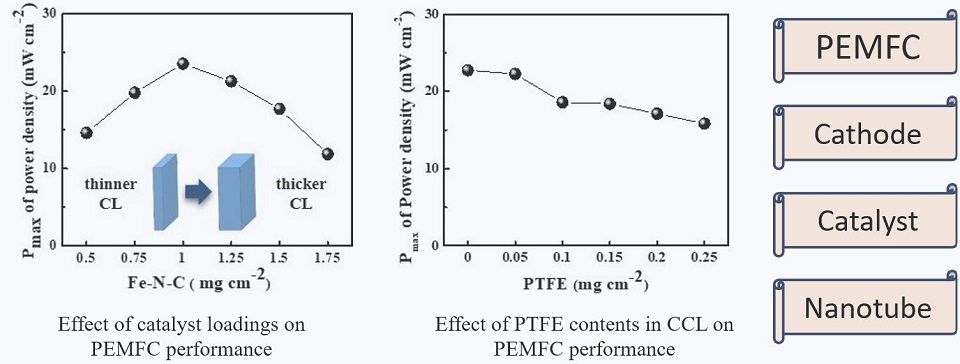
廉价的铁-氮-碳(Fe-N-C)催化剂被视为质子交换膜燃料电池中铂族金属催化剂的有前景的替代品。尽管它们在旋转圆盘电极上表现出稳健的活性,但在膜电极组件中的性能往往受到限制,如氧气扩散减少、过氧化氢生成量高、质子传导性低以及电子转移数较低。本研究通过调整阴极催化剂层(CCL)的组成,对包括质子传输、电子传导和空气呼吸式质子交换膜燃料电池中的气体扩散在内的关键因素进行了研究。实验结果表明,当CCL中Fe-N-C催化剂的负载量为1 mg∙cm−2且Nafion含量为0.15 mg∙cm−2时,可获得峰值功率密度。研究发现,为增强疏水性而添加聚四氟乙烯对质子交换膜燃料电池性能有负面影响。此外,将不同种类的碳纳米管掺入CCL中,可使峰值功率密度显著提高30%以上,这归因于气体扩散和质子传导性的增强。本研究突出显示了气体传输和质子传导性在基于Fe-N-C的CCL中的关键作用。这些发现有助于推进经济型质子交换膜燃料电池的合理设计原则,为推动高效且经济的技术发展提供了宝贵见解。
周石 , Muhammad Tariq , Asif Nadeem Tabish , Muhammad Salman , 宁凡迪 , Muhammad Rayyan Tayyab , 彭冉冉 , 郝梦庚 , 李文木 , 周小春 . 制备含有Fe-N-C催化剂的无贵金属阴极催化剂层以提升质子交换膜燃料电池性能[J]. 电化学, 2026 , 32(4) : 2511141 . DOI: 10.61558/2993-074X.3607
Economical Fe-N-C catalysts are considered as promising alternatives to platinum group metal catalysts for proton exchange membrane fuel cells (PEMFCs). Despite exhibiting robust activity on rotating disk electrodes, their performance within membrane electrode assemblies often experiences limitations, such as decreased O2 diffusion, high H2O2 formation, low proton conduction, and a lower electron transfer number. In this study, key factors, including proton transport, electron conduction, and gas diffusion within air-breathing PEMFCs, have been investigated by adjusting cathode catalyst layer (CCL) compositions. From the experimental results, the optimal peak power density was obtained when the loading of Fe-N-C catalyst was 1 mg∙cm-2 and Nafion content was 0.15 mg∙cm-2 within CCLs. The addition of polytetrafluoroethylene to enhance hydrophobicity was found to have a negative impact on PEMFC performance. Furthermore, the incorporation of diverse carbon nanotubes into CCLs resulted in a significant increase of over 30% in peak power density, attributed to enhancements in the gas diffusion and proton conductivity. The critical roles of gas transport and proton conductivity within Fe-N-C-based CCLs have been highlighted by this study. These findings contribute to the advancement of rational design principles for economical PEMFCs, offering valuable insights to drive the development of efficient and cost-effective technology in future.
| [1] | Barbir F, Yazici S. Status and development of PEM fuel cell technology[J]. Int. J. Energy Res., 2008, 32(5): 369-378. http://dx.doi.org/10.1002/er.1371. |
| [2] | Xia W, Mahmood A, Liang Z B, Zou R Q, Guo S J. Earth-abundant nanomaterials for oxygen reduction[J]. Angew. Chem. Int. Ed., 2016, 55(8): 2650-2676. http://dx.doi.org/10.1002/anie.201504830. |
| [3] | Rabis A, Rodriguez P, Schmidt T J. Electrocatalysis for polymer electrolyte fuel cells: Recent achievements and future challenges[J]. ACS Catal., 2012, 2(5): 864-890. http://dx.doi.org/10.1021/cs3000864. |
| [4] | Tariq M, Wu Y Y, Ma C L, Ali M, Zaman W Q, Abbas Z, Ayub K S, Zhou J C, Wang G H, Cao L M, Yang J. Boosted up stability and activity of oxygen vacancy enriched RuO2/MoO3 mixed oxide composite for oxygen evolution reaction[J]. Int. J. Hydrogen Energy, 2020, 45(35): 17287-17298. http://dx.doi.org/10.1016/j.ijhydene.2020.04.101. |
| [5] | Liu M M, Wang L L, Zhao K N, Shi S S, Shao Q S, Zhang L, Sun X L, Zhao Y F, Zhang J J. Atomically dispersed metal catalysts for the oxygen reduction reaction: Synthesis, characterization, reaction mechanisms and electrochemical energy applications[J]. Energy Environ. Sci., 2019, 12(10): 2890-2923. http://dx.doi.org/10.1039/c9ee01722d. |
| [6] | Chung H T, Cullen D A, Higgins D, Sneed B T, Holby E F, More K L, Zelenay P. Direct atomic-level insight into the active sites of a high-performance PGM-free ORR catalyst[J]. Science, 2017, 357(6350): 479-484. http://dx.doi.org/10.1126/science.aan2255. |
| [7] | Chen Z W, Higgins D, Yu A P, Zhang L, Zhang J J. A review on non-precious metal electrocatalysts for PEM fuel cells[J]. Energy Environ. Sci., 2011, 4(9): 3167-3192. http://dx.doi.org/10.1039/c0ee00558d. |
| [8] | Wang L L, Bliznakov S, Isseroff R, Zhou Y C, Zuo X H, Raut A, Wang W H, Cuiffo M, Kim T, Rafailovich M H. Enhancing proton exchange membrane fuel cell performance via graphene oxide surface synergy[J]. Appl. Energy, 2020, 261: 114277. http://dx.doi.org/10.1016/j.apenergy.2019.114277. |
| [9] | Thompson S T, Papageorgopoulos D. Platinum group metal-free catalysts boost cost competitiveness of fuel cell vehicles[J]. Nat. Catal., 2019, 2(7): 558-561. http://dx.doi.org/10.1038/s41929-019-0291-x. |
| [10] | Shao Y Y, Dodelet J P, Wu G, Zelenay P. PGM-free cathode catalysts for PEM fuel cells: A mini-review on stability challenges[J]. Adv. Mater., 2019, 31(31): e1807615. http://dx.doi.org/10.1002/adma.201807615. |
| [11] | Wu G. Current challenge and perspective of PGM-free cathode catalysts for PEM fuel cells[J]. Front. Energy, 2017, 11(3): 286-298. http://dx.doi.org/10.1007/s11708-017-0477-3. |
| [12] | Chen C, Yang X D, Zhou Z Y, Lai Y J, Rauf M, Wang Y, Pan J, Zhuang L, Wang Q, Wang Y C, Tian N, Zhang X S, Sun S G. Aminothiazole-derived N,S,Fe-doped graphene nanosheets as high performance electrocatalysts for oxygen reduction[J]. Chem. Commun., 2015, 51(96): 17092-17095. http://dx.doi.org/10.1039/c5cc06562c. |
| [13] | Jiang W J, Gu L, Li L, Zhang Y, Zhang X, Zhang L J, Wang J Q, Hu J S, Wei Z, Wan L J. Understanding the high activity of Fe-N-C electrocatalysts in oxygen reduction: Fe/Fe3C nanoparticles boost the activity of Fe-Nx[J]. J. Am. Chem. Soc., 2016, 138(10): 3570-3578. http://dx.doi.org/10.1021/jacs.6b00757. |
| [14] | Banham D, Ye S. Current status and future development of catalyst materials and catalyst layers for proton exchange membrane fuel cells: An industrial perspective[J]. ACS Energy Lett., 2017, 2(3): 629-638. http://dx.doi.org/10.1021/acsenergylett.6b00644. |
| [15] | Li J Z, Chen M J, Cullen D A, Hwang S, Wang M Y, Li B Y, Liu K X, Karakalos S, Lucero M, Zhang H G, Lei C, Xu H, Sterbinsky G E, Feng Z X, Su D, More K L, Wang G F, Wang Z, Wu G. Atomically dispersed manganese catalysts for oxygen reduction in proton-exchange membrane fuel cells[J]. Nat. Catal., 2018, 1(12): 935-945. http://dx.doi.org/10.1038/s41929-018-0164-8. |
| [16] | Li Q, Wang T Y, Havas D, Zhang H G, Xu P, Han J T, Cho J, Wu G. High-performance direct methanol fuel cells with precious-metal-free cathode[J]. Adv. Sci., 2016, 3(11): http://dx.doi.org/10.1002/advs.201600140. |
| [17] | He Y H, Liu S W, Priest C, Shi Q R, Wu G. Atomically dispersed metal-nitrogen-carbon catalysts for fuel cells: Advances in catalyst design, electrode performance, and durability improvement[J]. Chem. Soc. Rev., 2020, 49(11): 3484-3524. http://dx.doi.org/10.1039/c9cs00903e. |
| [18] | Xu X L, Xia Z X, Zhang X M, Sun R L, Sun X J, Li H Q, Wu C C, Wang J H, Wang S, Sun G Q. Atomically dispersed Fe-N-C derived from dual metal-organic frameworks as efficient oxygen reduction electrocatalysts in direct methanol fuel cells[J]. App. Catal. B: Environ., 2019, 259: http://dx.doi.org/10.1016/j.apcatb.2019.118042. |
| [19] | He Y H, Tan Q, Lu L L, Sokolowski J, Wu G. Metal-nitrogen-carbon catalysts for oxygen reduction in pem fuel cells: Self-template synthesis approach to enhancing catalytic activity and stability[J]. Electrochem. Energy Rev., 2019, 2(2): 231-251. http://dx.doi.org/10.1007/s41918-019-00031-9. |
| [20] | Martinez U, Komini Babu S, Holby E F, Zelenay P. Durability challenges and perspective in the development of pgm-free electrocatalysts for the oxygen reduction reaction[J]. Curr. Opin. Electrochem., 2018, 9: 224-232. http://dx.doi.org/10.1016/j.coelec.2018.04.010. |
| [21] | Ajmal M, Guo X, Memon M A, Asim M, Shi C, Gao R, Pan L, Zhang X, Huang Z F, Zou J J. Ligand-regulated Ni-based coordination compounds to promote self-reconstruction for improved oxygen evolution reaction[J]. J. Mater. Chem. A, 2024, 12: 18294-18303. http://dx.doi.org/10.1039/d4ta03086a. |
| [22] | Lefèvre M, Proietti E, Jaouen F, Dodelet J P. Iron-based catalysts with improved oxygen reduction activity in polymer electrolyte fuel cells[J]. Science, 2009, 324(5923): 71-74. http://dx.doi.org/10.1126/science.1170051. |
| [23] | Sa Y J, Seo D J, Woo J, Lim J T, Cheon J Y, Yang S Y, Lee J M, Kang D, Shin T J, Shin H S, Jeong H Y, Kim C S, Kim M G, Kim T Y, Joo S H. A general approach to preferential formation of active Fe-Nx sites in Fe-N/C electrocatalysts for efficient oxygen reduction reaction[J]. J. Am. Chem. Soc., 2016, 138(45): 15046-15056. http://dx.doi.org/10.1021/jacs.6b09470. |
| [24] | Zhan Y F, Xie F Y, Zhang H, Jin Y S, Meng H, Chen J, Sun X L. Highly dispersed nonprecious metal catalyst for oxygen reduction reaction in proton exchange membrane fuel cells[J]. ACS Appl. Mater. Interfaces, 2020, 12(15): 17481-17491. http://dx.doi.org/10.1021/acsami.0c00126. |
| [25] | Wu G, More K L, Johnston C M, Zelenay P. High-performance electrocatalysts for oxygen reduction derived from polyaniline, iron, and cobalt[J]. Science, 2011, 332(6028): 443-447. http://dx.doi.org/10.1126/science.1200832. |
| [26] | Martinez U, Komini Babu S, Holby E F, Chung H T, Yin X, Zelenay P. Progress in the development of Fe-based PGM-free electrocatalysts for the oxygen reduction reaction[J]. Adv. Mater., 2019, 31(31): 1806545. http://dx.doi.org/10.1002/adma.201806545. |
| [27] | Shi W, Wang Y C, Chen C, Yang X D, Zhou Z Y, Sun S G. A mesoporous Fe/N/C ORR catalyst for polymer electrolyte membrane fuel cells[J]. Chin. J. Catal., 2016, 37(7): 1103-1108. http://dx.doi.org/10.1016/S1872-2067(16)62471-3. |
| [28] | Wu Y J, Wang Y C, Wang R X, Zhang P F, Yang X D, Yang H J, Li J T, Zhou Y, Zhou Z Y, Sun S G. Three-dimensional networks of S-doped Fe/N/C with hierarchical porosity for efficient oxygen reduction in polymer electrolyte membrane fuel cells[J]. ACS Appl. Mater. Interfaces, 2018, 10(17): 14602-14613. http://dx.doi.org/10.1021/acsami.7b19332. |
| [29] | Rauf M, Chen R, Wang Q, Wang Y C, Zhou Z Y. Nitrogen-doped carbon nanotubes with encapsulated Fe nanoparticles as efficient oxygen reduction catalyst for alkaline membrane direct ethanol fuel cells[J]. Carbon, 2017, 125: 605-613. http://dx.doi.org/10.1016/j.carbon.2017.09.093. |
| [30] | Zhang H G, Hwang S, Wang M Y, Feng Z X, Karakalos S, Luo L L, Qiao Z, Xie X H, Wang C M, Su D, Shao Y Y, Wu G. Single atomic iron catalysts for oxygen reduction in acidic media: Particle size control and thermal activation[J]. J. Am. Chem. Soc., 2017, 139(40): 14143-14149. http://dx.doi.org/10.1021/jacs.7b06514. |
| [31] | Wang J, Huang Z Q, Liu W, Chang C R, Tang H L, Li Z J, Chen W X, Jia C J, Yao T, Wei S Q, Wu Y, Li Y D. Design of N-coordinated dual-metal sites: A stable and active Pt-free catalyst for acidic oxygen reduction reaction[J]. J. Am. Chem. Soc., 2017, 139(48): 17281-17284. http://dx.doi.org/10.1021/jacs.7b10385. |
| [32] | Wang Y C, Lai Y J, Song L, Zhou Z Y, Liu J G, Wang Q, Yang X D, Chen C, Shi W, Zheng Y P, Rauf M, Sun S G. S-doping of an Fe/N/C ORR catalyst for polymer electrolyte membrane fuel cells with high power density[J]. Angew. Chem. Int. Ed, 2015, 54(34): 9907-9910. http://dx.doi.org/10.1002/anie.201503159. |
| [33] | Wan X, Liu X F, Li Y C, Yu R H, Zheng L R, Yan W S, Wang H, Xu M, Shui J L. Fe-N-C electrocatalyst with dense active sites and efficient mass transport for high-performance proton exchange membrane fuel cells[J]. Nat. Catal., 2019, 2(3): 259-268. http://dx.doi.org/10.1038/s41929-019-0237-3. |
| [34] | Yuan S, Shui J L, Grabstanowicz L, Chen C, Commet S, Reprogle B, Xu T, Yu L, Liu D J. A highly active and support-free oxygen reduction catalyst prepared from ultrahigh-surface-area porous polyporphyrin[J]. Angew. Chem. Int. Ed., 2013, 52(32): 8349-8353. http://dx.doi.org/10.1002/anie.201302924. |
| [35] | Kübler M, Wagner S, Jurzinsky T, Paul S, Weidler N, Gomez Villa E D, Cremers C, Kramm U I. Impact of surface functionalization on the intrinsic properties of the resulting Fe-N-C catalysts for fuel cell applications[J]. Energy Technol., 2020, 8(9): 2000433. http://dx.doi.org/10.1002/ente.202000433. |
| [36] | Ge X M, Sumboja A, Wuu D V, An T, Li B, Goh F W T, Hor T S A, Zong Y, Liu Z L. Oxygen reduction in alkaline media: From mechanisms to recent advances of catalysts[J]. ACS Catal., 2015, 5(8): 4643-4667. http://dx.doi.org/10.1021/acscatal.5b00524. |
| [37] | Wan C Z, Duan X F, Huang Y. Molecular design of single-atom catalysts for oxygen reduction reaction[J]. Adv. Energy Mater., 2020, 10(14): 1903815. http://dx.doi.org/10.1002/aenm.201903815. |
| [38] | Pinaud B A, Bonakdarpour A, Daniel L, Sharman J, Wilkinson D P. Key considerations for high current fuel cell catalyst testing in an electrochemical half-cell[J]. J. Electrochem. Soc., 2017, 164(4): F321-F327. http://dx.doi.org/10.1149/2.0891704jes. |
| [39] | Kim E, Song S, Choi S, Park J O, Kim J, Kwon K. Parameter analysis from the modeling of high temperature proton exchange membrane fuel cells[J]. Appl. Energy, 2021, 301: 117488. http://dx.doi.org/10.1016/j.apenergy.2021.117488. |
| [40] | Wang W, Luo J, Chen S L. Carbon oxidation reactions could misguide the evaluation of carbon black-based oxygen-evolution electrocatalysts[J]. Chem. Commun., 2017, 53(84): 11556-11559. http://dx.doi.org/10.1039/c7cc04611a. |
| [41] | Zhang H, Chung H T, Cullen D A, Wagner S, Kramm U I, More K L, Zelenay P, Wu G. High-performance fuel cell cathodes exclusively containing atomically dispersed iron active sites[J]. Energy Environ. Sci., 2019, 12(8): 2548-2558. http://dx.doi.org/10.1039/c9ee00877b. |
| [42] | Wang Y C, Zhu P F, Yang H, Huang L, Wu Q H, Rauf M, Zhang J Y, Dong J, Wang K, Zhou Z Y, Sun S G. Surface fluorination to boost the stability of the Fe/N/C cathode in proton exchange membrane fuel cells[J]. ChemElectroChem, 2018, 5(14): 1914-1921. http://dx.doi.org/10.1002/celc.201700939. |
| [43] | Wang Y C, Huang L, Zhang P, Qiu Y T, Sheng T, Zhou Z Y, Wang G, Liu J G, Rauf M, Gu Z Q, Wu W T, Sun S G. Constructing a triple-phase interface in micropores to boost performance of Fe/N/C catalysts for direct methanol fuel cells[J]. ACS Energy Lett., 2017, 2(3): 645-650. http://dx.doi.org/10.1021/acsenergylett.7b00071. |
| [44] | Xiao F, Wang Y C, Wu Z P, Chen G, Yang F, Zhu S, Siddharth K, Kong Z, Lu A, Li J C, Zhong C J, Zhou Z Y, Shao M. Recent advances in electrocatalysts for proton exchange membrane fuel cells and alkaline membrane fuel cells[J]. Adv. Mater., 2021, 33(50): e2006292. http://dx.doi.org/10.1002/adma.202006292. |
| [45] | Wang W, Jia Q Y, Mukerjee S, Chen S L. Recent insights into the oxygen-reduction electrocatalysis of Fe/N/C materials[J]. ACS Catal., 2019, 9(11): 10126-10141. http://dx.doi.org/10.1021/acscatal.9b02583. |
| [46] | Xiong K N, Wu W, Wang S F, Zhang L. Modeling, design, materials and fabrication of bipolar plates for proton exchange membrane fuel cell: A review[J]. Appl. Energy, 2021, 301: 117443. http://dx.doi.org/10.1016/j.apenergy.2021.117443. |
| [47] | Kiciński W, Dyjak S, Gratzke M, Tokarz W, B?achowski A. Platinum group metal-free Fe-N-C catalysts for PEM fuel cells derived from nitrogen and sulfur doped synthetic polymers[J]. Fuel, 2022, 328: 125323. http://dx.doi.org/10.1016/j.fuel.2022.125323. |
| [48] | Yin S H, Chen L, Yang J, Cheng X Y, Zeng H B, Hong Y H, Huang H, Kuai X X, Lin Y G, Huang R, Jiang Y X, Sun S G. A Fe-NC electrocatalyst boosted by trace bromide ions with high performance in proton exchange membrane fuel cells[J]. Nat. Commun. 2024, 15(1): 7489. http://dx.doi.org/10.1038/s41467-024-51858-w. |
| [49] | Rahbarshendi F, Charkhesht V, Rajabalizadeh Mojarrad N, ?etiner B, Yarar Kaplan B. Enhancing PEM fuel cell performance and durability with CeO2-modified Fe-N-C hollow-fiber cathodes[J]. Electrochim. Acta, 2025, 541: 147329. http://dx.doi.org/10.1016/j.electacta.2025.147329. |
| [50] | Ning F, He X D, Shen Y B, Jin H H, Li Q W, Li D, Li S P, Zhan Y L, Du Y, Jiang J J, Yang H, Zhou X C. Flexible and lightweight fuel cell with high specific power density[J]. ACS Nano, 2017, 11(6): 5982-5991. http://dx.doi.org/10.1021/acsnano.7b01880. |
| [51] | Dun R M, Hao M G, Su Y M, Li W M. Fe-N-doped hierarchical mesoporous carbon nanomaterials as efficient catalysts for oxygen reduction in both acidic and alkaline media[J]. J. Mater. Chem. A, 2019, 7(20): 12518-12525. http://dx.doi.org/10.1039/c9ta01807g. |
| [52] | Wang X X, Prabhakaran V, He Y H, Shao Y Y, Wu G. Iron-free cathode catalysts for proton-exchange-membrane fuel cells: Cobalt catalysts and the peroxide mitigation approach[J]. Adv. Mater., 2019, 31(31):1805126. http://dx.doi.org/10.1002/adma.201805126. |
| [53] | Goellner V, Armel V, Zitolo A, Fonda E, Jaouen F. Degradation by hydrogen peroxide of metal-nitrogen-carbon catalysts for oxygen reduction[J]. J. Electrochem. Soc., 2015, 162(6): H403-H414. http://dx.doi.org/10.1149/2.1091506jes. |
| [54] | Choi C H, Lim H K, Chung M W, Chon G, Ranjbar Sahraie N, Altin A, Sougrati M T, Stievano L, Oh H S, Park E S, Luo F, Strasser P, Dra?i? G, Mayrhofer K J J, Kim H, Jaouen F. The achilles' heel of iron-based catalysts during oxygen reduction in an acidic medium[J]. Energy Environ. Sci., 2018, 11(11): 3176-3182. http://dx.doi.org/10.1039/c8ee01855c. |
| [55] | Cruz-Manzo S, Chen R, Rama P. Study of current distribution and oxygen diffusion in the fuel cell cathode catalyst layer through electrochemical impedance spectroscopy[J]. Int. J. Hydrogen Energy, 2013, 38(3): 1702-1713. http://dx.doi.org/10.1016/j.ijhydene.2012.08.141. |
| [56] | Banham D, Kishimoto T, Zhou Y J, Sato T, Bai K, Ozaki J, Imashiro Y, Ye S Y. Critical advancements in achieving high power and stable nonprecious metal catalyst-based MEAs for real-world proton exchange membrane fuel cell applications[J]. Sci. Adv., 2018, 4(3): eaar7180. http://dx.doi.org/ARTNeaar718010.1126/sciadv.aar7180. |
| [57] | Kornyshev A A, Kuznetsov A M, Spohr E, Ulstrup J. Kinetics of proton transport in water[J]. J. Phys. Chem. B, 2003, 107(15): 3351-3366. http://dx.doi.org/10.1021/jp020857d. |
| [58] | Yin X, Lin L, Chung H T, Babu S K, Martinez U, Purdy G M, Zelenay P. Effects of MEA fabrication and ionomer composition on fuel cell performance of PGM-free ORR catalyst[J]. ECS Trans., 2017, 77: 1273-1281. http://dx.doi.org/10.1149/07711.1273ecst. |
| [59] | Wang Y C, Wan L Y, Cui P X, Tong L, Ke Y Q, Sheng T, Zhang M, Sun S H, Liang H W, Wang Y S, Zaghib K, Wang H, Zhou Z Y, Yuan J Y. Porous carbon membrane-supported atomically dispersed pyrrole-type Fe-N4 as active sites for electrochemical hydrazine oxidation reaction[J]. Small, 2020, 16(31): 2002203. http://dx.doi.org/10.1002/smll.202002203. |
| [60] | Liu L, Guo L Y, Zhang R Y, Chen L, Tao W Q. Numerically investigating two-phase reactive transport in multiple gas channels of proton exchange membrane fuel cells[J]. Appl. Energy, 2021, 302: 117625. http://dx.doi.org/10.1016/j.apenergy.2021.117625. |
| [61] | Shui J, Chen C, Grabstanowicz L, Zhao D, Liu D J. Highly efficient nonprecious metal catalyst prepared with metal-organic framework in a continuous carbon nanofibrous network[J]. PNAS, 2015, 112(34): 10629-10634. http://dx.doi.org/10.1073/pnas.1507159112. |
/
| 〈 |
|
〉 |