高导电性和催化活性的Janus-TiNbCO2析氢反应催化材料
收稿日期: 2020-11-09
修回日期: 2020-12-22
网络出版日期: 2021-02-09
基金资助
国家自然科学基金项目(12105236)
Janus-TiNbCO2 for Hydrogen Evolution Reaction with High Conductivity and Catalytic Activity
Received date: 2020-11-09
Revised date: 2020-12-22
Online published: 2021-02-09
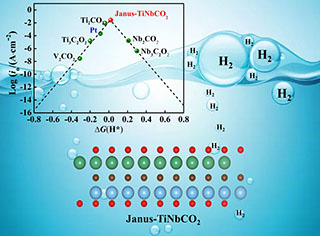
探寻具有高导电性和高催化活性的析氢反应(HER)催化材料一直是可持续能源发展研究中的热点。Ti2C具有表面活性位点多和优良的力学稳定性、导电性等,已成为潜在的制氢催化剂。然而,终端O修饰Ti2C表面,会降低该材料的导电性,进而限制了电子在价带与导带间的输运。本研究通过Nb掺杂,构建双电层Janus-TiNbCO2,并借助VASP软件研究了Janus-TiNbCO2的能带结构、HER性能和HER反应路径过渡态。结果表明,Janus-TiNb-CO2为导体材料,其在应力、氧空位缺陷和H*覆盖度的影响下,均表现出极优异的催化活性,计算获得的最优ΔGH*值为0.02 eV。H*在Janus-TiNbCO2上可能以Heyrovsky路径进行反应,该路径的迁移能势垒为0.23 eV。Janus-TiNbCO2是一种具有HER应用前景的催化材料。
关键词: MXene; Janus-TiNbCO2; 能带; 析氢反应
徐黎黎 , 任冬燕 , 赵骁锋 , 易勇 . 高导电性和催化活性的Janus-TiNbCO2析氢反应催化材料[J]. 电化学, 2021 , 27(5) : 570 -578 . DOI: 10.13208/j.electrochem.201109
Exploring the potential hydrogen evolution reaction (HER) catalysts with the high activity and high conductivity has always been a hot spot in the research of renewable energy development. Ti2C, as one of the 2D-MXene, has excellent properties relating to many active sites, mechanical stability, conductivity, etc., and has become a potential HER catalyst. However, the modification of the surface of Ti2C by terminal O will reduce the conductivity, thereby limiting the transport of electrons between the valence band and the conduction band. In this study, an electric double layer Janus-TiNbCO2 was constructed by Nb doping. The band property, HER activity and HER reaction path of Janus-TiNbCO2 are studied by the first-principles calculations. The results show that Nb doping increases the distance between Ti and O atoms, which increases the lattice parameters of Janus-TiNbCO2 comparing with that of Ti2CO2 structure. The Janus-TiNbCO2 structure is stable by calculating the thermodynamic stability at 500 K using AIMD method. The band gap of Ti2CO2 is approximate 0.9 eV. After Nb doping, the orbital hybridization between Nd-3d and O-2p affects the electronic rearrangement of Ti-3d, leading that Janus-TiNbCO2 has the metal band structure. In Janus-TiNbCO2, both Ti and Nb surfaces adsorb H* by O site, where the ΔGH*(@Ti) = -0.55 eV,ΔGH*(@Nb) = 0.02 eV, showing Ti and Nb surfaces have different catalytic activities. Comparing with graphenes, e.g., h-B2O, Pt, and g-C3N4, Janus-TiNbCO2 has better catalytic activity. The charge distribution of Janus-TiNbCO2 near the Fermi level was analyzed by HSE-06 function. The result reveals that O atoms on the Ti surface exhibit charge unsaturation at the Fermi level, while those on Nb surface strong saturation. Moreover, the effects of H* coverage and strains(+2% ~ +4%) on the catalyst activity of Janus-TiNbCO2 are studied. When the H* coverage is low, the optimal ΔGH* of Nb surface is approximate 0.02 eV, while Ti surface has an excellent catalytic activity at high H* coverages (θ = 7/9, ΔGH* = -0.06 eV). Under the strain action, the H* coverage on surface is not affected. However, strains will reduce the HER activity of Nb surface, and increase the HER activity of Ti surface. Furthermore, oxygen defect is a stable point defect in Janus-TiNbCO2 . Oxygen defect will increase the HER activity of Ti surface and decrease the HER activity of Nb surface. Comparing to the Tafel pathway, the Heyrovsky is a more suitable pathway for the HER, in which the migration barrier of Heyrovsky is 0.23 eV for H* on Nb surface. Janus-TiNbCO2 can be used as a potential HER catalyst.
Key words: MXene; Janus-TiNbCO2; band; hydrogen evolution reaction
/
| 〈 |
|
〉 |