分子催化剂电化学活化氮气用于可持续合成氨
Molecular Catalysts for Electrochemical Nitrogen Activation toward Sustainable Ammonia Synthesis
分子催化剂电化学活化氮气用于可持续合成氨 |
| 韩金秀, 薛皓, 付先彪 |
|
Molecular Catalysts for Electrochemical Nitrogen Activation toward Sustainable Ammonia Synthesis |
| Jin-Xiu Han, Hao Xue, Xian-Biao Fu |
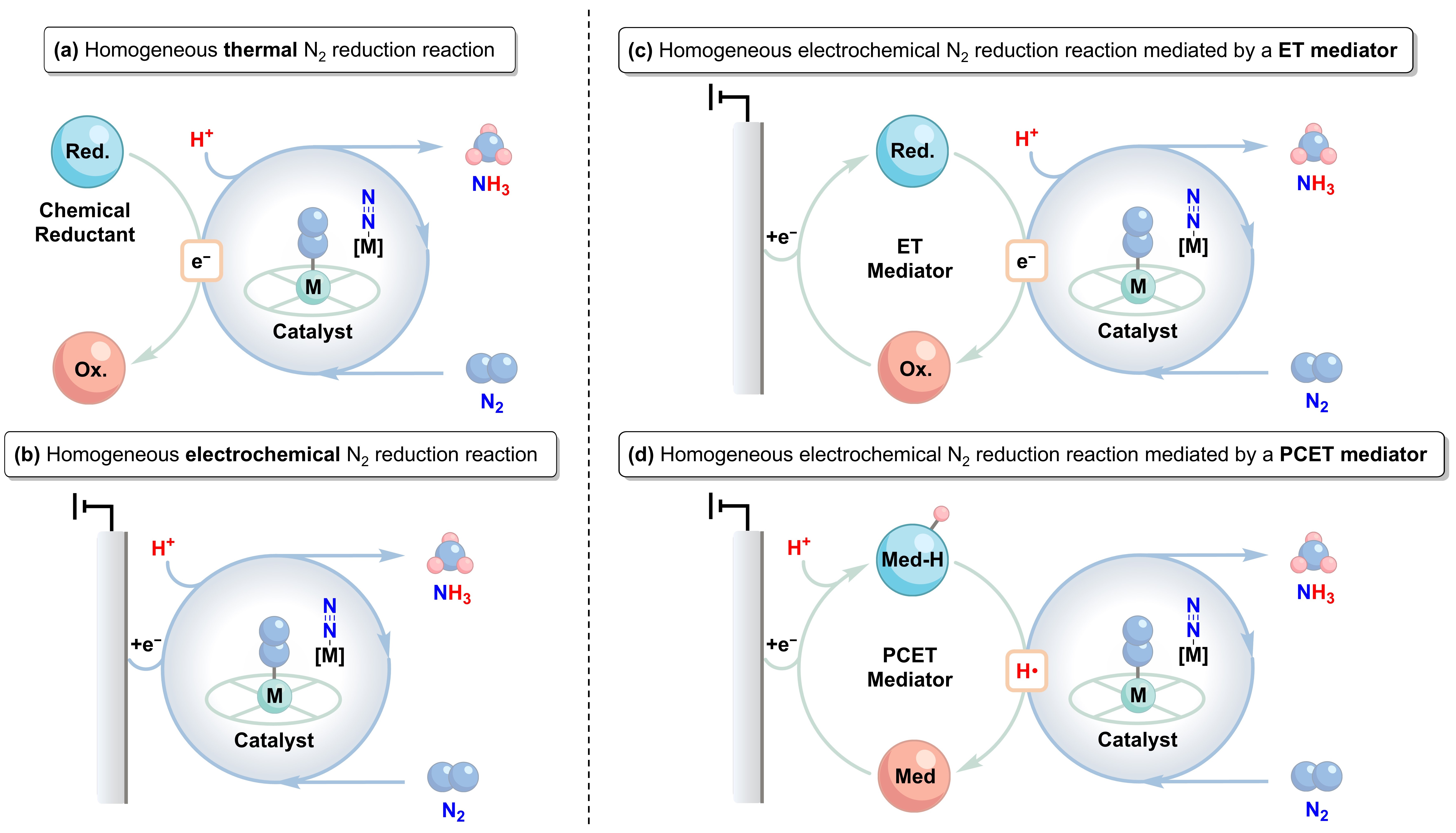
| Fig. 2. Conceptual electron/proton delivery pathways for homogeneous N2 reduction to NH3. (a) Thermal N2 reduction: a chemical reductant provides reducing equivalents (e−), while an external proton source supplies H+; both are coupled to the molecular catalyst cycle that converts N2 to NH3. (b) DET: the electrode directly transfers electrons to the molecular catalyst in solution, with H+ provided by the proton donor. (c) Mediated electron transfer with an ET mediator: the mediator cycles between reduced and oxidized forms (Red./Ox.). The electrode regenerates Red., which then shuttles electrons to the catalyst for N2-to-NH3 conversion without direct proton transfer by the mediator. (d) Mediated electron transfer with a PCET mediator: the mediator cycles between Med−H/Med, where Med−H delivers an H-atom (coupled e−/H+ transfer) to the catalytic cycle to facilitate N−H bond formation, and is regenerated electrochemically at the electrode”. |
|
|