电催化乙二醇氧化制乙醇酸:机理与策略
|
|
张曼, 李雪, 彭馨玉, 王琳, 陈文文, 阳耀月
|
Electrocatalytic Oxidation of Ethylene Glycol to Glycolic Acid: From Mechanism and Catalyst Design to Emerging Neutral Electrolyte Systems
|
|
Man Zhang, Xue Li, Xin-Yu Peng, Lin Wang, Wen-Wen Chen, Yao-Yue Yang
|
|
| |
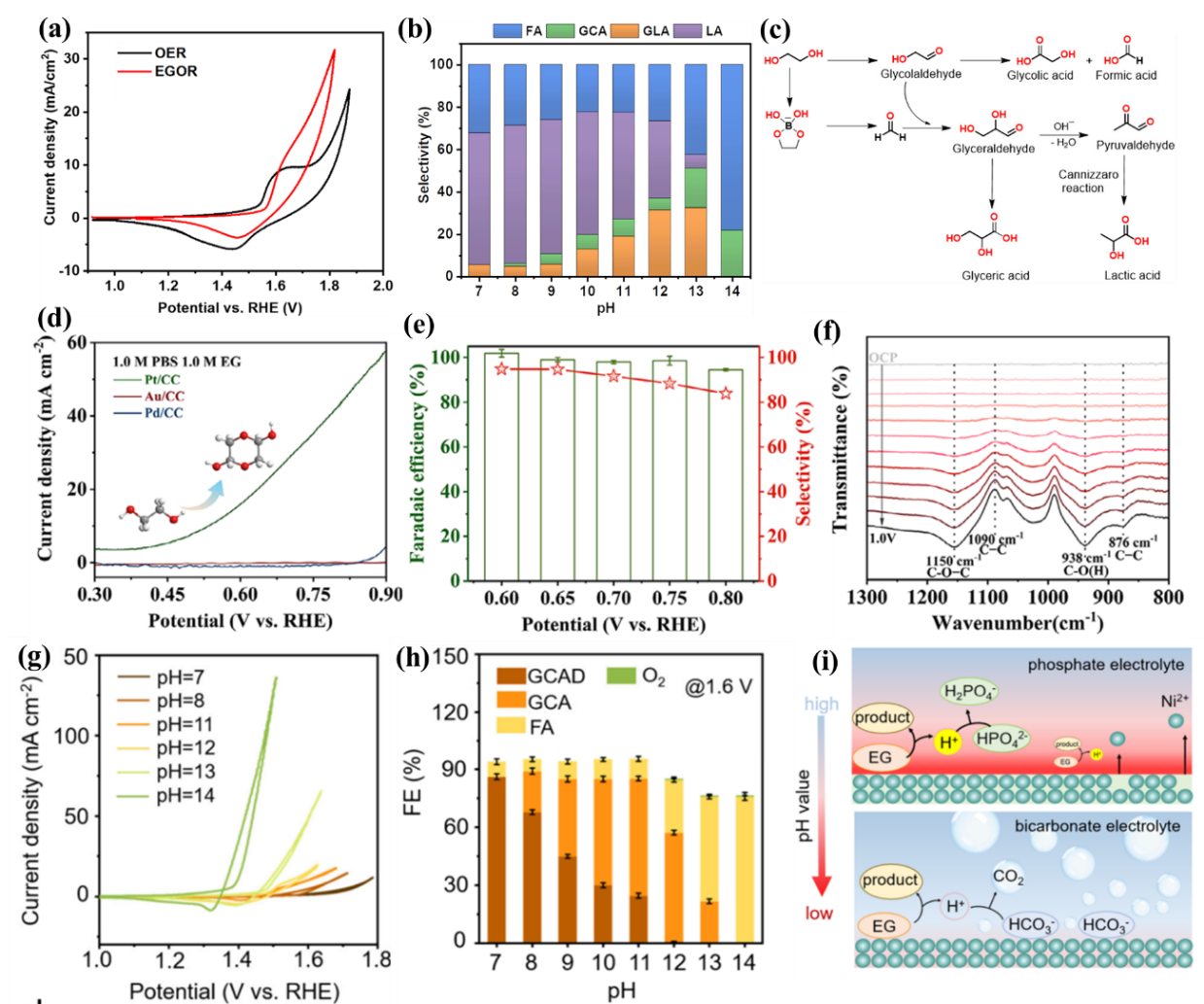
Figure 9. (a) CV curves of a Ni foam electrode in the absence and presence of 0.1 mol·L-1 EG in borate buffer solution at pH 10 at a scan rate of 10 mV·s-1[81]. Reproduced with permission from Ref. [81]. Copyright © 2024 Royal Society of Chemistry. (b) Product selectivity of the EGOR after 1 h of electrolysis at 5 mA·cm-2 and various pH conditions for FA, LA, GA, and glyceric acid (GLA). (c) Suggested mechanism for the electrochemical oxidation of EG in borate buffer solution. (d) LSV curves of Pt/CC, Pd/CC, and Au/CC anodes in 1.0 mol·L-1 PBS with 1.0 mol·L-1 EG[83]. Reproduced with permission from Ref. [83]. Copyright © 2025 Wiley-VCH. (e) FE and selectivity of Pt/CC for glycolaldehyde dimer production during 60 min chronoamperometric electrolysis at varied potentials. (f) Potential-dependent in-situ FTIR spectra of Pt/Co3O4/CC in 1.0 mol·L-1 PBS solution with 1.0 mol·L-1 EG addition. (g) CVs of the β-NiOOH electrode with 0.1 mol·L-1 EG at pH 7-14 [82]. Reproduced with permission from Ref. [82]. Copyright © 2025 American Chemical Society. (h) FEs of the EG oxidation products on β-NiOOH at 1.6 V vs. RHE at different pH values. (i) Schematic comparison of the interfacial dynamics during EGOR in the phosphate and bicarbonate electrolytes.
|
|
|
|
|